
Chef Juliette
John Dory (St. Pierre)
John Dory has the delicacy of sole and the firmness of turbot. A light flouring, a quick butter sauté, and nut-brown beurre noisette show exactly why looks never mattered.
A cooking platform built around craft, culture, and the stories behind what we eat.
Created by Chef Juliette
Based on No. 1673, Mousselines de Volaille au Paprika, from Le Guide Culinaire (1907) by Auguste Escoffier
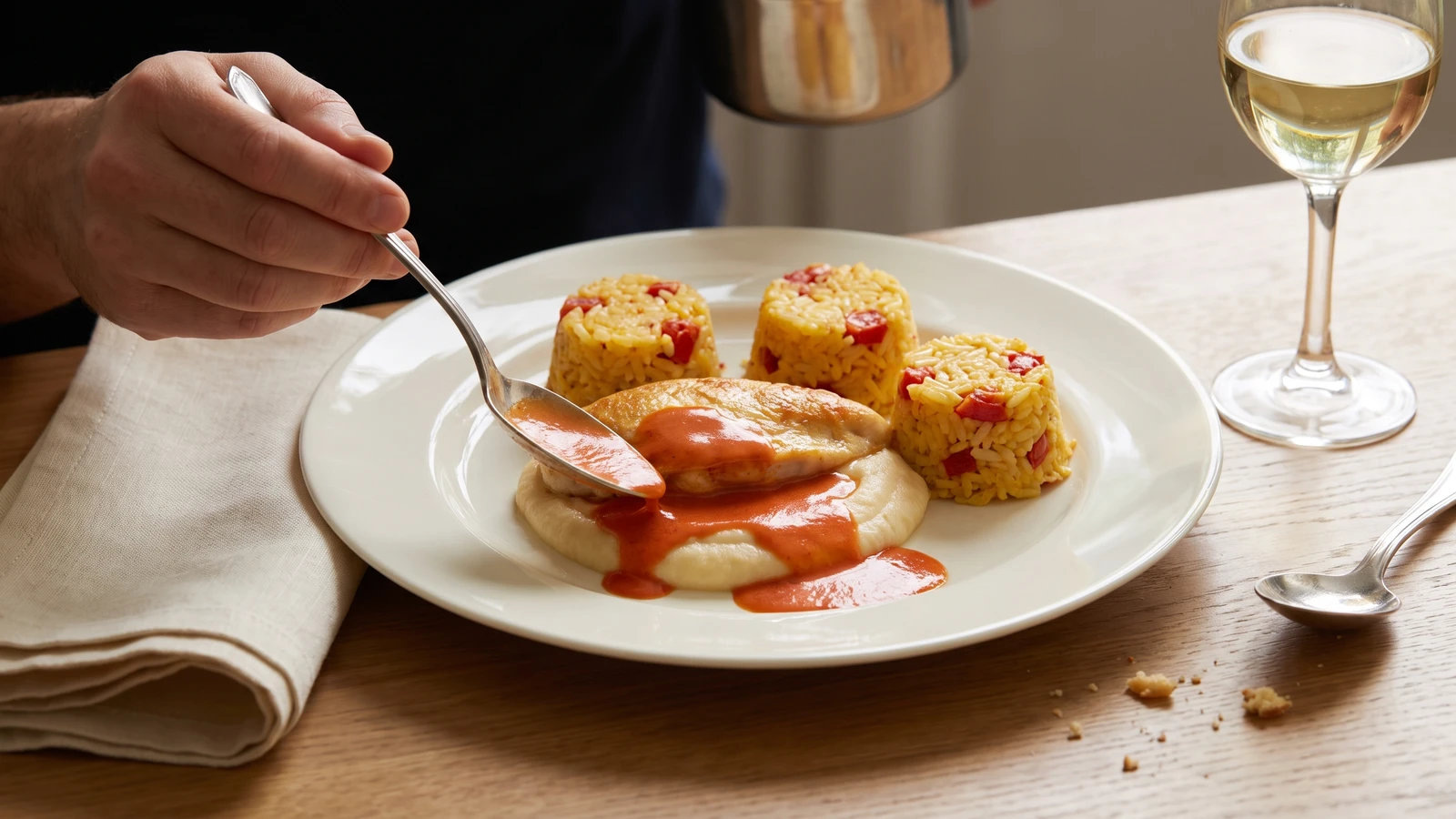
Silken Mousselines de Volaille meet a paprika-red suprême sauce, tender breast collops, and buttery tomato pilaff timbales, a composed French main whose real discipline is temperature.
Mousselines de Volaille au Paprika (individual chicken mousses with paprika suprême sauce) teach one discipline in two temperatures: the forcemeat stays very cold, while the paprika meets only gentle warmth. Cold gives the mousselines their fine, buoyant crumb; fierce heat turns paprika bitter before the sauce can blush. This is the one true thing to know before touching a pan.
The original entry assumed a cold station to pound and sieve the chicken, a saucier with a stockpot never off the fire, and rows of matching molds ready for service. A salamander has no work here because nothing is gratinéed. Your equivalents are a food processor, four ramekins, good chicken stock, one saucepan of genuine sauce suprême, and a single measuring cup used repeatedly for the rice timbales. We have changed the tools and scaled the plate for four, not altered its intent. One cook, one stove, one evening.
The brigade's many hands and battery of timbale molds are scaffolding, and they can go. What must stay is the cold-made mousseline, the gentle poach, a fine collop of suprême (breast fillet), the cream-enriched sauce, and tomato concassée (peeled, seeded, and roughly chopped) cooked in butter before it meets the pilaff. Chill the forcemeat before poaching; that single pause decides whether the mousse rises tender or cooks dense.
Mousselines de volaille au paprika belong to the composed Parisian classical table, where individually molded forcemeats joined the saucier's velouté and carefully shaped garnishes on one generous plate. Paprika entered this French register through Central European cooking, while pilaff carried influences from farther east, making the composition cosmopolitan rather than Provençal, Norman, or Lyonnais. The collop laid over each mousseline preserves suprême in its first sense, the finest breast fillet, while sauce suprême names the cream-enriched chicken velouté beneath it.
Quantity
4 medium (about 1¼ pounds / 560 g)
Divide into 320 g cubed and chilled for the mousselines and 240 g sliced into four fine collops
Quantity
1 (about 2 tablespoons / 30 g)
Quantity
1¼ cups (300 ml / 300 g)
divided between the mousselines and sauce
Quantity
8 tablespoons (120 ml / 113 g)
divided
Quantity
3¼ cups (780 ml / 780 g)
divided between the pilaff and sauce
Quantity
3 tablespoons (45 ml / 24 g)
Quantity
4 teaspoons (20 ml / 9 g)
divided, with half held in reserve
Quantity
1 cup (240 ml / 185 g)
Quantity
3 medium (about 10½ ounces / 300 g)
peeled, seeded, and concassées
Quantity
1 (about 2 ounces / 60 g)
finely chopped
Quantity
2¼ teaspoons (11 ml / 13 g)
divided
Quantity
¾ teaspoon (4 ml / 2 g)
divided
Quantity
⅛ teaspoon (0.6 ml / 0.3 g)
| Ingredient | Quantity |
|---|---|
| skinless, boneless chicken breastsDivide into 320 g cubed and chilled for the mousselines and 240 g sliced into four fine collops | 4 medium (about 1¼ pounds / 560 g) |
| large egg white | 1 (about 2 tablespoons / 30 g) |
| cold heavy creamdivided between the mousselines and sauce | 1¼ cups (300 ml / 300 g) |
| unsalted butterdivided | 8 tablespoons (120 ml / 113 g) |
| chicken stockdivided between the pilaff and sauce | 3¼ cups (780 ml / 780 g) |
| plain flour | 3 tablespoons (45 ml / 24 g) |
| sweet paprikadivided, with half held in reserve | 4 teaspoons (20 ml / 9 g) |
| long-grain white rice | 1 cup (240 ml / 185 g) |
| ripe plum tomatoespeeled, seeded, and concassées | 3 medium (about 10½ ounces / 300 g) |
| small onionfinely chopped | 1 (about 2 ounces / 60 g) |
| fine saltdivided | 2¼ teaspoons (11 ml / 13 g) |
| ground white pepperdivided | ¾ teaspoon (4 ml / 2 g) |
| freshly grated nutmeg | ⅛ teaspoon (0.6 ml / 0.3 g) |
Put the food processor bowl, blade, and 320 g of cubed chicken in the freezer for 15 minutes. They should become thoroughly cold but not frozen. Slice the remaining 240 g of chicken across the grain into four broad collops, place them between sheets of parchment, and tap them to an even 5 mm thickness. Refrigerate the collops. Brush four 5-ounce (150 ml) ramekins with 1 tablespoon of the butter.
Process the chilled 320 g of chicken with ¾ teaspoon salt, ¼ teaspoon white pepper, and the nutmeg until it becomes smooth and tacky. Add the egg white and process just until absorbed. Add ¾ cup (180 ml / 180 g) of the cold cream in four additions, pulsing briefly and scraping the bowl between each. The finished forcemeat should be glossy, thick, and able to hold a soft peak. If it turns dull, loose, or grainy, stop immediately, set the processor bowl over ice for 5 minutes, then pulse briefly until it gathers. Ça se rattrape. Poach a teaspoonful in barely trembling water for 2 minutes, taste it, and correct the seasoning. Divide the forcemeat among the buttered ramekins, pressing out air pockets, smooth the tops, cover, and refrigerate.
Cut a shallow cross in the base of each tomato and lower them into boiling water for 20 seconds. Cool them in cold water, peel, halve, and remove the seeds, then chop the flesh roughly into a concassée. Melt 1 tablespoon butter over medium heat, add the tomatoes and a pinch of salt, and cook for 6 to 8 minutes. Their loose moisture should evaporate while the pieces retain their shape. Transfer them to a bowl.
Melt 1 tablespoon butter in a small heavy saucepan. Add the onion and cook gently for 3 minutes without coloring. Stir in the rice and cook until every grain is coated and slightly pearly, the classical nacrer stage. Add 1½ cups (360 ml / 360 g) chicken stock and ½ teaspoon salt, bring to a bare simmer, cover tightly, and cook over the lowest heat for 15 minutes. Remove from the heat and leave covered for 10 minutes. Fluff the rice gently, fold in the buttered tomato concassée, and correct the salt. Keep it covered and warm. Reserve another tablespoon of butter for greasing the timbale measure.
Melt 2 tablespoons butter in a saucepan over medium-low heat. Stir in the flour and cook this blond roux for 2 minutes without letting it brown. Whisk in the remaining 1¾ cups (420 ml / 420 g) chicken stock a little at a time, scraping into the corners so no flour hides there. Simmer gently for 12 to 15 minutes, whisking occasionally, then add the remaining ½ cup (120 ml / 120 g) cream. Simmer for another 3 to 5 minutes, until the sauce reaches nappé, a coating consistency that leaves a clear trail when a finger is drawn across the back of a spoon. Season with ¼ teaspoon each salt and white pepper. If it is lumpy, strain it; if too thick, loosen it with stock; if too thin, simmer a little longer. Hold it warm without boiling.
Heat the oven to 325°F (160°C). Set the chilled ramekins in a deep roasting pan and pour in just-boiled water to reach halfway up their sides. This bain-marie, the hot-water bath, gives the mousselines the gentle poach they require. Cook for 22 to 28 minutes, until the centers are softly firm and register 165°F (74°C). The water should barely quiver; if it begins bubbling hard, add a little cold water and lower the oven. Lift out the ramekins and let them stand for 3 minutes.
Season the four collops with the remaining salt and white pepper. Melt 1 tablespoon butter in a wide skillet over medium heat. When the bubbling quiets, add the collops in one layer and cook for about 90 seconds on each side, just until tender and 165°F (74°C) at the thickest point. Transfer them to a warm plate. Take the skillet off the heat and wait 30 seconds, then add 1 tablespoon butter. When it melts quietly, stir in 2 teaspoons paprika for 10 seconds, only until fragrant and brick-red, and immediately whisk this butter into the sauce suprême. Never let paprika darken. If it smells bitter, discard that spoonful and repeat with the reserved paprika and a teaspoon of the butter intended for the timbale cup. Ça se rattrape.
Run a thin knife around each ramekin and unmold one mousseline onto each warm plate. Lay a fine collop of suprême over every mousseline, then coat both generously with the paprika sauce suprême, allowing it to pool around the base. Lightly butter a ¼-cup (60 ml) measure, pack it with tomato pilaff, and turn out three small timbales around each mousseline, re-buttering only when the rice begins to cling. Serve at once while the sauce gleams and the mousselines remain tender. À table!
1 serving (about 500g)
Culinary guides, cultural storytelling, and the editorial depth that makes cooking meaningful.
Discover Culinary ExplorerChef Juliette
John Dory has the delicacy of sole and the firmness of turbot. A light flouring, a quick butter sauté, and nut-brown beurre noisette show exactly why looks never mattered.

Chef Juliette
Fresh haddock proves its delicacy in the meunière pan: a fine flour crust, moist pearly flakes, and beurre noisette sharpened with lemon and parsley, ready from one skillet in half an hour.

Chef Juliette
Éperlans à l’Anglaise turns small fish into a lesson in disciplined coating: boned smelts under a close, crisp crumb, pan-fried in clarified butter and finished with bright, half-melted maître d’hôtel butter.

Chef Juliette
Tiny smelts, shallot, mushrooms, white wine, gratin sauce, and fine bread raspings meet a fierce oven, where the fish must turn tender in the same breath the buttered crust bronzes.