
Chef Juliette
John Dory (St. Pierre)
John Dory has the delicacy of sole and the firmness of turbot. A light flouring, a quick butter sauté, and nut-brown beurre noisette show exactly why looks never mattered.
A cooking platform built around craft, culture, and the stories behind what we eat.
Created by Chef Juliette
Based on No. 1663, Desirs de Mascotte, from Le Guide Culinaire (1907) by Auguste Escoffier
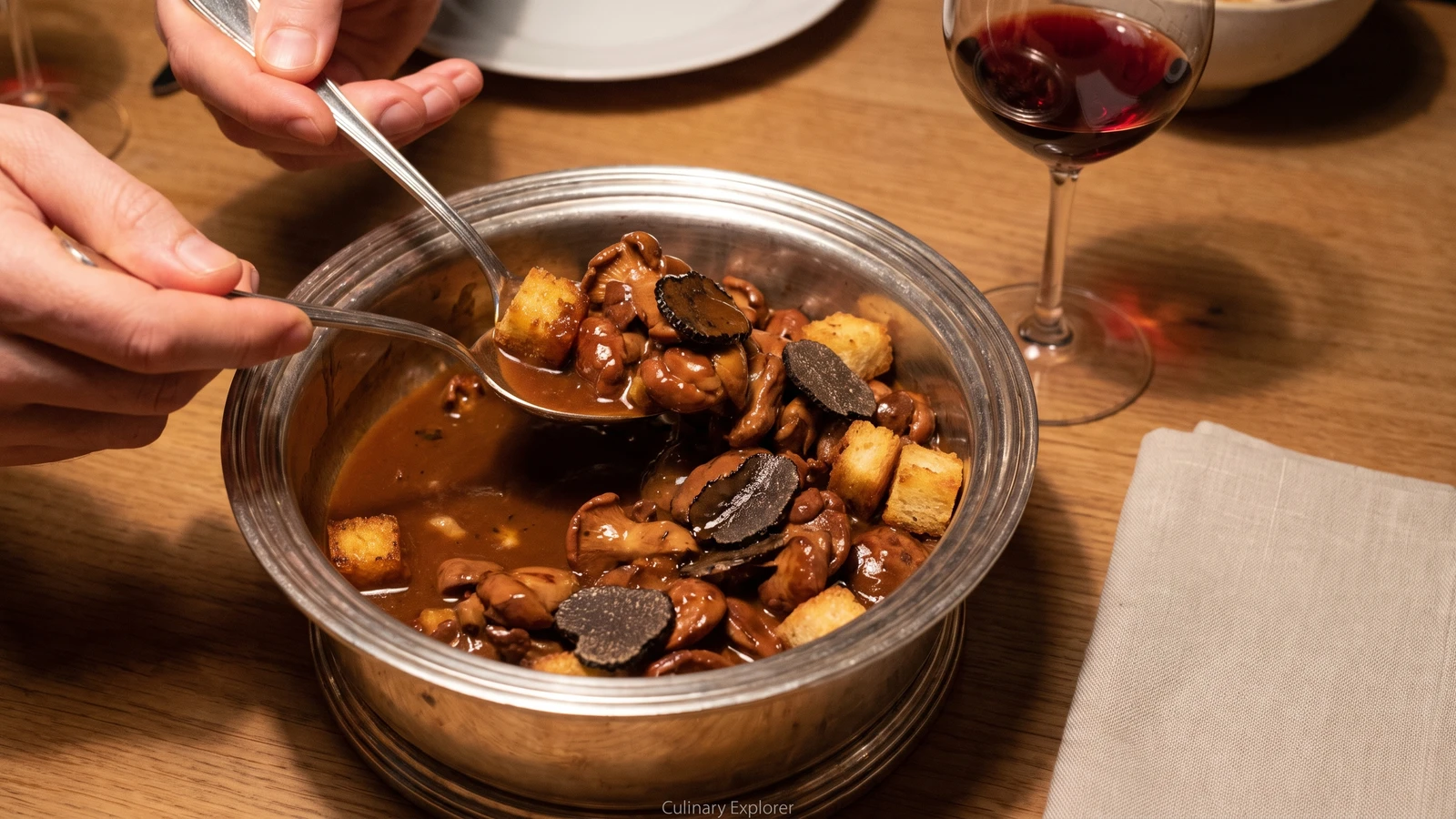
Désirs de Mascotte puts the whole finish in your wrist: tender cocks' kidneys, black truffle, and crisp croûtons bound in reduced demi-glace with cold butter, rolled off the heat until every surface gleams.
Désirs de Mascotte (Mascotte's desires, cocks' kidneys with black truffle and croûtons) teaches the quiet art of monter au beurre, binding cold butter into a finished sauce. The one true thing is this: the saucepan must leave the heat before the finishing butter enters. Keep it simmering and the gloss becomes grease; roll it off the heat and the sauce clings like satin.
The original assumed a saucier, a stockpot never off the fire, twenty-four impeccably fresh rognons de coq arriving from the poultry market, and another pair of hands frying croûtons at the final instant. For four people, sixteen kidneys preserve the proportion, with the original butter and croûton quantities reduced by one-third and four truffles becoming three small ones. A finished unsalted demi-glace, made ahead and frozen or bought from a serious butcher, replaces the perpetual stockpot; the croûtons are fried just before the kidneys rather than simultaneously. That concurrency was brigade scaffolding, so it goes. The five-to-six-minute cooking and the off-heat butter mounting are the dish, so they stay. One cook, one stove, one evening.
When it lands in a hot serving bowl, the kidneys should be just firm, the truffle dark and fragrant, and the croûtons edged in butter gold beneath a mahogany glaze. Have every component ready before the kidneys touch the beurre noisette, then remove the sauce from the heat before adding the final butter. That last movement decides everything.
Désirs de Mascotte belongs to the fancifully named repertoire of Parisian grand kitchens, where a small poultry delicacy became ceremonial through reduced demi-glace, black truffle, fried bread, and service in a silver timbale. Rognons de coq are not renal kidneys but a cock's testes, a highly perishable poultry-yard morsel whose freshness determines the dish. Its luxury comes from truffle and sauce, but its identity rests on minute cooking and immediate service, not on the silver vessel.
Quantity
16
cleaned, loose membrane removed, and patted very dry
Quantity
4 tablespoons (60 ml / 57 g)
Quantity
3/4 teaspoon (3.75 ml / 4 g)
Quantity
1/4 teaspoon (1.25 ml / 0.6 g)
Quantity
1/16 teaspoon (0.3 ml / 0.1 g)
Quantity
3 small (about 2 oz / 60 g)
cut into somewhat thick slices
Quantity
3/4 cup (180 ml / 190 g)
reduced to coating consistency
Quantity
8 rounds, each 2/3 inch (1.7 cm) across and 1/3 inch (8 mm) thick
Quantity
2 tablespoons (30 ml / 28 g)
Quantity
2 tablespoons (30 ml / 28 g)
cut into small pieces
Quantity
1/8 teaspoon (0.6 ml / 0.6 g)
added drop by drop
| Ingredient | Quantity |
|---|---|
| fresh cocks' kidneys (rognons de coq, the testes)cleaned, loose membrane removed, and patted very dry | 16 |
| cultured unsalted butter for the kidneys | 4 tablespoons (60 ml / 57 g) |
| fine sea salt | 3/4 teaspoon (3.75 ml / 4 g) |
| freshly ground black pepper | 1/4 teaspoon (1.25 ml / 0.6 g) |
| cayenne pepper | 1/16 teaspoon (0.3 ml / 0.1 g) |
| fresh black winter trufflescut into somewhat thick slices | 3 small (about 2 oz / 60 g) |
| finished unsalted veal demi-glacereduced to coating consistency | 3/4 cup (180 ml / 190 g) |
| fine-crumb white bread | 8 rounds, each 2/3 inch (1.7 cm) across and 1/3 inch (8 mm) thick |
| cultured unsalted butter for the croûtons | 2 tablespoons (30 ml / 28 g) |
| very cold cultured unsalted buttercut into small pieces | 2 tablespoons (30 ml / 28 g) |
| fresh lemon juiceadded drop by drop | 1/8 teaspoon (0.6 ml / 0.6 g) |
Chill the finishing butter and place the serving timbale or bowl nearby. Shortly before serving, fill the bowl with very hot water so it will be ready to empty and dry. Slice the truffles, stamp out the bread rounds, measure every seasoning, and pat the kidneys dry without rinsing them. Once the butter browns, there is no useful pause, so complete the mise en place first.
Put the finished demi-glace into a small saucepan and bring it to the barest simmer. It should nappe, coating the back of a spoon in a thin, even film; if it runs like stock, reduce it briefly before proceeding. Add the thick truffle slices and hold them over the lowest heat for 2 to 3 minutes, without boiling, while their perfume enters the sauce.
Melt the croûton butter in a small skillet over medium heat. Add the bread rounds and fry them on both sides until evenly butter-gold and crisp at the edges, about 2 minutes per side. Drain them on a rack or absorbent paper and leave them uncovered. The original kitchen fried these alongside the kidneys; doing them immediately beforehand gives one cook the same fresh result without pretending to have another pair of hands.
Heat the larger sauté pan over medium-high heat and add the kidney butter. Let it foam, quiet, and turn beurre noisette, nut-brown butter, with a hazelnut aroma and brown specks under the foam. Add the dry kidneys in one layer, season at once with the salt, black pepper, and cayenne, then roll and toss them frequently for 5 to 6 minutes. They should be lightly bronzed, opaque throughout, and just firm; the largest should register 165°F (74°C) when checked sideways with an instant-read thermometer. If they release water and begin to stew, lift them out, boil the moisture away until the butter sizzles again, then return them only long enough to finish. Ça se rattrape. Drain the kidneys with a slotted spoon and leave the cooking butter behind, as the source directs.
Bring the truffled demi-glace back just to a bare simmer, then remove the saucepan completely from the heat. Add the drained kidneys, the croûtons, the cold finishing butter, and the lemon juice drop by drop. Monter au beurre means binding with butter off the heat: roll the saucepan gently in a circular motion until the butter disappears and the sauce becomes glossy. Do not whisk and do not return it to the burner. If butter beads on the surface, lift out the kidneys and croûtons, put 1 teaspoon of cold water in a cool saucepan, and roll the broken sauce into it one spoonful at a time until it binds; then return the solids. Ça se rattrape.
Empty and dry the heated timbale or serving bowl. Pour in the kidneys, truffle, croûtons, and every spoonful of sauce, arranging nothing more than the pan naturally gives you. Carry it straight to the table. The butter mounting cannot be held or reheated without losing its gloss, and the croûtons wait for no one. À table!
1 serving (about 120g)
Culinary guides, cultural storytelling, and the editorial depth that makes cooking meaningful.
Discover Culinary ExplorerChef Juliette
John Dory has the delicacy of sole and the firmness of turbot. A light flouring, a quick butter sauté, and nut-brown beurre noisette show exactly why looks never mattered.

Chef Juliette
Fresh haddock proves its delicacy in the meunière pan: a fine flour crust, moist pearly flakes, and beurre noisette sharpened with lemon and parsley, ready from one skillet in half an hour.

Chef Juliette
Éperlans à l’Anglaise turns small fish into a lesson in disciplined coating: boned smelts under a close, crisp crumb, pan-fried in clarified butter and finished with bright, half-melted maître d’hôtel butter.

Chef Juliette
Tiny smelts, shallot, mushrooms, white wine, gratin sauce, and fine bread raspings meet a fierce oven, where the fish must turn tender in the same breath the buttered crust bronzes.