
Chef Juliette
John Dory (St. Pierre)
John Dory has the delicacy of sole and the firmness of turbot. A light flouring, a quick butter sauté, and nut-brown beurre noisette show exactly why looks never mattered.
A cooking platform built around craft, culture, and the stories behind what we eat.
Created by Chef Juliette
Based on No. 1660, Chicken Pie, from Le Guide Culinaire (1907) by Auguste Escoffier
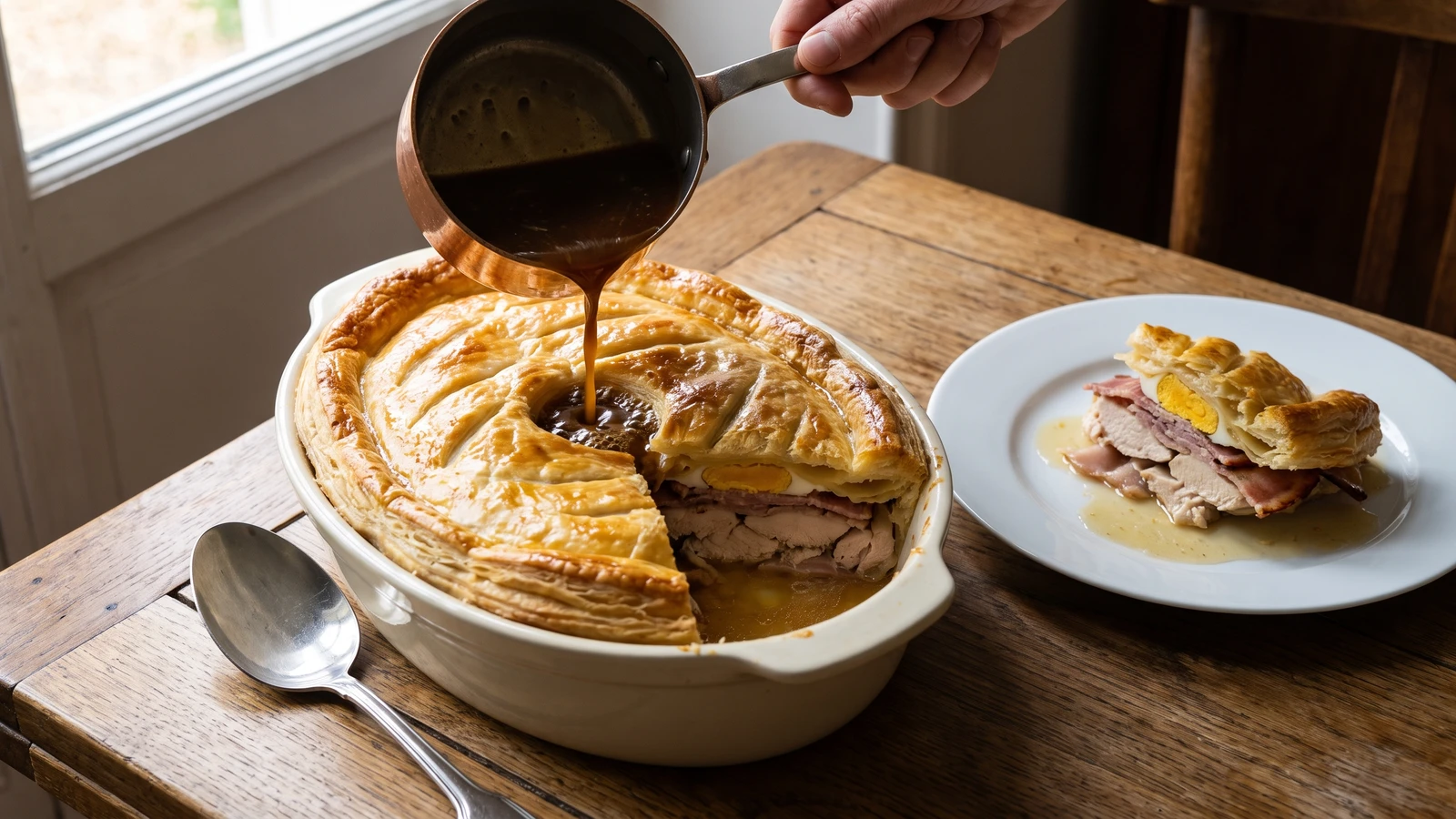
A deep chicken pie built in the classical order: veal beneath, fowl and bacon within, puff pastry above, then strong gravy poured through the gilded crust.
Pâté de Poulet à l’Anglaise (Chicken Pie) teaches the architecture of a covered pie. One true thing before you touch a pan: don't brown the chicken. This is a fricassée enclosed beneath pastry, and its delicacy comes from seasoned raw meat baking gently in consommé, not from a roasted fond.
The source assumed a saucier with chicken consommé and strong gravy always ready, a pastry bench rolling puff paste, and enough hands to joint the fowl while someone else watched the stockpot. At home, good prepared consommé, all-butter puff pastry, and unsalted chicken stock reduced to a few concentrated spoonfuls do the work. It needs no salamander because the gilded pastry takes its bronze in the oven. The entry is already close to a home quantity, so I have fixed its single fowl at a practical size for four and kept the three onions, 1½ ounces of mushrooms, 5 ounces of bacon, four yolks, and full veal lining in their original proportions. Homemade puff paste and laborious clarification are brigade scaffolding; the veal, bacon, yolks, three-quarter bath of consommé, and final strong gravy are the dish and must stay.
The finished pie carries a deep butter-gold lid over tender chicken, soft veal, salty ribbons of bacon, and yolks made rich by the clear cooking liquor. One cook, one stove, one evening. Cool the mushrooms and consommé, wipe the dish rim completely dry, and seal the pastry collar firmly. That seal is the step that decides the pie.
Chicken pie belongs first to the English household pie table, but French classical kitchens admitted it as a préparation à l’anglaise, retaining the covered-pie structure while applying fricassée cutting, consommé, and a gilded puff-paste lid. In this version, veal replaces the expected bottom crust, protecting and enriching the fowl while bacon and hard-boiled yolks make the filling generous. The strong gravy poured through the vent after baking restores the concentrated meat savor that a stock-rich professional kitchen could keep ready at all times.
Quantity
1, about 3½ lb (1.6 kg)
jointed as for a fricassée into 8 pieces
Quantity
1½ teaspoons (7.5 ml / 9 g)
Quantity
½ teaspoon (2.5 ml / 1.5 g)
Quantity
3, about 2 cups (475 ml / 300 g)
finely chopped
Quantity
½ cup (120 ml / 43 g)
finely chopped
Quantity
1 tablespoon (15 ml / 14 g)
Quantity
1 teaspoon (5 ml / 1 g)
finely chopped
Quantity
8, about 8 oz (225 g)
pounded no thicker than ⅛ inch (3 mm)
Quantity
10 thin slices, about 5 oz (140 g)
Quantity
4
halved
Quantity
2 cups (475 ml / 475 g), or enough to come three-quarters up the filling
cooled
Quantity
1 cup (240 ml / 240 g), reduced to 3 tablespoons (45 ml / 45 g)
Quantity
1 sheet, about 14 oz (400 g)
Quantity
1 tablespoon (15 ml / 8 g)
for rolling
Quantity
1 tablespoon (15 ml / 15 g)
for sealing
Quantity
1
beaten for gilding
| Ingredient | Quantity |
|---|---|
| small whole chickenjointed as for a fricassée into 8 pieces | 1, about 3½ lb (1.6 kg) |
| fine sea salt | 1½ teaspoons (7.5 ml / 9 g) |
| freshly ground black pepper | ½ teaspoon (2.5 ml / 1.5 g) |
| small yellow onionsfinely chopped | 3, about 2 cups (475 ml / 300 g) |
| button mushroomsfinely chopped | ½ cup (120 ml / 43 g) |
| unsalted butter | 1 tablespoon (15 ml / 14 g) |
| flat-leaf parsleyfinely chopped | 1 teaspoon (5 ml / 1 g) |
| thin veal escalopespounded no thicker than ⅛ inch (3 mm) | 8, about 8 oz (225 g) |
| unsmoked streaky bacon | 10 thin slices, about 5 oz (140 g) |
| hard-boiled egg yolkshalved | 4 |
| unsalted or lightly salted chicken consommécooled | 2 cups (475 ml / 475 g), or enough to come three-quarters up the filling |
| unsalted gelatin-rich chicken stock for the strong gravy | 1 cup (240 ml / 240 g), reduced to 3 tablespoons (45 ml / 45 g) |
| cold all-butter puff pastry | 1 sheet, about 14 oz (400 g) |
| all-purpose flourfor rolling | 1 tablespoon (15 ml / 8 g) |
| cold waterfor sealing | 1 tablespoon (15 ml / 15 g) |
| large eggbeaten for gilding | 1 |
Pour the gelatin-rich chicken stock into a small saucepan and hold it at a lively simmer until only 3 tablespoons (45 ml) remain. It should taste deeply of chicken and lightly coat a spoon, but it must still pour. If it becomes sticky before reaching the right volume, loosen it with cooled consommé a teaspoon at a time. Ça se rattrape. Set the strong gravy aside; this short reduction is the home equivalent of the saucier's ready saucepan.
Melt the butter in a small skillet over medium heat. Add the finely chopped mushrooms and cook for 4 to 6 minutes, stirring, until their water has evaporated and they smell nutty rather than raw. Scrape them onto a plate and cool completely. Warm mushrooms soften puff pastry before it reaches the oven, so don't hurry this cooling.
Pat the chicken pieces dry and season them evenly with the salt and pepper. Sprinkle over the chopped onions, cooled mushrooms, and parsley, turning the pieces once so the seasonings cling to every side. Leave the chicken raw. Fricassée is the governing technique here, a gentle pale cooking in liquid, and browning the meat would change the pie's character.
Overlap the thin veal escalopes across the bottom and sides of a deep 3-quart (2.8-liter) pie dish, pressing them into the corners and leaving no broad gaps. The veal is not merely a liner. It shields the chicken from the ceramic, releases its own juices into the consommé, and becomes part of each serving.
Set the chicken legs and thighs into the dish first, close to the bottom where the heat is strongest. Fit the breast pieces and wings above them, distributing the onions, mushrooms, and parsley around the joints. Tuck the bacon slices between and over the chicken, then place the eight yolk halves through the filling so every portion receives some. Pack firmly but do not crush the meat.
Pour the cooled chicken consommé slowly down the inside edge of the dish until it reaches three-quarters of the way up the filling. Do not cover the meat completely. If the liquid rises too high, ladle some out and reserve it; an overfilled dish forces consommé through the pastry seal. Wipe the rim and the outside of the dish completely dry.
Heat the oven to 350°F (180°C) with a rimmed baking sheet on the center rack. On a lightly floured surface, roll the cold puff pastry to about ⅛ inch (3 mm) thick and large enough to overhang the dish. Cut a ¾-inch (2 cm) strip from the edge. Brush the dry dish rim with cold water, attach the strip as a pastry collar, brush that collar lightly with water, and lay the remaining pastry over it without stretching. Press firmly, trim, and crimp. If the pastry softens or tears, patch it with a cold scrap and refrigerate the whole dish for 15 minutes. Ça se rattrape, provided the pastry returns to the oven cold.
Brush the pastry evenly with beaten egg to gild it, meaning to coat it so the oven gives it a golden sheen. Keep the egg away from the trimmed edge because it can glue the puff layers together. Streak shallow decorative arcs across the lid with the back of a small knife, taking care not to cut through, then make a 1-inch (2.5 cm) slit in the center for pressure to escape.
Set the pie on the heated baking sheet and bake for 1½ hours. The crust should rise, turn a deep butter-gold, and show a little glossy consommé bubbling at the central slit. If the pastry darkens too quickly after the first 45 minutes, cover it loosely with foil and continue baking. Check through the vent with an instant-read thermometer; the thickest part of a leg must reach at least 165°F (74°C). If it has not, lower the oven to 325°F (165°C) and continue for 10 to 15 minutes.
Warm the strong gravy until fluid. As soon as the pie leaves the oven, pour it through the central slit a spoonful at a time, pausing so it settles into the filling rather than running over the crust. Rest the pie for 10 minutes. Cut the lid into four generous sections, then spoon the chicken, veal, bacon, yolks, and gleaming cooking liquor beneath each piece of pastry. À table!
1 serving (about 570g)
Culinary guides, cultural storytelling, and the editorial depth that makes cooking meaningful.
Discover Culinary ExplorerChef Juliette
John Dory has the delicacy of sole and the firmness of turbot. A light flouring, a quick butter sauté, and nut-brown beurre noisette show exactly why looks never mattered.

Chef Juliette
Fresh haddock proves its delicacy in the meunière pan: a fine flour crust, moist pearly flakes, and beurre noisette sharpened with lemon and parsley, ready from one skillet in half an hour.

Chef Juliette
Éperlans à l’Anglaise turns small fish into a lesson in disciplined coating: boned smelts under a close, crisp crumb, pan-fried in clarified butter and finished with bright, half-melted maître d’hôtel butter.

Chef Juliette
Tiny smelts, shallot, mushrooms, white wine, gratin sauce, and fine bread raspings meet a fierce oven, where the fish must turn tender in the same breath the buttered crust bronzes.