
Chef Juliette
John Dory (St. Pierre)
John Dory has the delicacy of sole and the firmness of turbot. A light flouring, a quick butter sauté, and nut-brown beurre noisette show exactly why looks never mattered.
A cooking platform built around craft, culture, and the stories behind what we eat.
Created by Chef Juliette
Based on No. 1657, Quenelles de Volaille Morland, from Le Guide Culinaire (1907) by Auguste Escoffier
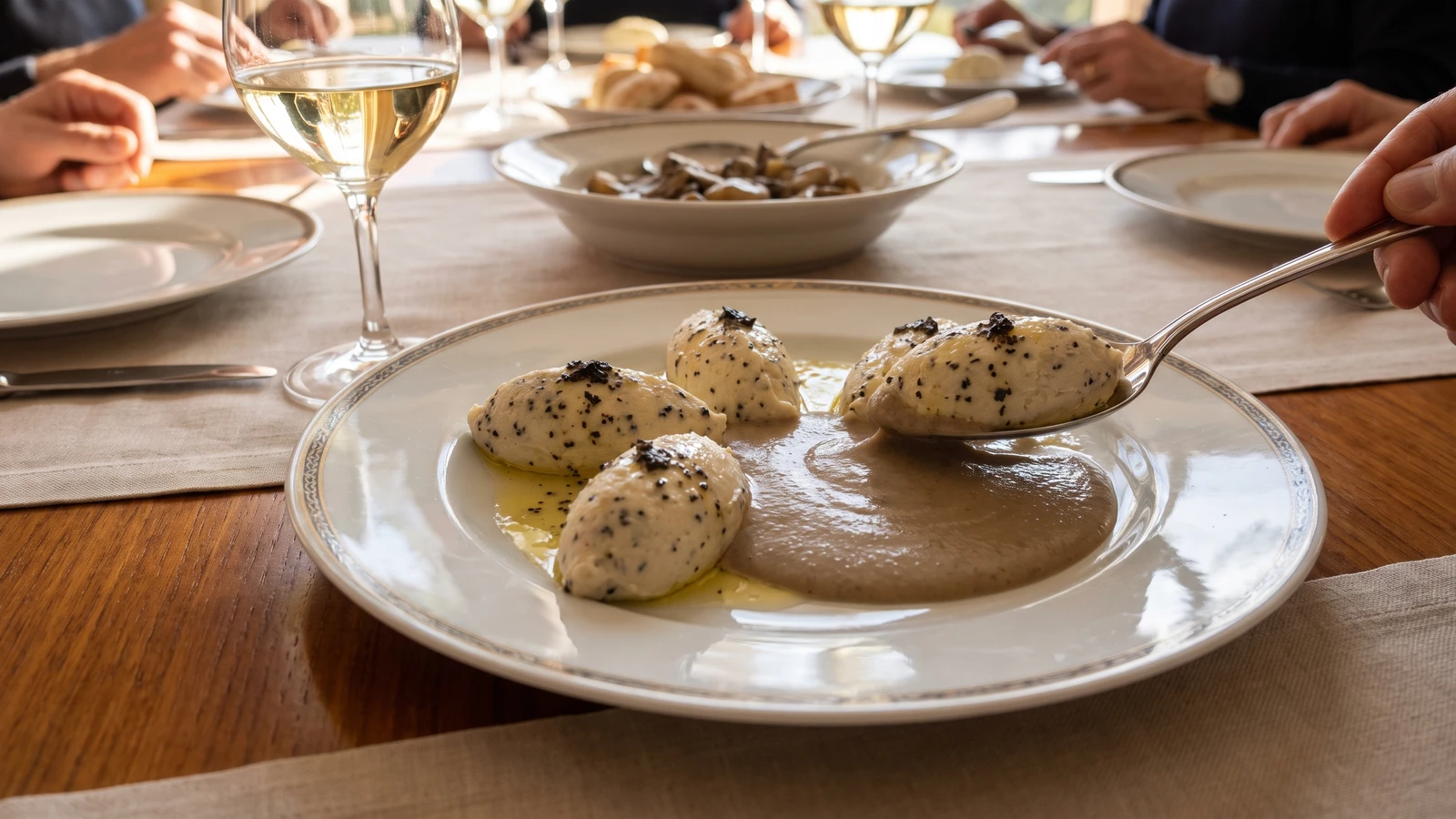
Cold chicken mousseline, shaped into generous ovals, coated with egg and minced black truffle, then poached beneath a lid in clarified butter and served around a deep mushroom purée.
Quenelles de Volaille Morland (truffle-coated chicken dumplings) teach the discipline of a cold mousseline. One true thing governs the dish before you touch a pan: the chicken, cream, bowl, and blade must remain thoroughly cold. Let the mixture warm and the emulsion separates, leaving a grainy quenelle where there should be something tender, fine, and almost weightless.
The grand kitchen assumed a garde-manger shaping mousselines, a saucier holding mushroom purée, and clarified butter ready by the potful. A stock never off the fire and a salamander stood nearby too, but this entry calls on neither, so I won't drag them in for ceremony. The mortar and tamis become a chilled food processor and blender; separate stations and holding pots are brigade scaffolding, and they can go.
I have scaled the quantity to four of the source's original three-ounce quenelles, one generous portion for each diner. The beaten-egg coating, finely minced truffle pressed on with the blade of a knife, covered clarified-butter poach, and circle of quenelles around mushroom purée all remain because those steps are the dish. Keep the mousseline cold while the cream goes in. That is the moment that decides everything.
Quenelles de Volaille Morland belong to the Parisian grand-kitchen repertory, where a mousseline was portioned for one diner, dressed with a named garnish, and sent out with a separate purée from the saucier. Unlike Lyon's quenelles de brochet, traditionally built on a panade, a cooked flour-and-liquid binder, Morland uses poultry mousseline worked cold with egg white and cream. Morland is a service name rather than a regional style: its identity rests on the truffle coating, covered clarified-butter poach, and mushroom purée kept together.
Quantity
2 small breasts (7 ounces / 200 g)
sinew removed, cut into 1-inch (2.5 cm) cubes, and thoroughly chilled
Quantity
1 (2 tablespoons / 30 ml / 30 g)
chilled
Quantity
3/4 cup (180 ml / 180 g)
divided
Quantity
1 teaspoon (5 ml / 6 g)
Quantity
1/8 teaspoon (0.6 ml / 0.3 g)
Quantity
about 6 cups (1.4 liters / 450 g)
thinly sliced
Quantity
1 (1/4 cup / 60 ml / 40 g)
finely minced
Quantity
3 tablespoons (45 ml / 42 g)
Quantity
1/2 cup (120 ml / 120 g)
Quantity
1/2 teaspoon (2.5 ml / 3 g)
Quantity
1/8 teaspoon (0.6 ml / 0.3 g)
Quantity
2 (about 6 tablespoons / 90 ml / 100 g)
beaten
Quantity
1/3 cup (80 ml / 45 g)
finely minced; preserved truffle drained and blotted thoroughly
Quantity
2 1/2 cups (600 ml / 545 g), prepared from about 1 1/2 pounds (680 g) unsalted butter
| Ingredient | Quantity |
|---|---|
| boneless, skinless chicken breastssinew removed, cut into 1-inch (2.5 cm) cubes, and thoroughly chilled | 2 small breasts (7 ounces / 200 g) |
| large egg whitechilled | 1 (2 tablespoons / 30 ml / 30 g) |
| cold heavy cream for the mousselinedivided | 3/4 cup (180 ml / 180 g) |
| fine sea salt for the mousseline | 1 teaspoon (5 ml / 6 g) |
| finely ground white pepper for the mousseline | 1/8 teaspoon (0.6 ml / 0.3 g) |
| white button mushroomsthinly sliced | about 6 cups (1.4 liters / 450 g) |
| small shallotfinely minced | 1 (1/4 cup / 60 ml / 40 g) |
| unsalted butter | 3 tablespoons (45 ml / 42 g) |
| heavy cream for the mushroom purée | 1/2 cup (120 ml / 120 g) |
| fine sea salt for the mushroom purée | 1/2 teaspoon (2.5 ml / 3 g) |
| finely ground white pepper for the mushroom purée | 1/8 teaspoon (0.6 ml / 0.3 g) |
| large eggsbeaten | 2 (about 6 tablespoons / 90 ml / 100 g) |
| fresh black truffle, or preserved whole black trufflefinely minced; preserved truffle drained and blotted thoroughly | 1/3 cup (80 ml / 45 g) |
| clarified butter | 2 1/2 cups (600 ml / 545 g), prepared from about 1 1/2 pounds (680 g) unsalted butter |
If the clarified butter isn't already prepared, melt the 1 1/2 pounds (680 g) unsalted butter slowly in a narrow saucepan without stirring. Skim away the foam, let the milk solids settle, then pour the clear golden fat through a fine-mesh sieve, leaving the cloudy liquid behind. Measure 2 1/2 cups (600 ml / 545 g). Clarifying removes the milk solids and water that would brown, sputter, and turn this gentle poach into frying.
Melt the 3 tablespoons (45 ml / 42 g) butter over medium heat. Add the shallot and cook without colouring until softened, then add the mushrooms and 1/2 teaspoon (2.5 ml / 3 g) salt. Cook until the mushrooms surrender their liquid, the liquid evaporates completely, and the pan begins to sound quiet again. Add the 1/2 cup (120 ml / 120 g) cream and simmer gently until reduced by about one-third. Cool for five minutes, then blend until perfectly smooth, venting the blender lid safely. Season with white pepper and keep covered. If the purée runs, return it to the pan and reduce it; if it stands too stiffly, loosen it with a spoonful of cream.
Chill the food processor bowl and blade for fifteen minutes. Reserve 2 tablespoons (30 ml / 30 g) of the cold cream. Put the cold chicken, 1 teaspoon (5 ml / 6 g) salt, and white pepper in the processor, then pulse until the meat becomes a smooth, tacky paste, scraping the bowl often. Add the cold egg white and process just until absorbed. With the motor running, pour the remaining 5/8 cup (150 ml / 150 g) cream through the feed tube in a thin, steady thread. Stop as soon as the mousseline is satin-smooth and cohesive. If it warms above 45°F (7°C), loosens suddenly, or develops oily beads around the edge, stop immediately. Nest the bowl over ice until thoroughly cold, then pulse briefly with 1 tablespoon of the reserved cream until the emulsion closes again. Ça se rattrape, but only if you stop the machine before heat finishes the damage.
Warm a teaspoon of the measured clarified butter in a small covered pan over low heat. Cook a teaspoon of mousseline until completely opaque, then taste it. It should be tender, springy, and fine-grained. If it feels dense, pulse in the remaining reserved cream; if the raw mixture is too soft to hold an oval, chill it for fifteen minutes rather than adding starch. Weigh four portions of exactly 3 ounces (85 g), preserving the source's portion, and mould each between two large spoons into a firm, smooth oval. Set them on parchment and chill for twenty minutes. The small amount left in the processor accounts for the test and what clings to the bowl.
Spread the finely minced truffle in a shallow tray and put the beaten eggs in a second shallow dish. Dip each cold quenelle completely in egg, let the excess fall away for a moment, then roll it in the truffle. Lay the flat side of a clean knife blade lightly against the coating, pressing all around so the truffle combines with the egg exactly as the source directs. The pressure should secure the truffle without flattening the oval. Touch any bare patch with egg, add more truffle, and press again.
Warm the clarified butter in the smallest lidded sauté pan that will hold all four quenelles without touching. Bring it to 175 to 180°F (79 to 82°C), with no sizzling. Lower in the quenelles; the butter should reach at least halfway up their sides. Spoon butter over the tops, cover, and poach over very low heat for sixteen to twenty minutes, basting once after eight minutes, until the quenelles feel gently springy and their centres reach 165°F (74°C). If the butter begins to sizzle or truffle starts floating away, lift the pan off the heat for a minute, lower the burner, and resume; spoon any loose truffle back over the tops while basting. Frying hardens the outside before the poultry is safely cooked through.
Reheat the mushroom purée gently without boiling and warm a round serving platter. Lift the quenelles from the butter with a slotted spoon and let them drain briefly on a rack. Arrange the four ovals in a circle, then pour the warm mushroom purée into the middle, preserving the service of the original entry. Bring the platter directly to the table while the truffle coating gleams with clarified butter. À table!
1 serving (about 235g)
Culinary guides, cultural storytelling, and the editorial depth that makes cooking meaningful.
Discover Culinary ExplorerChef Juliette
John Dory has the delicacy of sole and the firmness of turbot. A light flouring, a quick butter sauté, and nut-brown beurre noisette show exactly why looks never mattered.

Chef Juliette
Fresh haddock proves its delicacy in the meunière pan: a fine flour crust, moist pearly flakes, and beurre noisette sharpened with lemon and parsley, ready from one skillet in half an hour.

Chef Juliette
Éperlans à l’Anglaise turns small fish into a lesson in disciplined coating: boned smelts under a close, crisp crumb, pan-fried in clarified butter and finished with bright, half-melted maître d’hôtel butter.

Chef Juliette
Tiny smelts, shallot, mushrooms, white wine, gratin sauce, and fine bread raspings meet a fierce oven, where the fish must turn tender in the same breath the buttered crust bronzes.