
Chef Juliette
Abatis aux Navets
Glazed turnips, pearl onions, and tender poultry giblets settle into a pale, glossy sauce, with crisp-edged salt pork lending depth: a thrifty braise whose whole success rests on cooking the flour first.
A cooking platform built around craft, culture, and the stories behind what we eat.
Created by Chef Juliette
Based on No. 1655, Boudins de Volaille à la Richelieu, from Le Guide Culinaire (1907) by Auguste Escoffier
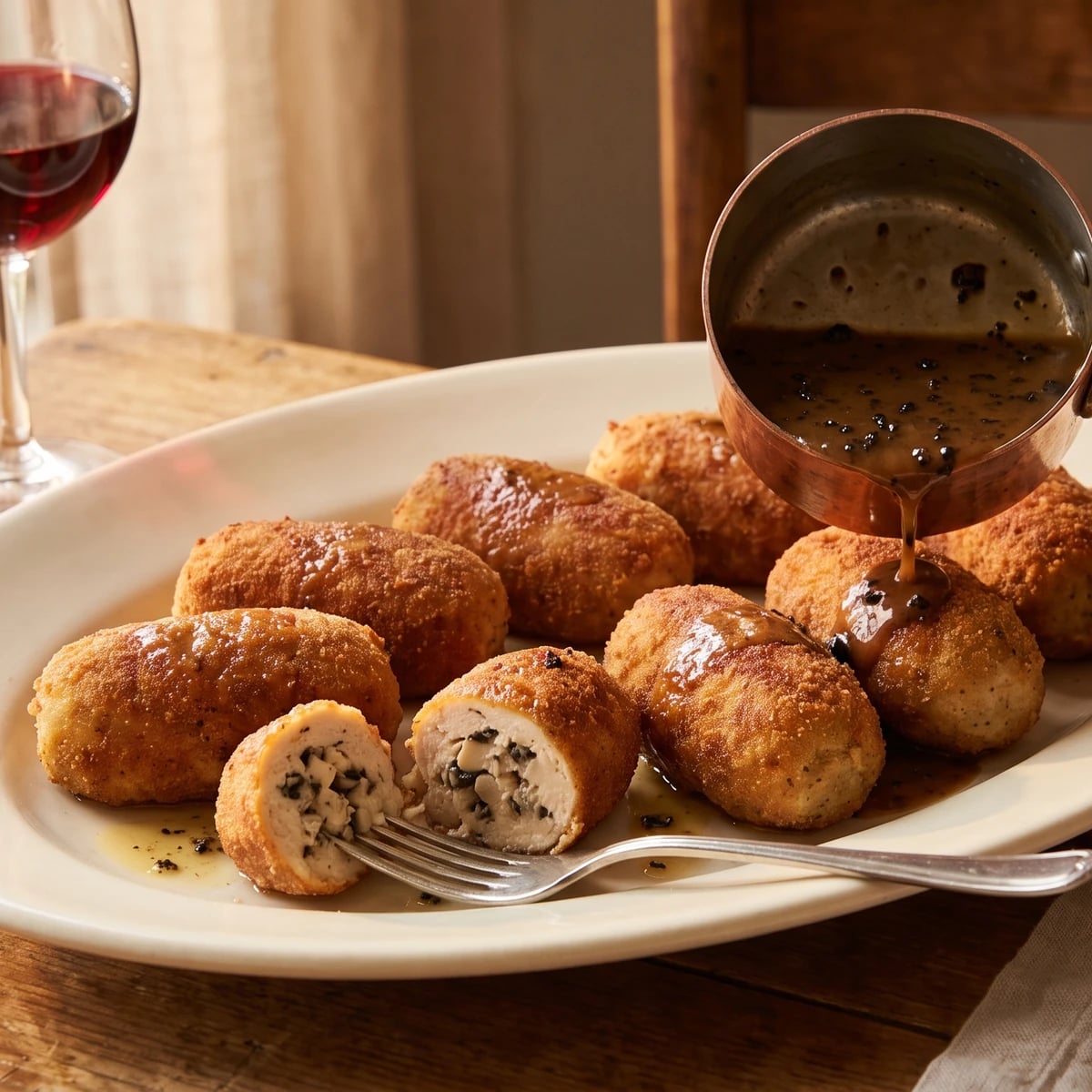
Boudins de Volaille à la Richelieu turn a cold chicken mousseline around truffled salpicon, then poach, crumb, and bronze it in clarified butter, with glossy Périgueux sauce served separately.
Boudins de Volaille à la Richelieu (chicken mousseline rolls filled with a sauce-bound dice of chicken, mushroom, and truffle) teach the discipline behind every delicate forcemeat: cold is structure. The paste must stay cold enough for chicken, panada, egg white, and cream to bind as one smooth emulsion. Let it warm, and it turns grainy before the pan is even hot.
The old entry assumed a saucier maintaining reduced Allemande and Périgueux sauces, stock never off the fire, little biscuit moulds by the dozen, linen for draining, and a salamander waiting over the range, though this dish itself takes its final colour in clarified butter. The home translation makes compact quantities of both sauces, shapes eight three-ounce portions on buttered parchment, poaches them in one wide saucepan, and drains them on a rack. The moulds, linen, and folded napkin are brigade scaffolding and can go. The panada-and-cream forcemeat, enclosed salpicon, gentle poach, egg and crumb, clarified-butter colouring, and sauce served apart are the dish, and they stay.
Done properly, each boudin wears a fine butter-gold crust around tender ivory mousseline, with dark flecks of truffle waiting at its centre and Périgueux sauce gleaming beside it. Before touching a pan, clear refrigerator space and chill the processor blade, bowl, chicken, panada, and cream. That is the one discipline the whole dish obeys.
Boudins de volaille à la Richelieu belong to the Parisian grand-kitchen repertoire, where boudin could mean a shaped forcemeat as readily as a blood sausage; here the name describes the plump sausage form, not its contents. The Richelieu treatment in this entry joins white poultry, mushroom, and truffle salpicon to Périgueux sauce, whose black-truffle identity comes from Périgord even though the composed dish is Parisian. It traveled from staffed dining rooms to bourgeois celebration tables because the poaching could be completed ahead, leaving only the butter colouring for service.
Quantity
14 oz (400 g)
trimmed, cut into 1-inch (2.5 cm) cubes, and thoroughly chilled
Quantity
1/4 cup (60 ml / 62 g)
Quantity
1 tablespoon (15 ml / 14 g)
Quantity
1/4 cup (60 ml / 30 g)
Quantity
1
separated
Quantity
2/3 cup (160 ml / 160 g)
thoroughly chilled, with 1 tablespoon held back
Quantity
1 1/2 teaspoons (7.5 ml / 9 g)
divided
Quantity
1/2 teaspoon (2.5 ml / 1.2 g)
divided
Quantity
1/8 teaspoon (0.6 ml / 0.3 g)
Quantity
3.2 oz (90 g)
cut into 1/8-inch (3 mm) dice
Quantity
3.2 oz (90 g)
cut into 1/8-inch (3 mm) dice
Quantity
1 oz (30 g)
finely diced and divided
Quantity
1 tablespoon (15 ml / 14 g)
Quantity
2 teaspoons (10 ml / 9 g)
Quantity
2 teaspoons (10 ml / 5 g)
Quantity
1/3 cup (80 ml / 80 g)
Quantity
2 tablespoons (30 ml / 30 g)
Quantity
1 teaspoon (5 ml / 5 g)
Quantity
1/2 cup (120 ml / 120 g)
Quantity
1 small
finely minced
Quantity
1 1/2 cups (360 ml / 360 g)
Quantity
2 tablespoons (30 ml / 36 g)
Quantity
1 tablespoon (15 ml / 15 g)
Quantity
1 tablespoon (15 ml / 14 g)
Quantity
1 quart (950 ml / 950 g)
Quantity
1 quart (950 ml / 950 g)
Quantity
2
beaten
Quantity
1 1/2 cups (360 ml / 90 g)
Quantity
1/3 cup (80 ml / 75 g)
| Ingredient | Quantity |
|---|---|
| boneless, skinless chicken breasttrimmed, cut into 1-inch (2.5 cm) cubes, and thoroughly chilled | 14 oz (400 g) |
| whole milk for the panada | 1/4 cup (60 ml / 62 g) |
| unsalted butter for the panada | 1 tablespoon (15 ml / 14 g) |
| all-purpose flour for the panada | 1/4 cup (60 ml / 30 g) |
| large eggseparated | 1 |
| heavy cream for the mousselinethoroughly chilled, with 1 tablespoon held back | 2/3 cup (160 ml / 160 g) |
| fine saltdivided | 1 1/2 teaspoons (7.5 ml / 9 g) |
| ground white pepperdivided | 1/2 teaspoon (2.5 ml / 1.2 g) |
| freshly grated nutmeg | 1/8 teaspoon (0.6 ml / 0.3 g) |
| cooked white chicken meatcut into 1/8-inch (3 mm) dice | 3.2 oz (90 g) |
| button mushroomscut into 1/8-inch (3 mm) dice | 3.2 oz (90 g) |
| black truffle, fresh or preserved wholefinely diced and divided | 1 oz (30 g) |
| unsalted butter for the mushrooms | 1 tablespoon (15 ml / 14 g) |
| unsalted butter for the Allemande sauce | 2 teaspoons (10 ml / 9 g) |
| all-purpose flour for the Allemande sauce | 2 teaspoons (10 ml / 5 g) |
| unsalted chicken stock for the Allemande sauce | 1/3 cup (80 ml / 80 g) |
| heavy cream for the Allemande sauce | 2 tablespoons (30 ml / 30 g) |
| fresh lemon juice | 1 teaspoon (5 ml / 5 g) |
| dry Madeira | 1/2 cup (120 ml / 120 g) |
| shallotfinely minced | 1 small |
| unsalted veal or beef stock | 1 1/2 cups (360 ml / 360 g) |
| good-quality demi-glace concentrate | 2 tablespoons (30 ml / 36 g) |
| black truffle juice (optional) | 1 tablespoon (15 ml / 15 g) |
| cold unsalted butter for the Périgueux sauce | 1 tablespoon (15 ml / 14 g) |
| unsalted chicken stock for poaching | 1 quart (950 ml / 950 g) |
| water for poaching | 1 quart (950 ml / 950 g) |
| large eggs for coatingbeaten | 2 |
| fine fresh white breadcrumbs | 1 1/2 cups (360 ml / 90 g) |
| clarified butter | 1/3 cup (80 ml / 75 g) |
Chill the food processor bowl and blade while you work. Bring the milk, panada butter, and a pinch of the measured salt just to a simmer in a small saucepan. Add the flour at once and beat firmly with a wooden spoon until the panada forms a smooth ball and leaves a light film on the pan, then cook it for 2 minutes over gentle heat. Spread it about 1/2 inch (1.25 cm) thick on a cold plate, cover its surface, and refrigerate until completely cold, about 20 minutes. Warm panada would loosen the mousseline before it ever reaches the poaching liquid.
Melt the mushroom butter over medium heat. Add the diced mushrooms and a pinch of salt, then cook until their liquid has evaporated and their edges are barely golden, 5 to 6 minutes. Cool them completely. For the reduced Allemande sauce, melt its butter in a small saucepan, stir in its flour, and cook for 2 minutes without browning. Whisk in the chicken stock and simmer until very thick. Whisk the reserved egg yolk with the Allemande cream, temper it with a spoonful of the hot sauce, then stir the liaison back into the saucepan over the lowest heat. Cook just until the sauce clings heavily to the spoon, without boiling, and season with lemon juice and a pinch each of salt and white pepper. If the yolk catches, take the pan off the heat at once, press the sauce through a fine sieve, and whisk it smooth with a teaspoon of cold stock. Ça se rattrape. Combine the cooked chicken, mushrooms, 2/3 of the diced truffle, and just enough Allemande sauce to cohere the fine dice. This sauce-bound mixture is the salpicon. Spread it on a plate, cover, and chill.
Put the very cold raw chicken, cold panada, egg white, 1 teaspoon of the measured salt, 1/4 teaspoon of the white pepper, and the nutmeg in the chilled processor. Pulse until the paste is smooth, tacky, and beginning to gather around the blade. With the motor running in short bursts, add the cold cream gradually, holding back 1 tablespoon, and stop to scrape the bowl between additions. The mousseline must remain below 50°F (10°C). If it begins to look greasy or grainy, stop immediately, set the bowl over ice for 10 minutes, then pulse briefly with the held-back cream until smooth. Poach a teaspoon of the paste in barely trembling water for 2 minutes, then taste it for seasoning and check that it holds a tender, even texture. Cold is structure here. Don't shape the boudins until the test piece holds.
Cut eight sheets of parchment about 6 by 8 inches (15 by 20 cm) and brush them lightly with clarified butter. Weigh the mousseline into eight 3 oz (85 g) portions, preserving the source recipe's brigade ratio at a home scale. With a damp offset spatula, spread each portion into a rectangle about 4 by 3 inches (10 by 7.5 cm) and 1/3 inch (8 mm) thick. Lay one-eighth of the cold salpicon along the centre. Use the parchment to fold the mousseline around the filling, seal the long edge completely, and roll it into a plump sausage. Smooth the ends with damp fingers. If salpicon appears through a seam, patch it with a teaspoon of mousseline and chill again. Refrigerate the shaped boudins for 20 minutes so their surfaces firm.
While the boudins chill, simmer the Madeira and shallot in a small saucepan until only about 2 tablespoons remain. Add the veal or beef stock and demi-glace concentrate, whisk smooth, and reduce at a lively simmer until the sauce coats the back of a spoon, about 20 minutes. Strain it into a clean saucepan, add the remaining diced truffle and the truffle juice if using, and taste before adding salt. Hold it warm. Just before serving, take it off the heat and whisk in the cold butter until the Périgueux sauce gleams. Do not boil it after the butter goes in. If the sauce separates, whisk in a teaspoon of cold stock away from the heat.
Combine the poaching stock and water in a wide saucepan and bring them to 180°F to 185°F (82°C to 85°C), a bare tremble with no rolling bubbles. Unwrap four chilled boudins and lower them in with a slotted spatula. Poach for 12 to 14 minutes, turning once, until they feel evenly firm and the centre of one reaches 165°F (74°C). Repeat with the remaining four. If the liquid begins to boil and roughens their surfaces, pull the pan off the heat until it settles, then continue gently. Lift the boudins onto a wire rack and let them drain and cool for 10 minutes. The original linen absorbed surface moisture; the rack does the same work without leaving fibres behind.
Put the beaten eggs and breadcrumbs in separate shallow dishes. Pat each poached boudin dry, coat it completely in egg, then roll it in the fine crumbs, pressing only enough to make them adhere. The source uses egg and crumbs without a flour dredge, and the tender mousseline surface needs nothing more. Set the crumbed boudins on the rack and chill them for 10 minutes so the coating settles.
Heat half the clarified butter in a wide skillet over medium-low heat until it flows freely and shows a clear shimmer. Add four boudins and roll them gently, giving every side time against the pan, until their crumbs are evenly butter-gold and the centres are hot, 5 to 7 minutes. Repeat with the remaining butter and boudins. The heat must be gentle enough to warm the salpicon while the outside colours. If the crumbs darken too quickly, move the pan off the burner for 30 seconds and lower the heat before continuing. Drain briefly on the rack so the crust stays crisp.
Arrange the boudins in a ring on a warmed oval platter. The folded napkin of the brigade presentation was service scaffolding for absorbing butter; the rack has already done that work. Pour the glossy Périgueux sauce into a warmed saucière and serve it separately, as the source directs, so each guest can spoon it beside the boudin without softening the crumb. One cook, one stove, one evening. À table!
1 serving (about 365g)
Culinary guides, cultural storytelling, and the editorial depth that makes cooking meaningful.
Discover Culinary Explorer
Chef Juliette
Glazed turnips, pearl onions, and tender poultry giblets settle into a pale, glossy sauce, with crisp-edged salt pork lending depth: a thrifty braise whose whole success rests on cooking the flour first.

Chef Juliette
Pâté d’abatis turns modest poultry giblets into a generous supper: browned in butter, bound with a light consommé sauce, cooled completely, then sealed beneath puff pastry that rises crisp and gilded.

Chef Juliette
Four boned chicken legs become compact ballotines, packed with good sausage meat, sewn into their own skin, browned deeply, and braised until the filling stays juicy and the pan sauce gleams.

Chef Juliette
Boudins de Volaille Soubise hide a cold truffled onion purée inside delicate chicken forcemeat, then take an egg-and-crumb coat and clarified-butter browning, with silky Soubise passed at the table.