
Chef Juliette
John Dory (St. Pierre)
John Dory has the delicacy of sole and the firmness of turbot. A light flouring, a quick butter sauté, and nut-brown beurre noisette show exactly why looks never mattered.
A cooking platform built around craft, culture, and the stories behind what we eat.
Created by Chef Juliette
Based on No. 1646, Poussins Cendrillon, from Le Guide Culinaire (1907) by Auguste Escoffier
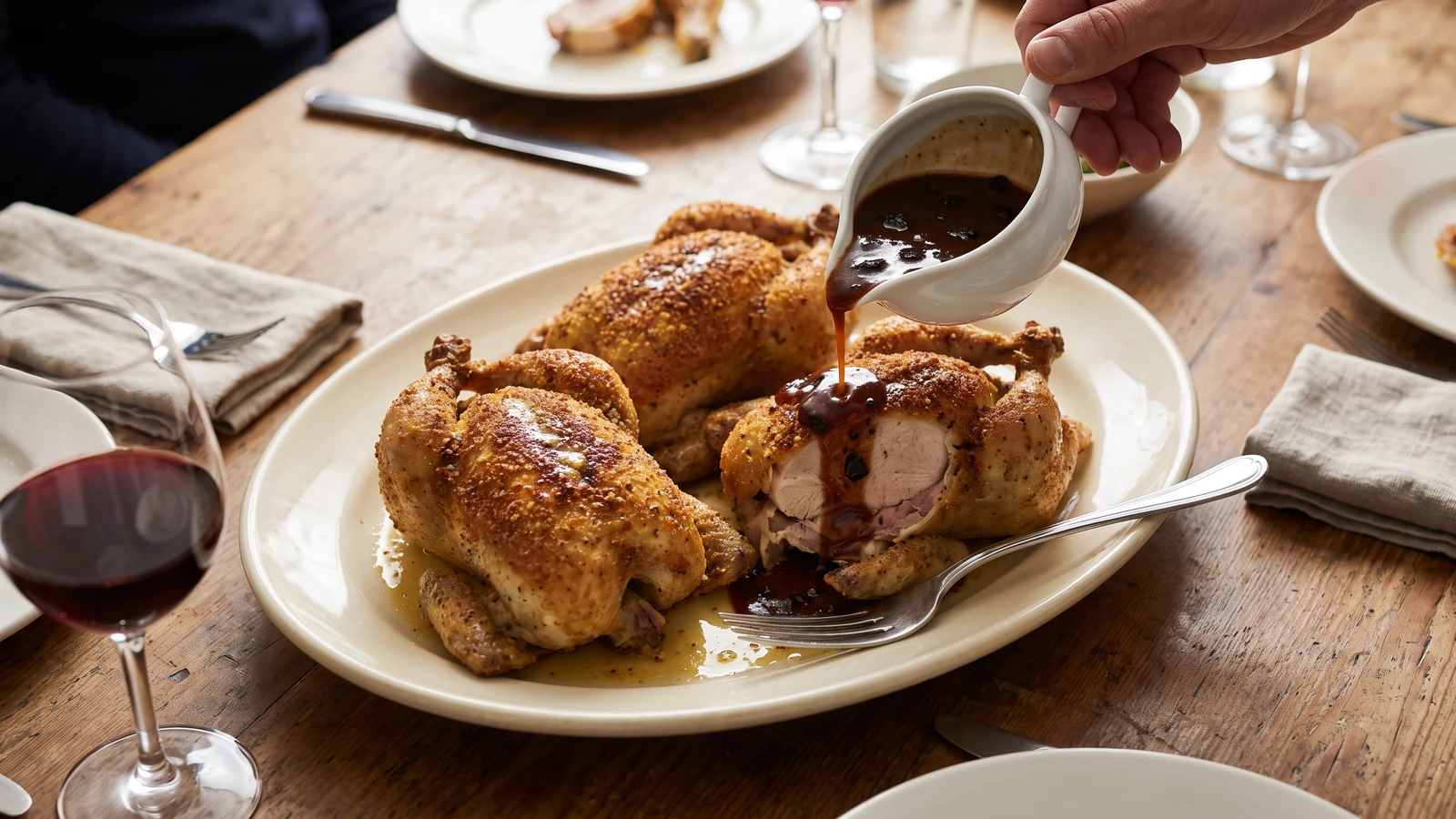
Butter-browned poussins disappear beneath fine pork forcemeat, melting caul, and a golden crumb jacket, then meet truffle-rich Périgueux sauce at the table: gentle heat is the whole discipline.
Poussins Cendrillon (Cinderella-style young chickens) teaches one true thing: a crust and its filling must cook at the same pace. Let the heat grow fierce and the crumbs blacken while the bird and forcemeat remain raw beneath them. Keep it gentle and the caul melts, the pork bastes the poussin, and the buttered jacket turns evenly bronze.
The original kitchen assumed a saucier on staff, stock never off the fire, and a salamander whose distance from the heat could be adjusted by instinct. At home, prepared Périgueux sauce replaces the sauce station, while a moderate oven followed by a brief broiler finish replaces the salamander. That is brigade scaffolding, and it may go. The browned bird, two thin layers of forcemeat, caul, butter, crumbs, and restrained heat are the dish itself, so every one stays. One cook, one stove, one evening.
The finished poussins arrive as burnished parcels with crisp crumbs outside, juicy poultry and fine pork within, and dark, truffle-rich sauce waiting in its own saucière. Guard the heat during those final twenty-five minutes. That is the step that decides everything.
Poussins Cendrillon belongs to the grand-kitchen table of Paris rather than to a regional farmhouse repertoire, its poetic name marking a formal presentation of small birds enclosed in an elaborate jacket. Périgueux sauce contributes the black-truffle character of Périgord, but its presence does not make the whole preparation a Périgord household dish. The caul is practical as well as luxurious: it holds the forcemeat against the birds, then melts into the crumb coating as they cook.
Quantity
4, about 12 to 14 oz (340 to 400 g) each
Quantity
6 tablespoons (90 ml / 85 g)
divided
Quantity
2 teaspoons (10 ml / 12 g)
Quantity
1/4 teaspoon (1.25 ml / 0.5 g)
Quantity
2 cups (480 ml / 450 g)
well chilled
Quantity
4 large sheets, about 8 oz (225 g) total
soaked briefly in cold water, drained, and patted dry
Quantity
1 1/2 cups (360 ml / 150 g)
Quantity
1 1/2 cups (360 ml / 360 g)
kept warm
| Ingredient | Quantity |
|---|---|
| small poussins | 4, about 12 to 14 oz (340 to 400 g) each |
| unsalted butterdivided | 6 tablespoons (90 ml / 85 g) |
| fine salt | 2 teaspoons (10 ml / 12 g) |
| cayenne pepper | 1/4 teaspoon (1.25 ml / 0.5 g) |
| fine plain pork forcemeatwell chilled | 2 cups (480 ml / 450 g) |
| very soft pig’s caulsoaked briefly in cold water, drained, and patted dry | 4 large sheets, about 8 oz (225 g) total |
| fine dry breadcrumbs | 1 1/2 cups (360 ml / 150 g) |
| prepared Périgueux saucekept warm | 1 1/2 cups (360 ml / 360 g) |
Use poultry shears to cut along both sides of each backbone and remove it. Open each poussin like a book, turn it breast-side up, and press firmly on the breastbone until the bird lies flat. Remove any stray feathers, then dry every surface thoroughly. Wet skin stews in the pan, while dry skin gives the butter something it can brown.
Melt 2 tablespoons (30 ml / 28 g) of the butter in a large heavy skillet over medium heat. When the foam subsides, brown the poussins in two batches, skin-side down first, until deep gold in patches, about 3 minutes per side. Add the reserved tablespoon of butter if the pan becomes dry. You are beginning the colour, not cooking the birds through. If the butter turns black, lift out the poussins, wipe away only the burnt fat, and continue with fresh butter. Ça se rattrape.
Combine the salt and cayenne, then season the browned poussins evenly on both sides, following the source sequence precisely. Let them cool for 10 minutes. Lay one sheet of caul flat for each bird. Divide the cold forcemeat into eight equal portions and press four portions into thin bird-shaped layers on the caul, no more than 1/8 inch (3 mm) thick. Set a poussin over each, cover with the remaining forcemeat, and smooth it into an equally thin upper layer. Fold the caul snugly around each parcel and trim only the heavy excess. If the caul tears, overlap the edges or patch it with a scrap. It will fuse as its fat melts.
Heat the oven to 375°F (190°C) with a rack in the upper third. Melt the remaining 3 tablespoons (45 ml / 43 g) butter. Brush every surface of the wrapped poussins generously, then roll and press them in the breadcrumbs until completely coated. Set them seam-side down on a wire rack placed over a rimmed sheet pan and let the coating settle for 10 minutes while the oven finishes heating.
Bake the crumbed poussins for 12 minutes, turn them carefully with two broad spatulas, and continue for 8 to 12 minutes. Set the broiler to low and give each side only enough direct heat to become evenly bronze, usually 30 to 90 seconds. The centre of the pork layer and the thickest part of each thigh must reach at least 165°F (74°C). If the crust colours before the centres are ready, cover it loosely with foil and return the birds to the regular oven for 3 to 5 minutes. Ça se rattrape. Fierce broiler heat is the enemy here.
Rest the poussins for 8 minutes so the forcemeat settles and the caul finishes basting the crumb. Meanwhile, warm the Périgueux sauce over gentle heat until it barely trembles, without boiling it. If it has tightened too far, loosen it with a spoonful of hot water. Transfer the poussins to a warm platter and serve the Périgueux sauce separately in a heated saucière, exactly as the dish requires. À table!
1 serving (about 460g)
Culinary guides, cultural storytelling, and the editorial depth that makes cooking meaningful.
Discover Culinary ExplorerChef Juliette
John Dory has the delicacy of sole and the firmness of turbot. A light flouring, a quick butter sauté, and nut-brown beurre noisette show exactly why looks never mattered.

Chef Juliette
Fresh haddock proves its delicacy in the meunière pan: a fine flour crust, moist pearly flakes, and beurre noisette sharpened with lemon and parsley, ready from one skillet in half an hour.

Chef Juliette
Éperlans à l’Anglaise turns small fish into a lesson in disciplined coating: boned smelts under a close, crisp crumb, pan-fried in clarified butter and finished with bright, half-melted maître d’hôtel butter.

Chef Juliette
Tiny smelts, shallot, mushrooms, white wine, gratin sauce, and fine bread raspings meet a fierce oven, where the fish must turn tender in the same breath the buttered crust bronzes.