
Chef Juliette
John Dory (St. Pierre)
John Dory has the delicacy of sole and the firmness of turbot. A light flouring, a quick butter sauté, and nut-brown beurre noisette show exactly why looks never mattered.
A cooking platform built around craft, culture, and the stories behind what we eat.
Created by Chef Juliette
Based on No. 1644, Poulet de Grains Souvaroff, from Le Guide Culinaire (1907) by Auguste Escoffier
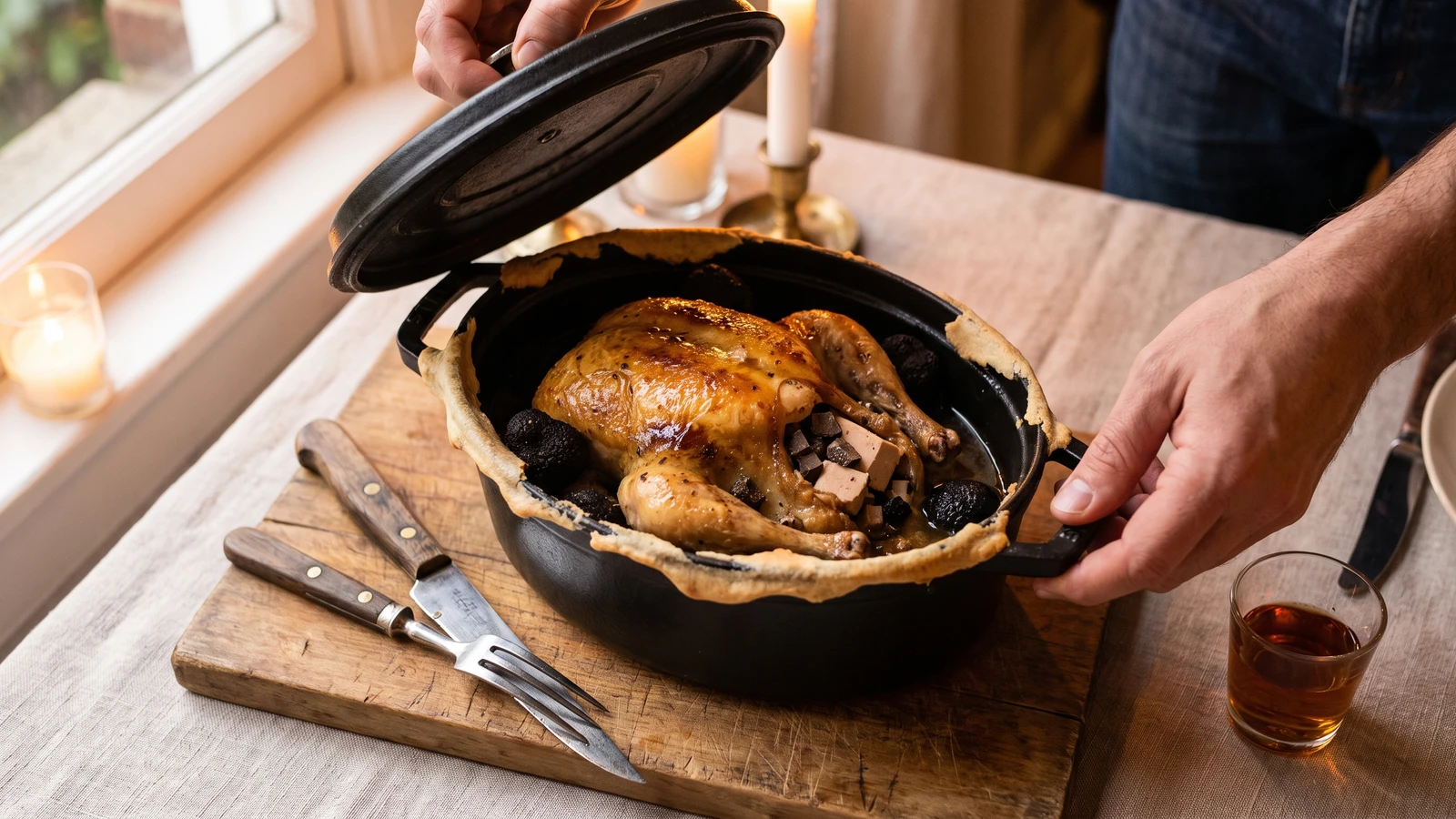
A grain-fed chicken filled with foie gras and truffle, poêlé in butter, then enclosed with Madeira and whole truffles beneath a paste-sealed cocotte lid broken at the table.
Poulet de Grains Souvaroff (grain-fed chicken with foie gras, truffle, and Madeira in a sealed cocotte) teaches containment. The seal is the dish. It holds every drop of the bird's juice and every breath of truffle beneath the lid, then gives them back in one magnificent moment when the crust is broken at the table.
The original assumed a saucier on staff, veal stock never off the fire, one pan for the poêlé and another cocotte waiting to receive the bird. Your home equivalent is concentrated veal stock and one heavy cocotte that browns, roasts, and seals. The second pan was brigade scaffolding and can go. A salamander never mattered here. The cord of paste does, and it stays. The smaller chicken receives exactly half the foie gras and truffle garnish of the larger poularde, as the entry directs. One cook, one stove, one evening.
Inside, the foie gras softens into the diced truffle while the Madeira and whole truffles make a dark, gleaming jus around the bird. Press the paste continuously over the lid seam and inspect it with your fingertips before the cocotte enters the oven. An unbroken seal is the one step that decides the Souvaroff.
Poulet de Grains Souvaroff belongs to Parisian grande cuisine, where dishes named for public figures joined French technique to an international dining-room vocabulary. Souvaroff is the French rendering of the Russian commander Alexander Suvorov, but the preparation itself is thoroughly French: poultry poêlé with foie gras, black truffle, Madeira, and concentrated veal stock, finished in a paste-sealed cocotte. The smaller poulet de grains follows Poularde Souvaroff (No. 1520) while halving its garnish, a practical distinction between the young chicken and the larger pullet rather than a separate sauce or regional variant.
Quantity
1 chicken, 3½ to 4 lb (1.6 to 1.8 kg)
giblets removed; garnish reduced by half as directed
Quantity
½ cup (120 ml / 115 g)
thoroughly chilled and cut into 1-inch dice
Quantity
Scant ½ cup (100 ml / 70 g)
cut into large dice
Quantity
5 fair-sized truffles
brushed clean
Quantity
4 tablespoons (60 ml / 56 g)
divided
Quantity
½ cup (120 ml / 120 g)
Quantity
⅓ cup plus 1 tablespoon (95 ml / 95 g)
Quantity
¾ cup (180 ml / 90 g)
for the sealing paste
Quantity
3 tablespoons (45 ml / 45 g)
plus a few drops if required
Quantity
2 teaspoons (10 ml / 12 g)
Quantity
1 teaspoon (5 ml / 2 g)
| Ingredient | Quantity |
|---|---|
| whole grain-fed chicken for Poularde Souvaroff (No. 1520)giblets removed; garnish reduced by half as directed | 1 chicken, 3½ to 4 lb (1.6 to 1.8 kg) |
| raw foie grasthoroughly chilled and cut into 1-inch dice | ½ cup (120 ml / 115 g) |
| black truffle for the stuffingcut into large dice | Scant ½ cup (100 ml / 70 g) |
| whole black trufflesbrushed clean | 5 fair-sized truffles |
| unsalted butterdivided | 4 tablespoons (60 ml / 56 g) |
| dry Madeira | ½ cup (120 ml / 120 g) |
| concentrated unsalted veal stock | ⅓ cup plus 1 tablespoon (95 ml / 95 g) |
| all-purpose flourfor the sealing paste | ¾ cup (180 ml / 90 g) |
| cool waterplus a few drops if required | 3 tablespoons (45 ml / 45 g) |
| fine salt | 2 teaspoons (10 ml / 12 g) |
| freshly ground black pepper | 1 teaspoon (5 ml / 2 g) |
Follow the proportion rule attached to Poularde Souvaroff (No. 1520): halve the garnish for the smaller chicken, not the method and not the one-sixth pint of veal stock. The exact half garnish is 4 ounces of foie gras, 2½ ounces of diced truffle inside, and five whole truffles around the bird. Keep the foie gras and diced truffle thoroughly cold. Pat the chicken dry, then season its cavity and skin with the salt and pepper.
Mix the flour with the cool water until it forms a firm, smooth paste. Knead it briefly, then cover and rest it for 15 minutes so it rolls without springing back. It should feel like modeling clay, supple enough to bend but firm enough to hold a seam. If it crumbles, knead in water a few drops at a time. Reserve a walnut-sized piece for repairs, then roll the rest into a cord long enough to encircle the cocotte lid.
Mix the chilled foie gras and diced truffle lightly, keeping the cubes intact. Spoon them loosely into the chicken cavity without packing them into a solid plug; a little space allows heat to reach the center. Close the opening with a small skewer or kitchen twine, then truss the legs neatly against the body. Refrigerate the bird while the oven and cocotte heat.
Heat the oven to 350°F (175°C). Melt 3 tablespoons of the butter in a 4½ to 5-quart heavy cocotte over medium heat, reserving the final tablespoon. Poêler means to covered-roast the bird in butter: begin by coloring the chicken on every side for 10 to 12 minutes, turning only when the skin releases, then cover and roast for 25 to 30 minutes, basting once halfway through. Stop when the center of the stuffing reaches 140 to 145°F (60 to 63°C) and the thigh is about 150°F (66°C). The chicken must be only three-quarters cooked because another sealed half-hour remains. If the butter blackens before the skin colors, lift out the bird, wipe away the burnt fat, and continue more gently with the reserved butter; losing a little fond is better than building the jus on bitterness.
Transfer the chicken to a warm plate and pour off excess fat, leaving about a tablespoon and every clean brown trace of fond in the cocotte. Add the five whole truffles and the Madeira. Simmer for 3 to 4 minutes, rolling the truffles through the wine and scraping the fond from the pot floor, until the Madeira has reduced by roughly half and smells rounded rather than sharply alcoholic. If it reduces to a sticky glaze, loosen it immediately with a spoonful of the measured veal stock. Return the chicken and its resting juices to the cocotte, then pour the remaining veal stock around it.
Set the lid firmly on the cocotte. Press the cord of paste continuously over the seam where lid meets pot, pinching it onto both surfaces so no gap remains. Inspect the full circle with your fingertips. Bake in the moderate oven for exactly 30 minutes without lifting the lid. If the paste develops a crack before the pot enters the oven, press the reserved piece over it with damp fingers. Ça se rattrape. The paste is not decoration and it is not meant to be eaten; it is the gasket that keeps the truffle, Madeira, and chicken enclosed together.
Carry the cocotte directly to the table. Crack the baked paste cord with the back of a sturdy knife, remove it, and lift the lid away from you. Check the center of the stuffing for 165°F (74°C) and the thigh for at least 170°F (77°C). If either falls short, replace the lid without resealing and return the cocotte to the oven for 5 to 10 minutes. Carve the chicken and give each guest some foie gras and truffle stuffing, a whole truffle or a portion of one, and plenty of the glossy Madeira jus. Serve it as it stands in the cocotte. À table!
1 serving (about 330g)
Culinary guides, cultural storytelling, and the editorial depth that makes cooking meaningful.
Discover Culinary ExplorerChef Juliette
John Dory has the delicacy of sole and the firmness of turbot. A light flouring, a quick butter sauté, and nut-brown beurre noisette show exactly why looks never mattered.

Chef Juliette
Fresh haddock proves its delicacy in the meunière pan: a fine flour crust, moist pearly flakes, and beurre noisette sharpened with lemon and parsley, ready from one skillet in half an hour.

Chef Juliette
Éperlans à l’Anglaise turns small fish into a lesson in disciplined coating: boned smelts under a close, crisp crumb, pan-fried in clarified butter and finished with bright, half-melted maître d’hôtel butter.

Chef Juliette
Tiny smelts, shallot, mushrooms, white wine, gratin sauce, and fine bread raspings meet a fierce oven, where the fish must turn tender in the same breath the buttered crust bronzes.