
Chef Juliette
John Dory (St. Pierre)
John Dory has the delicacy of sole and the firmness of turbot. A light flouring, a quick butter sauté, and nut-brown beurre noisette show exactly why looks never mattered.
A cooking platform built around craft, culture, and the stories behind what we eat.
Created by Chef Juliette
Based on No. 1639, Poulet de Grains à l’Hôtelière, from Le Guide Culinaire (1907) by Auguste Escoffier
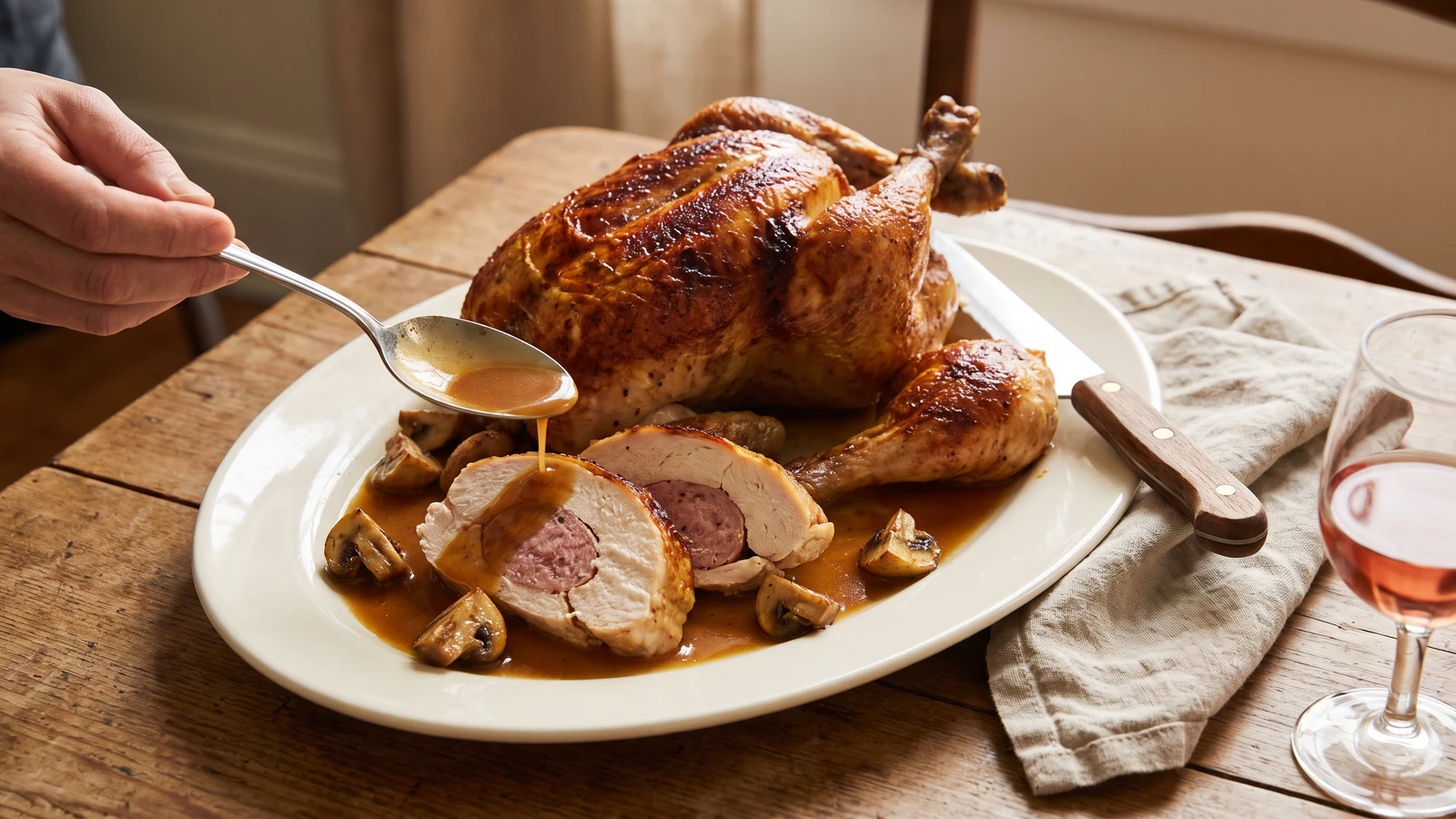
Boned at the breast, filled evenly with sausage meat, and browned in butter, this compact roast teaches the quiet geometry of stuffing: shape it well, cook it gently, and every slice holds together.
Poulet de Grains à l’Hôtelière (grain-fed chicken in the innkeeper’s manner) teaches the quiet geometry of stuffing. The breast bones come out, sausage meat takes their place, and the bird keeps enough shape to brown whole and carve into clean, generous slices. The one true thing is this: spread the sausage in an even layer. A tight lump cooks late, and by the time its center is safe the chicken has surrendered its tenderness.
The original entry expected a commis or poulterer to bone and truss the bird, heatproof earthenware that could move from range to oven, and a saucier with veal gravy waiting beside a stockpot never off the fire. At home, ask the butcher to remove only the breast cage or use poultry shears, replace the trussing needle with two wooden picks and kitchen twine, roast in a heavy enameled braiser, and use good prepared veal gravy at pouring consistency. Its single-bird proportions already feed four, so the book’s ratio stays intact: half a pound of sausage meat, four ounces of mushrooms, and three tablespoonfuls of gravy. One cook, one stove, one evening.
The exact classical entrée truss is brigade scaffolding and can go. The boning, even packing, butter browning, delayed addition of the mushrooms, and final veal gravy are the dish, so every one remains. Before the pan heats, make the sausage layer flat and the bird compact. That is the step that decides whether each slice holds together.
À l’Hôtelière belongs to the French inn and hotel table, a practical branch of the classical canon that turned a good poulet de grains into a compact, easily carved entrée rather than tying it to one regional larder. Here the title is defined by practice: bone the breast, replace the bones with sausage meat, brown the bird in butter, then finish its roasting with sautéed mushrooms and veal gravy. Poulet de grains is a market description of a young grain-fed bird, not a garnish, and the boning allows the host to serve breast and stuffing together in clean slices.
Quantity
1 chicken, 3½ to 4 lb (1.6 to 1.8 kg)
giblets removed
Quantity
½ lb (about 1 packed cup / 240 ml / 225 g)
well seasoned and without sage or fennel
Quantity
¼ cup (4 tbsp / 60 ml / 57 g)
divided
Quantity
4 oz (about 1½ cups / 355 ml / 115 g)
quartered
Quantity
3 tbsp (45 ml / 45 g)
brought to pouring consistency
Quantity
1 tsp (5 ml / 6 g)
Quantity
½ tsp (2.5 ml / 1 g)
| Ingredient | Quantity |
|---|---|
| whole young grain-fed chickengiblets removed | 1 chicken, 3½ to 4 lb (1.6 to 1.8 kg) |
| plain pork sausage meatwell seasoned and without sage or fennel | ½ lb (about 1 packed cup / 240 ml / 225 g) |
| unsalted butterdivided | ¼ cup (4 tbsp / 60 ml / 57 g) |
| small button mushroomsquartered | 4 oz (about 1½ cups / 355 ml / 115 g) |
| prepared veal gravybrought to pouring consistency | 3 tbsp (45 ml / 45 g) |
| fine salt | 1 tsp (5 ml / 6 g) |
| ground white pepper | ½ tsp (2.5 ml / 1 g) |
Set the chicken on a stable board with the large cavity facing you. Working through that opening with a short, flexible knife, scrape the breast flesh away from the inner ribs and breastbone, keeping the blade against bone so the skin remains whole. Snip the ribs where they join the back, free the wishbone, and ease out the breastbone and attached rib cage while leaving the backbone, wings, and legs in place. Run your fingers through the pocket and remove every loose fragment of bone.
Season the boned pocket and the outside of the chicken with the salt and white pepper. Press the sausage meat beneath the two breast lobes in an even layer about ½ inch (1.25 cm) thick, filling the space left by the bones without making a dense central ball. If the layer is thicker in the middle, press it outward now; uneven stuffing is the failure that dries the chicken while its center struggles to cook. Close the cavity with two wooden picks, tuck the wing tips underneath, tie the drumsticks together, and loop twine around the body to hold it in a compact oval. Tie firmly, but do not squeeze the filling out.
Heat the oven to 375°F (190°C), or 340°F (170°C) with a fan. Melt 3 tablespoons (45 ml / 43 g) of the butter in a heavy 4-quart (3.8-liter) enameled braiser over medium heat. When the foam subsides, add the chicken and brown it patiently on the breast, sides, and back, turning with two wooden spoons or sturdy tongs, until the skin is an even Maillard bronze, about 10 to 12 minutes. Keep the heat moderate because butter must brown the bird without turning black. If the butter burns, lift out the chicken, wipe away the bitter fat, and begin again with fresh butter. Ça se rattrape.
Set the chicken breast-side up in the same braiser and roast uncovered for 40 minutes, basting once with the butter and juices from the bottom. This first roasting period brings the bird roughly two-thirds of the way without asking the mushrooms to endure the whole oven time. The skin should be deeply golden and the juices should be gathering beneath it, but the sausage center will not yet be fully cooked.
Melt the remaining 1 tablespoon (15 ml / 14 g) butter in a 10-inch (25 cm) skillet over medium-high heat. Add the quartered mushrooms in one layer and sauté them until their released moisture has evaporated and their cut faces are well browned, 6 to 8 minutes. If they flood the pan, do not drain away their flavor. Increase the heat and keep cooking until the liquid disappears and the butter begins frying them again. Ça se rattrape. Add the mushrooms and their butter to the braiser around the chicken.
Return the braiser to the oven and roast for another 25 to 35 minutes. Insert an instant-read thermometer horizontally into the center of the sausage layer without touching bone; both the stuffing and the deepest part of the thigh must reach 165°F (74°C). If the skin is dark enough before the center is safe, cover the breast loosely with foil and lower the oven to 350°F (175°C), then continue checking every 5 minutes. Color can wait under foil. Safe stuffing cannot be negotiated.
Transfer the chicken to a carving board and rest it loosely covered for 15 minutes. Spoon off excess clear fat from the braiser while leaving the browned glaze and mushrooms behind. Set the braiser over low heat, add the prepared veal gravy, and scrape the fond from the bottom until the gravy is glossy and coats the mushrooms. If it tightens into a sticky glaze, remove the pan from the heat and stir in the juices collected beneath the resting chicken. If it remains thin, simmer it for another minute.
Remove every pick and length of twine. Detach the legs at their joints, then cut the stuffed breast crosswise into thick slices, carrying the knife down only until it reaches the remaining backbone. Lift each slice intact so chicken and sausage arrive together. Arrange the slices and legs on a warm platter, spoon the sautéed mushrooms around them, and pour over the veal gravy. À table!
1 serving (about 285g)
Culinary guides, cultural storytelling, and the editorial depth that makes cooking meaningful.
Discover Culinary ExplorerChef Juliette
John Dory has the delicacy of sole and the firmness of turbot. A light flouring, a quick butter sauté, and nut-brown beurre noisette show exactly why looks never mattered.

Chef Juliette
Fresh haddock proves its delicacy in the meunière pan: a fine flour crust, moist pearly flakes, and beurre noisette sharpened with lemon and parsley, ready from one skillet in half an hour.

Chef Juliette
Éperlans à l’Anglaise turns small fish into a lesson in disciplined coating: boned smelts under a close, crisp crumb, pan-fried in clarified butter and finished with bright, half-melted maître d’hôtel butter.

Chef Juliette
Tiny smelts, shallot, mushrooms, white wine, gratin sauce, and fine bread raspings meet a fierce oven, where the fish must turn tender in the same breath the buttered crust bronzes.