
Chef Juliette
John Dory (St. Pierre)
John Dory has the delicacy of sole and the firmness of turbot. A light flouring, a quick butter sauté, and nut-brown beurre noisette show exactly why looks never mattered.
A cooking platform built around craft, culture, and the stories behind what we eat.
Created by Chef Juliette
Based on No. 1637, Poulet de Grains, Grillé à l’Anglaise (Spatchcock), from Le Guide Culinaire (1907) by Auguste Escoffier
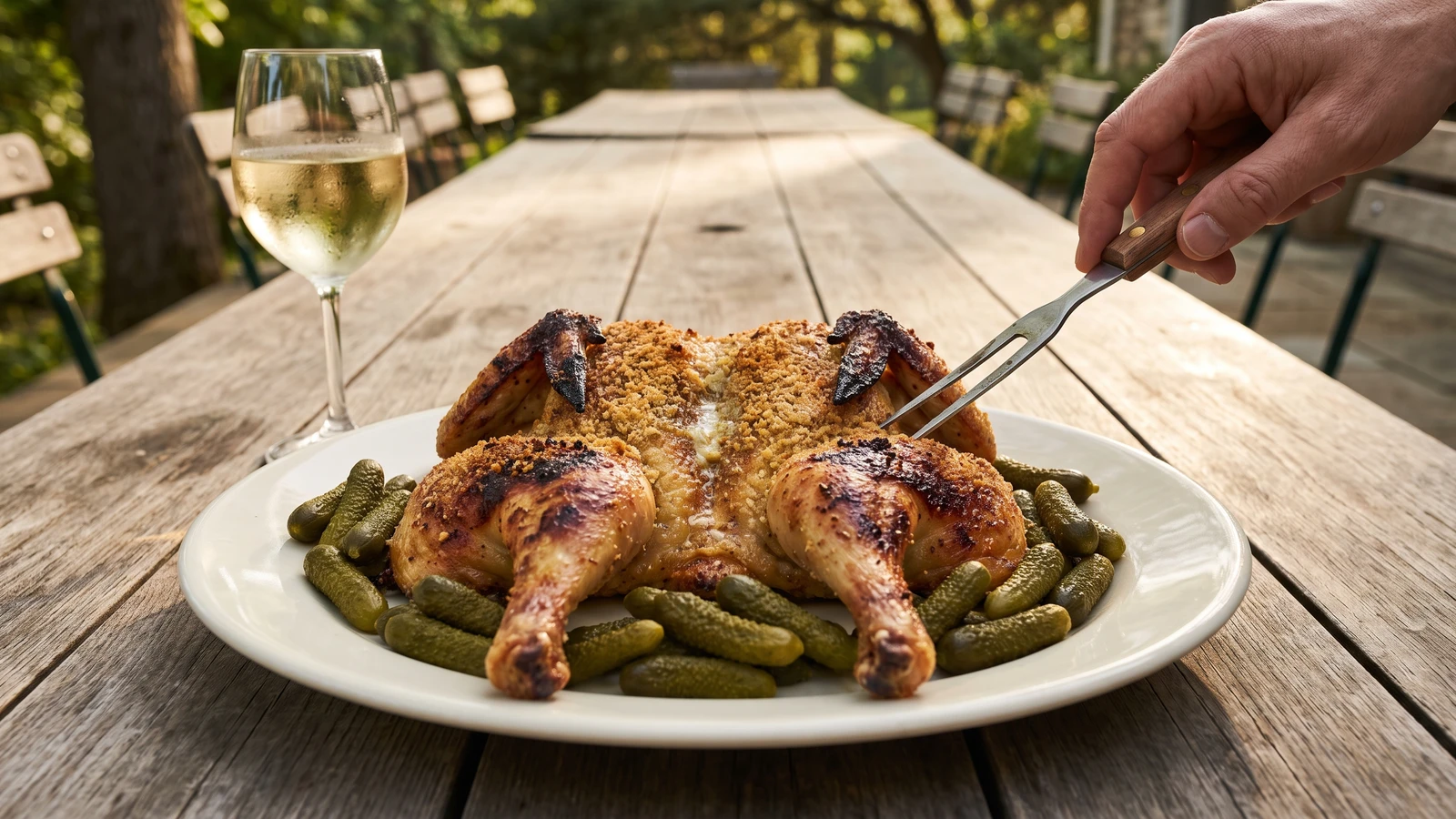
A young chicken opened through the breast, flattened, half-roasted, buttered and crumbed, then finished over the grill until crisp and bronze, with a bright ring of gherkins ready for every rich bite.
Poulet de Grains, Grillé à l’Anglaise (spatchcocked grain-fed chicken with buttered crumbs) teaches a clean division of labor: the oven cooks the bird, and the grill cooks the crust. Know that before touching the chicken. If you ask the grill to cook a raw center and brown loose crumbs at once, one will burn while the other waits.
The classical entry assumes a cook comfortable breaking a bird flat, an oven already hot, and a grill station ready for the finish. At home, poultry shears replace the heavy knife, a metal skewer secures the wings, a sheet pan handles the first cooking, and a two-zone barbecue replaces the grill station. An indoor broiler is the salamander’s honest equivalent. This version scales the preparation to one young chicken for four people. One cook, one stove, one evening.
The handoff between brigade stations is scaffolding and can go. The belly-side opening, the first cook in butter, the close coat of breadcrumbs, and the final fierce browning are the dish and must stay. Take the chicken from the oven near doneness, not at a guessed mathematical halfway point; that measured handoff protects both juicy meat and a bronzed crust.
Poulet de grain, grilled à l’anglaise, belongs to the French classical grill room rather than to a single regional larder, and poulet de grain means a tender young bird raised on grain, not a breed or place-name. In classical French usage, à l’anglaise identifies the close breadcrumb treatment and grill finish, a French technical category shaped by an English association rather than a claim of regional English origin. The preparation passed readily from grand dining rooms to household and garden grills because its architecture is practical: oven heat brings the flattened bird nearly through, then fierce grill heat bronzes the crumbs.
Quantity
1 chicken, 3½ to 4 pounds (1.6 to 1.8 kg)
giblets removed
Quantity
6 tablespoons (90 ml / 85 g)
melted and divided
Quantity
1½ teaspoons (7.5 ml / 9 g)
Quantity
¾ teaspoon (4 ml / 2 g)
Quantity
1 cup (240 ml / 85 g)
Quantity
1 cup (240 ml / 150 g)
drained
| Ingredient | Quantity |
|---|---|
| whole grain-fed young chickengiblets removed | 1 chicken, 3½ to 4 pounds (1.6 to 1.8 kg) |
| unsalted buttermelted and divided | 6 tablespoons (90 ml / 85 g) |
| fine sea salt | 1½ teaspoons (7.5 ml / 9 g) |
| freshly ground black pepper | ¾ teaspoon (4 ml / 2 g) |
| fine dry breadcrumbs | 1 cup (240 ml / 85 g) |
| cornichons (small sour gherkins)drained | 1 cup (240 ml / 150 g) |
Set a rack in the upper-middle of the oven and heat it to 425°F (220°C). Fit a wire rack inside a rimmed sheet pan. Melt the butter gently, then keep it fluid without letting it brown.
Set the chicken breast-side up with the cavity toward you. Starting at the lower belly opening, cut through the center of the breastbone toward the wing joints, stopping before the two halves separate. Open the chicken like a book, turn it skin-side up, and press firmly over the shoulder and rib joints until the bird lies broad and even. Run clean fingertips carefully along every cut bone and remove any loose fragments with kitchen tweezers. Draw the wings close and run a metal skewer through one wing, the upper breast, and the opposite wing to hold them in place. Pat the chicken dry, then season both sides evenly with the salt and pepper.
Brush both sides with 4 tablespoons (60 ml / 57 g) of the melted butter, giving the skin most of it. Set the chicken skin-side up on the prepared rack and roast for 20 to 25 minutes. During the final 10 minutes, heat a covered grill with one direct, medium-high zone and one indirect zone, aiming for about 450°F (230°C). The chicken is ready for its second cooking when the skin has set and begun to color, the breast registers 140 to 145°F (60 to 63°C), and the thigh registers 150 to 155°F (66 to 68°C). This is the classical half-cook translated into a dependable home cue. If the temperature runs a little higher, shorten the grill finish rather than sacrificing the crumb.
Leave the hot chicken on its rack. Scatter the fine breadcrumbs evenly over the entire skin side, pressing lightly so they cling to the buttery surface, then spoon the remaining 2 tablespoons (30 ml / 28 g) of melted butter over the crumbs in a thin, even drizzle. The coat should look dampened and close, not sodden. If a patch slides away, wait one minute, press fresh crumbs onto the bare spot, and dot them with butter. It can still be repaired.
Carry the chicken to the grill on its sheet pan. Supporting it with two wide spatulas, set it crumb-side down over direct heat for 60 to 90 seconds. Lift one edge after 45 seconds and look for a deep butter-gold crust. Turn the chicken bone-side down over indirect heat, close the lid, and cook for another 3 to 6 minutes, until the breast reaches 165°F (74°C) and the thickest part of the thigh reaches at least 170°F (77°C), without the thermometer touching bone. If the crumbs darken too quickly, move the bird away from the flame at once. If the crust is ready before the meat, keep it bone-side down over indirect heat until the temperature catches up. Ça se rattrape.
Rest the chicken uncovered for 8 minutes so its juices settle without softening the crumb. Remove the skewer, set the bird whole on a warm round platter, and arrange the drained gherkins generously around its edge. Bring it to the table with a carving knife and let the buttered crust speak for itself. À table!
1 serving (about 275g)
Culinary guides, cultural storytelling, and the editorial depth that makes cooking meaningful.
Discover Culinary ExplorerChef Juliette
John Dory has the delicacy of sole and the firmness of turbot. A light flouring, a quick butter sauté, and nut-brown beurre noisette show exactly why looks never mattered.

Chef Juliette
Fresh haddock proves its delicacy in the meunière pan: a fine flour crust, moist pearly flakes, and beurre noisette sharpened with lemon and parsley, ready from one skillet in half an hour.

Chef Juliette
Éperlans à l’Anglaise turns small fish into a lesson in disciplined coating: boned smelts under a close, crisp crumb, pan-fried in clarified butter and finished with bright, half-melted maître d’hôtel butter.

Chef Juliette
Tiny smelts, shallot, mushrooms, white wine, gratin sauce, and fine bread raspings meet a fierce oven, where the fish must turn tender in the same breath the buttered crust bronzes.