
Chef Juliette
John Dory (St. Pierre)
John Dory has the delicacy of sole and the firmness of turbot. A light flouring, a quick butter sauté, and nut-brown beurre noisette show exactly why looks never mattered.
A cooking platform built around craft, culture, and the stories behind what we eat.
Created by Chef Juliette
Based on No. 1634, Poulet de Grains en Cocotte, from Le Guide Culinaire (1907) by Auguste Escoffier
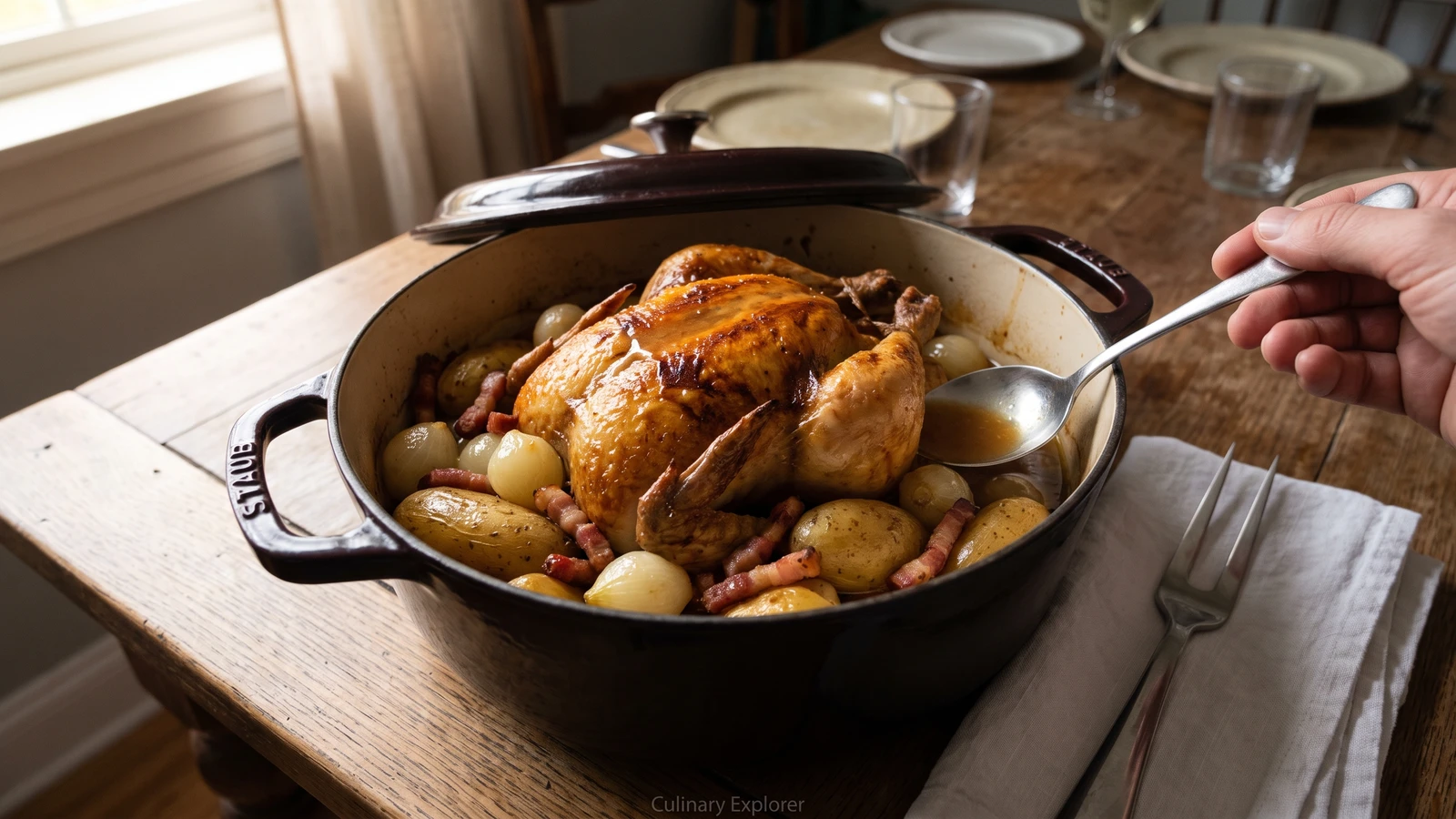
Butter-bronzed chicken cooks beneath its lid while crisp lardons, pearl onions, and olive-cut potatoes catch up around it, all finished with just enough veal jus to gloss the pot.
Poulet de Grains en Cocotte (grain-fed chicken cooked under cover) teaches one precise lesson: every part of a one-pot supper must arrive at tenderness together. The chicken begins alone in butter, taking colour beneath the lid; the lardons, onions, and potatoes join only when they have already done half their cooking elsewhere. Put them in raw and the chicken waits for them, growing dry while the potatoes remain stubborn.
The original entry assumed a commis turning twenty potatoes into perfect olive shapes and a saucier with veal gravy beside a stock never off the fire. At home, choose very small waxy potatoes and trim them into rough ovals, then reach for a good prepared veal jus or dilute a concentrated veal demi-glace. The proportions and sequence remain intact, scaled to one young chicken for four. We changed the labor, not the intent. One cook, one stove, one evening.
Perfect tournage and a separate sauce station are brigade scaffolding; they can go. Browning the bird in real butter under cover, then finishing it with the prepared garnish, is the dish and must stay. Before the chicken meets the pan, remember the one thing that decides everything: lardons frizzled, onions half-tender, potatoes half-cooked.
Poulet de Grains en Cocotte belongs to the well-provisioned cuisine bourgeoise table of Paris and to the classical dining rooms that refined the same covered-pot method. The name does not mean chicken cooked with grain; it identifies a young, well-fed table bird tender enough for brief cooking and delicate enough to carry a restrained garnish. Covered cocotte cookery passed easily between household and grand kitchen because the heavy pot conserved the bird's moisture while butter, pork, onions, potatoes, and a little veal jus made a complete meal around it.
Quantity
1 (3 1/2 to 4 lb / 1.6 to 1.8 kg)
Quantity
1/4 cup (60 ml / 57 g)
divided
Quantity
1/2 cup (120 ml / 57 g)
cut into small dice
Quantity
12, about 1 cup (240 ml / 180 g)
peeled
Quantity
20, about 2 cups (475 ml / 450 g)
peeled and trimmed into olive shapes
Quantity
1/4 cup (60 ml / 60 g)
or 1 tablespoon (15 ml / 18 g) veal demi-glace diluted with 3 tablespoons (45 ml / 45 g) water
Quantity
5 teaspoons (25 ml / 30 g)
divided
Quantity
1/2 teaspoon (2.5 ml / 1 g)
| Ingredient | Quantity |
|---|---|
| whole young grain-fed chicken | 1 (3 1/2 to 4 lb / 1.6 to 1.8 kg) |
| unsalted butterdivided | 1/4 cup (60 ml / 57 g) |
| fresh pork belly or unsmoked salt pork lardonscut into small dice | 1/2 cup (120 ml / 57 g) |
| small pearl onionspeeled | 12, about 1 cup (240 ml / 180 g) |
| very small waxy potatoespeeled and trimmed into olive shapes | 20, about 2 cups (475 ml / 450 g) |
| prepared light veal jusor 1 tablespoon (15 ml / 18 g) veal demi-glace diluted with 3 tablespoons (45 ml / 45 g) water | 1/4 cup (60 ml / 60 g) |
| fine sea saltdivided | 5 teaspoons (25 ml / 30 g) |
| freshly ground black pepper | 1/2 teaspoon (2.5 ml / 1 g) |
Take the chicken from the cold 30 minutes before cooking and heat the oven to 375°F (190°C). Dry the bird thoroughly, including the cavity, because surface moisture prevents the butter from doing its browning work. Season inside and out with 2 teaspoons of the salt and all the pepper, tuck the wing tips underneath, and tie the legs together loosely so the bird cooks evenly.
Put the potatoes in a small saucepan, cover with cold water, and add the remaining 3 teaspoons salt. Bring to a gentle simmer and cook for 7 to 9 minutes, until a knife enters the outside easily but meets a firm centre. Drain and let them dry. Meanwhile, frizzle the lardons in a dry skillet over medium heat until their edges are bronzed, then lift them out. Pour off the pork fat, wipe the skillet, and melt 1 tablespoon of the butter. Add the onions and roll them frequently for 7 to 8 minutes, until pale gold and about half-tender. Do not cook any garnish completely; it still has to absorb the chicken butter in the cocotte.
Melt the remaining 3 tablespoons butter in a 5 to 6 quart cocotte over medium heat, holding back a teaspoon in case the butter needs refreshing. When the foam subsides, lay in the chicken breast-side down and cover. Brown for 5 to 6 minutes, turn the bird onto one side, replace the lid, and continue turning every 5 minutes until every broad surface is a deep butter-gold, about 20 to 25 minutes altogether. If liquid collects and the skin stays pale, uncover the pot and raise the heat just long enough to boil the moisture away, then continue turning. Ça se rattrape. If the butter turns black and smells bitter, move the chicken aside, wipe out only the burnt loose butter without scraping away the brown fond, add the reserved teaspoon, and lower the heat.
Set the chicken breast-side up. Arrange the half-cooked potatoes and onions around it, add the frizzled lardons, and roll the garnish through the butter and chicken fat. Cover the cocotte and transfer it to the oven for 30 to 40 minutes, until the potatoes are tender, the breast reaches 165°F (74°C), and the thigh reaches about 175°F (80°C) without touching bone. If the chicken is ready before a potato yields cleanly to a knife, lift the bird out to rest and return the covered garnish to the oven for another 5 to 10 minutes. Never hold a cooked chicken hostage to a raw potato.
Lift the chicken to a board and rest it for 15 minutes. Spoon off excess clear fat from the cocotte, leaving the browned fond and about a tablespoon of fat with the garnish. Set the pot over medium-low heat, add the prepared veal jus, and roll the potatoes and onions through it for 1 to 2 minutes, scraping lightly so the fond enriches the jus. It should cling in a thin gloss, not form a deep sauce. If it tastes too concentrated, loosen it with a spoonful of hot water; if it runs like broth, simmer it for another minute. Return the whole chicken to the cocotte, spoon a little jus over its breast, and carve at the table. À table!
1 serving (about 380g)
Culinary guides, cultural storytelling, and the editorial depth that makes cooking meaningful.
Discover Culinary ExplorerChef Juliette
John Dory has the delicacy of sole and the firmness of turbot. A light flouring, a quick butter sauté, and nut-brown beurre noisette show exactly why looks never mattered.

Chef Juliette
Fresh haddock proves its delicacy in the meunière pan: a fine flour crust, moist pearly flakes, and beurre noisette sharpened with lemon and parsley, ready from one skillet in half an hour.

Chef Juliette
Éperlans à l’Anglaise turns small fish into a lesson in disciplined coating: boned smelts under a close, crisp crumb, pan-fried in clarified butter and finished with bright, half-melted maître d’hôtel butter.

Chef Juliette
Tiny smelts, shallot, mushrooms, white wine, gratin sauce, and fine bread raspings meet a fierce oven, where the fish must turn tender in the same breath the buttered crust bronzes.