
Chef Juliette
John Dory (St. Pierre)
John Dory has the delicacy of sole and the firmness of turbot. A light flouring, a quick butter sauté, and nut-brown beurre noisette show exactly why looks never mattered.
A cooking platform built around craft, culture, and the stories behind what we eat.
Created by Chef Juliette
Based on No. 1614, Suprêmes de Volaille à la Pojarski, from Le Guide Culinaire (1907) by Auguste Escoffier
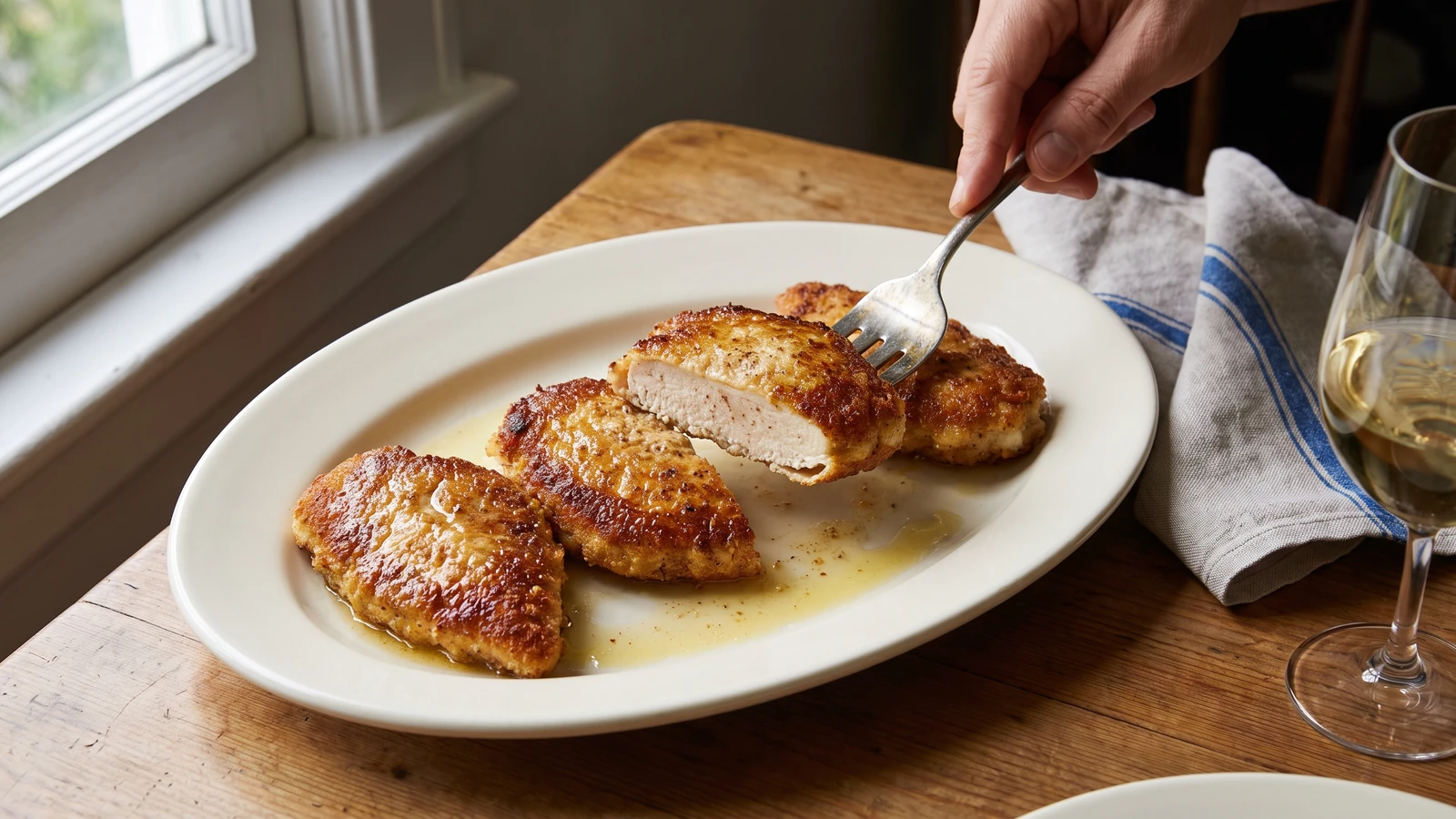
Chicken breast taken apart and rebuilt with milk-softened crumb, cold butter, and cream, then browned in clarified butter. The lesson is simple and exact: keep the mixture cold, and add the cream slowly.
Suprêmes de Volaille à la Pojarski (chicken breasts rebuilt as butter-rich cutlets) teaches the architecture of a good forcemeat: meat gives structure, milk-softened crumb gives tenderness, and butter and cream give the interior its extraordinary delicacy. The one true thing to know before touching a pan is temperature. Keep everything cold, because softened butter makes the mixture greasy and warm chicken can't hold the cream.
The brigade formula assumed a cold larder, mincing equipment, clarified butter ready beside the stove, and several hands to shape and cook every portion at once. It calls for no saucier, standing stock, or salamander. At home, short food-processor pulses replace repeated mincing, the refrigerator replaces the cold station, and a wide skillet holds four portions. Those conveniences are scaffolding. The proportions and sequence are the dish itself: for every four parts chicken, one part squeezed bread crumb, one part fresh butter, and one part fresh cream, added in that order. One cook, one stove, one evening.
Cooked properly, each suprême wears a thin Maillard-bronze shell while the interior stays pale, succulent, and almost custard-soft. Add the cream one spoonful at a time, waiting until each addition disappears before offering the next. If the mixture slackens, stop and chill it. Ça se rattrape. That slow incorporation is the step that decides everything.
Pojarski cutlets have their first home in Torzhok, on the road between Moscow and Saint Petersburg, where an innkeeping family became associated with unusually tender minced poultry cutlets enriched with bread and butter. The preparation traveled into the French classical kitchen, where the spelling became Pojarski and the method was applied to suprêmes, the breast fillets of poultry, which were minced and reconstructed in their original shape. Despite its French title and place in the canon, this is not a regional French dish but a Franco-Russian translation preserved through kitchen practice.
Quantity
4 fillets, 1 lb 1 oz (480 g) total
trimmed and cut into 1-inch (2.5 cm) pieces
Quantity
3 cups loosely packed (about 90 g), enough to yield 1/2 cup packed (120 g) after soaking and squeezing
Quantity
1 cup (240 ml / 245 g)
for soaking; excess discarded
Quantity
1/2 cup plus 1 1/2 teaspoons (126 ml / 120 g)
cut into 1/2-inch (1.25 cm) cubes
Quantity
1/2 cup (120 ml / 120 g)
Quantity
1 1/2 teaspoons (7.5 ml / 9 g), plus more if needed after testing
Quantity
1/2 teaspoon (2.5 ml / 1 g)
Quantity
1/8 teaspoon (0.6 ml / 0.25 g)
Quantity
1/2 cup (120 ml / 60 g)
for dredging
Quantity
1/3 cup (80 ml / 73 g)
for cooking
| Ingredient | Quantity |
|---|---|
| skinless, boneless chicken breast fillets (suprêmes)trimmed and cut into 1-inch (2.5 cm) pieces | 4 fillets, 1 lb 1 oz (480 g) total |
| fresh white breadcrumbs from crustless day-old bread | 3 cups loosely packed (about 90 g), enough to yield 1/2 cup packed (120 g) after soaking and squeezing |
| whole milkfor soaking; excess discarded | 1 cup (240 ml / 245 g) |
| cold unsalted buttercut into 1/2-inch (1.25 cm) cubes | 1/2 cup plus 1 1/2 teaspoons (126 ml / 120 g) |
| cold heavy cream | 1/2 cup (120 ml / 120 g) |
| fine sea salt | 1 1/2 teaspoons (7.5 ml / 9 g), plus more if needed after testing |
| finely ground white pepper | 1/2 teaspoon (2.5 ml / 1 g) |
| freshly grated nutmeg | 1/8 teaspoon (0.6 ml / 0.25 g) |
| all-purpose flourfor dredging | 1/2 cup (120 ml / 60 g) |
| clarified butterfor cooking | 1/3 cup (80 ml / 73 g) |
Cover the fresh breadcrumbs with the milk and leave them only until thoroughly saturated, about 1 minute. Gather the crumb in your hands and squeeze firmly until no milk drips from it, but don't wring it dry enough to crumble. Weigh out exactly 1/2 cup packed (120 g). This panade, the milk-softened bread binder, must equal one-quarter of the trimmed chicken's weight; prepare a little more crumb if you come up short, or remove the excess if you have too much. Chill the panade while you prepare the chicken.
Chill the processor bowl and blade, then refrigerate the chicken pieces and cubed butter until both feel very firm. Pulse the chicken in short bursts until finely minced but not puréed. Add the cold panade and pulse just until evenly distributed, then add the butter and pulse again until the mixture becomes cohesive and no large butter cubes remain. Scrape down the bowl as needed. If the bowl or mixture begins to feel warm, stop and chill it for 10 minutes before continuing; friction is useful for mincing and ruinous for this emulsion.
Transfer the mince to a chilled bowl. Add the cold cream 1 tablespoon (15 ml / 15 g) at a time, beating firmly with a sturdy spoon until each addition disappears before adding the next. Mix in the salt, white pepper, and nutmeg. The finished mixture should look moist and satiny but still hold a mound. If cream begins pooling or the mixture turns glossy, loose, or greasy, stop immediately. Set the bowl over ice or refrigerate it for 10 to 15 minutes, then beat gently until it tightens before continuing with the remaining cream. Ça se rattrape. Don't add extra flour or crumbs, which would change the ratio and make the suprêmes heavy.
Divide the mixture into 4 equal portions, about 7 1/2 oz (210 g) each. With cold, lightly moistened hands and a flexible scraper, form each portion into the shape of a chicken suprême: a plump oval about 5 inches (13 cm) long, gently tapered at one end and no more than 3/4 inch (2 cm) thick. Set them on parchment and chill for 20 minutes. This short rest is the home equivalent of a cold working station; it firms the butter so the shapes survive the pan.
Spread the flour in a shallow dish. Heat the clarified butter in a wide, heavy skillet over medium heat until it shimmers without smoking. Dredge each chilled suprême lightly on both sides, brush away every loose patch of flour, and place all four in the pan without letting them touch. Cook undisturbed for 5 to 6 minutes, until the undersides form an even butter-gold crust with bronze edges. Turn carefully with two broad spatulas, lower the heat slightly, and cook the second side for 5 to 7 minutes, spooning the clarified butter over the shoulders of the cutlets. The centres must reach 165°F (74°C), since this is minced poultry.
Lift the suprêmes onto a warm platter and let them settle for only 2 minutes. Their crust is most delicate and their butter-rich interior most succulent straight from the pan, which is why the formula insists they be served as soon as ready. The garnish is deliberately optional, and no sauce is required. Bring them to the table while the clarified butter still gleams on the bronze surface. À table!
1 serving (about 200g)
Culinary guides, cultural storytelling, and the editorial depth that makes cooking meaningful.
Discover Culinary ExplorerChef Juliette
John Dory has the delicacy of sole and the firmness of turbot. A light flouring, a quick butter sauté, and nut-brown beurre noisette show exactly why looks never mattered.

Chef Juliette
Fresh haddock proves its delicacy in the meunière pan: a fine flour crust, moist pearly flakes, and beurre noisette sharpened with lemon and parsley, ready from one skillet in half an hour.

Chef Juliette
Éperlans à l’Anglaise turns small fish into a lesson in disciplined coating: boned smelts under a close, crisp crumb, pan-fried in clarified butter and finished with bright, half-melted maître d’hôtel butter.

Chef Juliette
Tiny smelts, shallot, mushrooms, white wine, gratin sauce, and fine bread raspings meet a fierce oven, where the fish must turn tender in the same breath the buttered crust bronzes.