
Chef Juliette
Filets
Filets de volaille sautés teach the discipline of even cutting and last-minute cooking: flour lightly, gild quickly in clarified butter, and serve before a tender chicken breast has time to harden.
A cooking platform built around craft, culture, and the stories behind what we eat.
Created by Chef Juliette
Based on No. 1610, Suprêmes de Volaille à l’Orientale, from Le Guide Culinaire (1907) by Auguste Escoffier
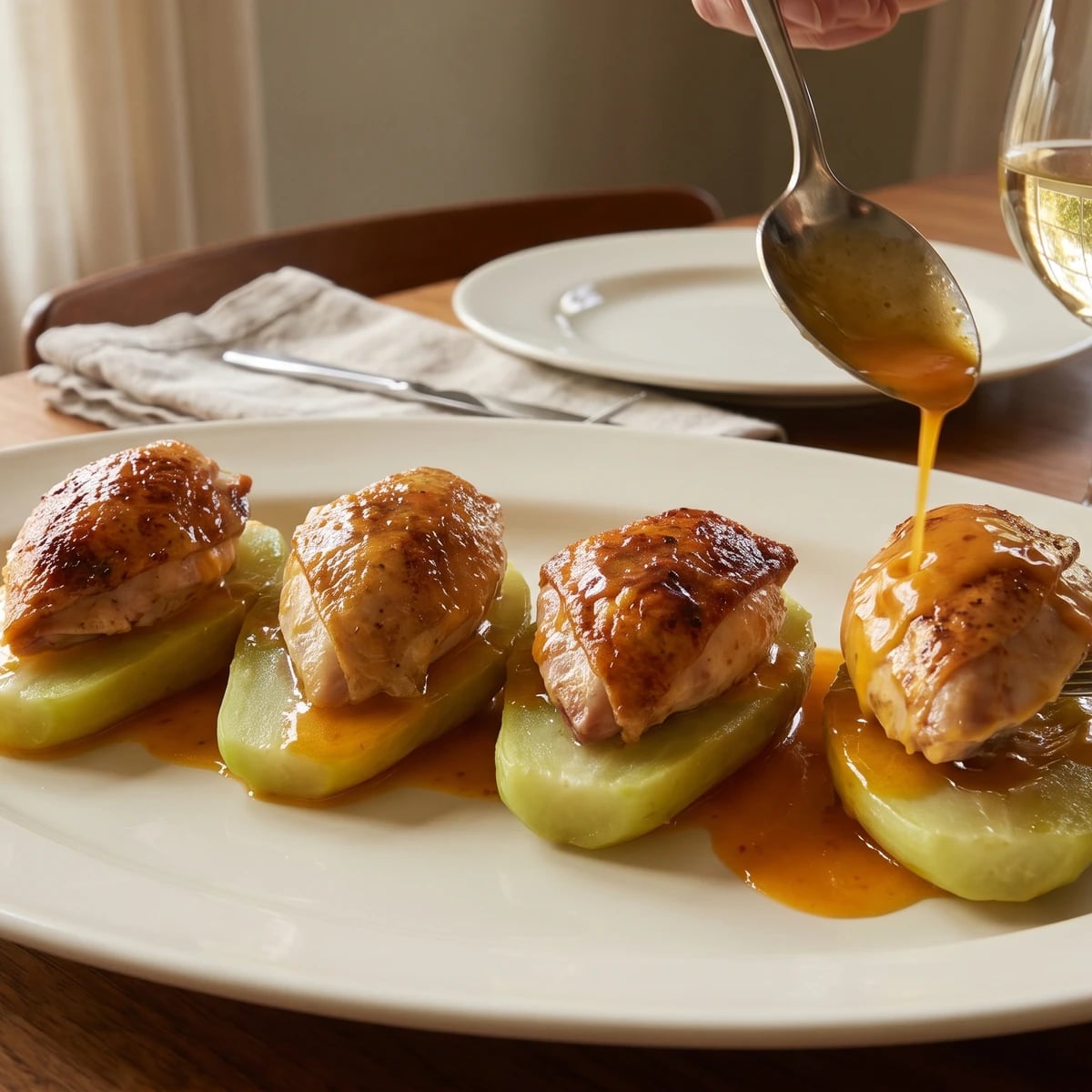
Butter-sautéed suprêmes rest on tender chayote, under a coral-gold sauce suprême held in exact balance: one part tomato purée to four parts sauce, with saffron kept to a measured breath.
Suprêmes de Volaille à l’Orientale (butter-sautéed chicken breasts on chayote with saffron-tomato cream sauce) is a lesson in proportion. Delicate chicken and mild chow-chow can carry tomato and saffron only when neither is allowed to shout. The one true thing to know before touching a pan is this: make the Sauce Suprême as a pale, silky chicken-stock sauce first, then add tomato purée at exactly one quarter its volume and saffron by the measured pinch.
The classical entry assumed a saucier with finished sauce at hand, chicken stock never off the fire, and a commis trimming the suprêmes and chow-chow into matching shapes. Your home equivalent is a small blond roux, good stock, cream, and a cold-butter finish made while the vegetable cooks. A salamander has no work here, so the broiler stays cold. The separate sauce station is brigade scaffolding and goes; the butter sauté, the parboiled then butter-stewed chow-chow, and the quarter-volume tomato ratio are the dish and stay. One cook, one stove, one evening.
The finished plate should be quiet and generous: tender green chayote beneath juicy golden chicken, all coated in a coral-gold sauce that tastes first of poultry and cream, then tomato, with saffron lingering behind. The final warming decides it. Once tomato meets cream and butter, keep the sauce below a simmer; if its sheen turns oily, ça se rattrape, and the method gives you the way back.
Suprêmes de Volaille à l’Orientale belongs to the Parisian grand-kitchen table, where à l’Orientale was a classical garnish name rather than a claim that the dish came from one specific eastern cuisine. Here the name is carried by chow-chow, the tropical gourd now commonly sold as chayote, together with tomato and restrained saffron. Its passage to the home table is chiefly a change of scale: four breast fillets and one small saucepan replace the service tray and the saucier’s batch, while the prescribed sequence and proportions remain intact.
Quantity
4 small, about 1⅓ pounds (600 g total)
Quantity
2 medium, about 1⅓ pounds (600 g total)
peeled and cut lengthwise into four thick oval slabs
Quantity
1 tablespoon plus 1 teaspoon (20 ml / 24 g)
divided
Quantity
¼ teaspoon (1.25 ml / 0.6 g)
Quantity
1⅔ cups (400 ml / 400 g)
divided
Quantity
6½ tablespoons (97 ml / 92 g)
divided
Quantity
1½ tablespoons (22 ml / 12 g)
Quantity
⅓ cup (80 ml / 80 g)
Quantity
¼ cup (60 ml / 60 g)
Quantity
1/16 teaspoon (0.3 ml / 0.05 g)
| Ingredient | Quantity |
|---|---|
| boneless, skinless chicken suprêmes | 4 small, about 1⅓ pounds (600 g total) |
| chow-chow or chayotespeeled and cut lengthwise into four thick oval slabs | 2 medium, about 1⅓ pounds (600 g total) |
| fine sea saltdivided | 1 tablespoon plus 1 teaspoon (20 ml / 24 g) |
| freshly ground white pepper | ¼ teaspoon (1.25 ml / 0.6 g) |
| unsalted chicken stockdivided | 1⅔ cups (400 ml / 400 g) |
| unsalted butterdivided | 6½ tablespoons (97 ml / 92 g) |
| all-purpose flour | 1½ tablespoons (22 ml / 12 g) |
| heavy cream | ⅓ cup (80 ml / 80 g) |
| thick, smooth tomato purée | ¼ cup (60 ml / 60 g) |
| saffron threads | 1/16 teaspoon (0.3 ml / 0.05 g) |
Cut four lengthwise chayote slabs about ¾ inch (2 cm) thick. Remove the soft seed and trim each slab into roughly the same oval outline as a chicken suprême, saving the trimmings for soup. Warm 1 tablespoon (15 ml) of the stock, crush the saffron lightly between your fingers, and leave it to bloom in the stock for at least 10 minutes. Pat the chicken very dry and gently press any unusually thick ends to an even depth so all four pieces sauté at the same rate.
Bring about 1 inch (2.5 cm) of water to a boil in a wide sauté pan and add 1 tablespoon (18 g) of the salt. Lower in the chayote slabs and parboil for 5 to 7 minutes, until a knife enters the surface but meets firm resistance at the center. Drain and dry them, then empty the pan. Melt 2 tablespoons (30 ml / 28 g) of the butter in it, return the chayote, and add ⅓ cup (80 ml) of stock with a small pinch of the remaining salt. Cover and stew gently for 8 to 10 minutes. Uncover and let the liquid reduce until the slabs are tender, intact, and glossed with butter. Transfer them to a covered warm plate and wipe out the pan.
Melt 1½ tablespoons (22 ml / 21 g) of butter in a small heavy saucepan over medium-low heat. Stir in the flour and cook this blond roux for 2 minutes without letting it color; it should smell faintly of warm biscuits, never raw flour. Whisk in ¾ cup (180 ml) of stock a little at a time, smoothing each addition before adding the next. Hold it at a bare simmer for 5 minutes, then add the cream and cook gently until the Sauce Suprême nappes, or coats, the back of a spoon in an even ivory layer. Season lightly with salt and white pepper, remembering that the chicken fond and tomato are still to come. Keep it warm over the lowest heat.
Season the dry chicken with the remaining salt and white pepper. Melt 2 tablespoons (30 ml / 28 g) of butter in the wiped sauté pan over medium heat. When the foam subsides, lay in the suprêmes with their smooth presentation sides down. Sauté without disturbing them for 4 to 5 minutes, until evenly golden, then turn and cook for another 4 to 6 minutes, spooning the butter over them, until the thickest part reaches 165°F (74°C). Move them to a warm plate and rest for 5 minutes. Add 3 tablespoons (45 ml) of stock to the pan, scrape up the golden fond, and reduce it to about 1 tablespoon (15 ml).
Whisk the reduced chicken fond and the saffron infusion into the Sauce Suprême. Let it simmer very gently until smooth, then measure or judge the volume before the final butter: it should be a scant cup, about 225 ml. If there is more, reduce it gently; if there is less, add reserved stock a teaspoon at a time. Remove the pan from the heat and whisk in the remaining 1 tablespoon (15 ml / 14 g) butter, giving approximately 1 cup (240 ml) of finished Sauce Suprême. Whisk in the ¼ cup (60 ml) tomato purée, exactly one quarter of the sauce by volume. Return it to the lowest heat only long enough to become glossy and hot. Do not boil. If the sauce turns oily at the edge, remove it from the heat and whisk in 1 teaspoon (5 ml) cold water, beginning at the clear edge and working inward. Ça se rattrape.
If the chayote has cooled, return it to the empty sauté pan with a teaspoon of reserved stock and warm it briefly. Arrange one thick slab on each warmed plate and settle a suprême directly on top, matching their long edges. Spoon the saffron-tomato Sauce Suprême generously over each breast so it coats the chicken and pools lightly around the chayote. Serve at once. À table!
1 serving (about 375g)
Culinary guides, cultural storytelling, and the editorial depth that makes cooking meaningful.
Discover Culinary Explorer
Chef Juliette
Filets de volaille sautés teach the discipline of even cutting and last-minute cooking: flour lightly, gild quickly in clarified butter, and serve before a tender chicken breast has time to harden.

Chef Juliette
Suprêmes de volaille sautés teach the Paris rule of tender breast meat: flour lightly, gild quickly in clarified butter, add no liquid, and carry the plates straight from skillet to table.

Chef Juliette
Small chicken suprêmes, wing bone attached, take a veil of flour and a swift bath in clarified butter, turning golden at the exact moment their flesh becomes tender.

Chef Juliette
Ailerons de poulet teach the discipline of fast sautéing: small skinless breasts, wing bone attached, floured lightly and gilded in clarified butter, then carried straight from pan to warm platter before tenderness has time to leave.