
Chef Juliette
John Dory (St. Pierre)
John Dory has the delicacy of sole and the firmness of turbot. A light flouring, a quick butter sauté, and nut-brown beurre noisette show exactly why looks never mattered.
A cooking platform built around craft, culture, and the stories behind what we eat.
Created by Chef Juliette
Based on No. 1608, Suprêmes de Volaille Montpensier, from Le Guide Culinaire (1907) by Auguste Escoffier
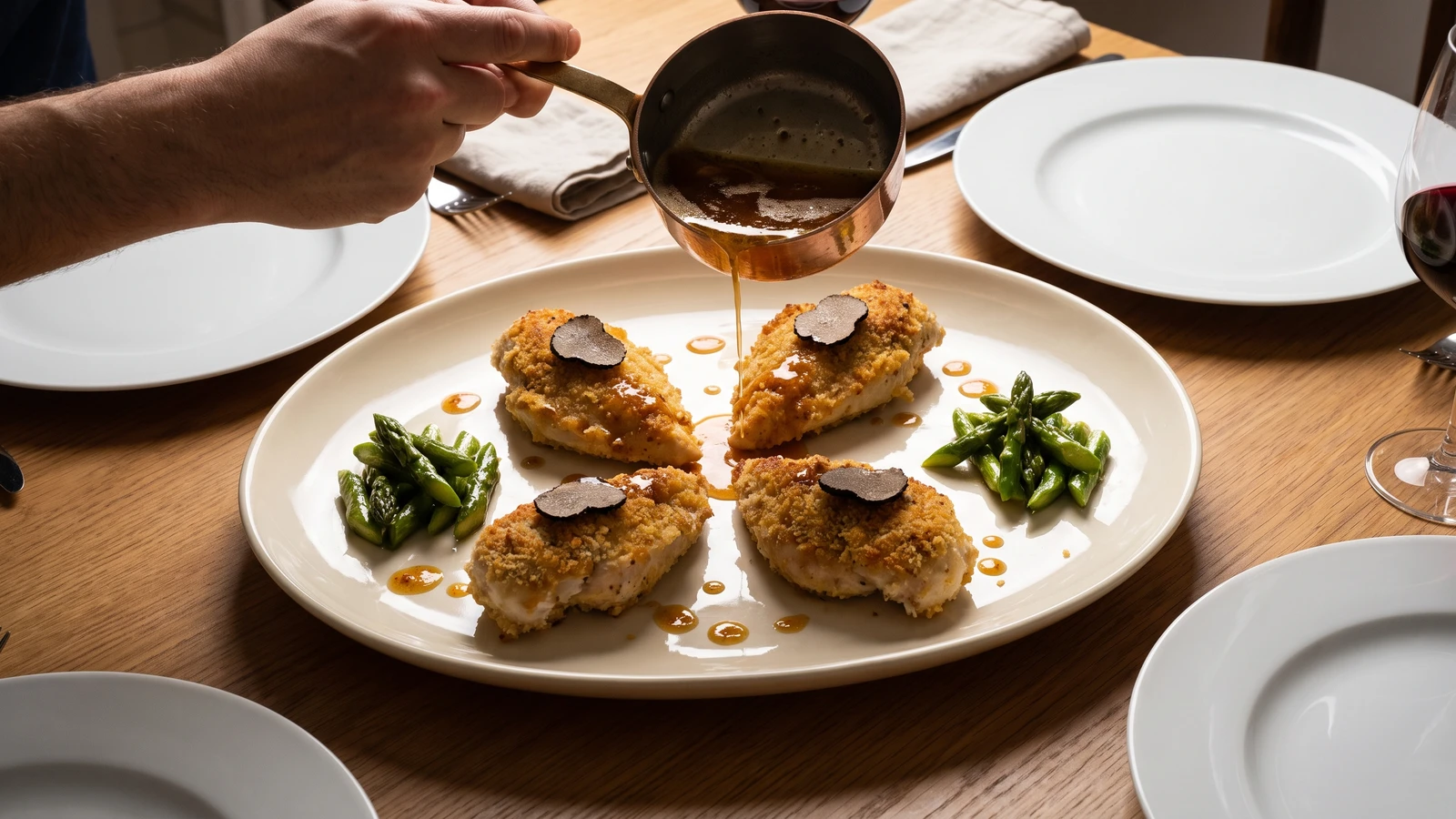
A butter-gold crumb around tender chicken, black truffle on each suprême, asparagus points gathered alongside, and beurre noisette spooned over at the last moment. Formal in composition, entirely manageable at home.
Suprêmes de Volaille Montpensier (chicken breast fillets with a crisp crumb, truffle, asparagus points, and hazelnut-brown butter) teaches coordination. The one true thing is this: the crumb and the chicken must finish cooking together. Even the breast to one thickness, settle the coating firmly, and govern the clarified butter so the outside reaches deep gold just as the centre becomes juicy and safe.
The old formula is brief because it assumes clarified butter ready, asparagus points sorted, truffle sliced, and several hands able to sauté, garnish, and send the platter at once. It calls for no saucier, no stock never off the fire, and no salamander, so we won't invent them. For one cook, one stove, one evening, the brigade's separate hands become an ordered mise en place, one heavy skillet, and a warmed platter. The crown is scaled to four suprêmes, but its egg-and-crumb coating, clarified-butter sauté, truffle, butter-bound asparagus, and final beurre noisette remain untouched. The extra hands were scaffolding. Those elements are the dish.
Before you touch the pan, make every suprême an even 3/4 inch thick and give the breading ten quiet minutes to adhere. That pause is what keeps the crumb on the chicken rather than floating in the butter.
Suprêmes de Volaille Montpensier belongs to the Parisian grand-kitchen repertoire, where titled names often identified a fixed composition rather than a regional household dish. Montpensier is a French princely title associated with the Orléans household, not evidence that this is an Auvergnat farmhouse preparation; its culinary identity lies in the repeated truffle slices, separate groups of asparagus points, and final beurre noisette. Unlike many named suprêmes, it requires no compound sauce, so precision in the sauté and last-minute service carries the grandeur.
Quantity
4, about 24 ounces (680 g) total
trimmed as suprêmes
Quantity
1 teaspoon (5 ml / 6 g), plus more for the blanching water
divided
Quantity
1/2 teaspoon (2.5 ml / 1 g)
Quantity
2
beaten
Quantity
1 1/4 cups (300 ml / 125 g)
Quantity
1/3 cup (80 ml / 75 g)
Quantity
24, about 1 1/2 cups (355 ml / 150 g)
cut 2 inches (5 cm) long
Quantity
5 tablespoons (75 ml / 71 g)
divided, 2 tablespoons for the asparagus and 3 tablespoons for the beurre noisette
Quantity
4 thin slices, about 1/4 ounce (8 g)
fresh or cut from a preserved whole truffle
| Ingredient | Quantity |
|---|---|
| boneless, skinless chicken breast filletstrimmed as suprêmes | 4, about 24 ounces (680 g) total |
| fine sea saltdivided | 1 teaspoon (5 ml / 6 g), plus more for the blanching water |
| freshly ground white or black pepper | 1/2 teaspoon (2.5 ml / 1 g) |
| large eggsbeaten | 2 |
| fine dry bread crumbs | 1 1/4 cups (300 ml / 125 g) |
| clarified butter | 1/3 cup (80 ml / 75 g) |
| slim asparagus tipscut 2 inches (5 cm) long | 24, about 1 1/2 cups (355 ml / 150 g) |
| unsalted butterdivided, 2 tablespoons for the asparagus and 3 tablespoons for the beurre noisette | 5 tablespoons (75 ml / 71 g) |
| black trufflefresh or cut from a preserved whole truffle | 4 thin slices, about 1/4 ounce (8 g) |
Set each suprême between two sheets of parchment and gently flatten only the thickest part until the breast is an even 3/4 inch (2 cm) throughout. Pat the chicken dry, then season both sides with 3/4 teaspoon of the salt and all the pepper. Set a wire rack over a tray. If the breasts will not fit your skillet without touching, heat the oven to 325°F (165°C); it will serve only as a finishing safety net.
Bring a saucepan of well-salted water to a boil. Add the asparagus tips and cook for 2 to 3 minutes, until vivid green and tender at the cut end but still resilient. Transfer them to cold water, then drain and dry them thoroughly. The cold water preserves their colour while you cook the chicken; drying matters because water would dilute the butter used to bind them at the finish.
Put the beaten eggs and bread crumbs in separate shallow dishes. Dip each suprême directly into the egg, let the excess fall away, then lay it in the crumbs and press gently on both sides. The source calls for egg and bread crumbs, with no flour underneath, so keep that clean sequence. Place the breaded suprêmes on the rack and leave them for 10 minutes. If a bare patch appears, dab it with egg and press on fresh crumbs now. Ça se rattrape before the pan.
Heat the clarified butter in a large heavy skillet over medium heat until it shimmers but does not smoke. Add the suprêmes without crowding and sauté, cooking briskly in a shallow layer of fat, for 4 to 5 minutes on the first side. Turn once and cook for another 3 to 5 minutes, until the crumb is evenly golden and the thickest part reaches 165°F (74°C). Work in two batches if necessary, holding the first on the rack without covering it. If the crumb colours before the centre is ready, lower the heat and transfer the chicken to the rack in the oven until it reaches temperature. Ça se rattrape, and the crust stays crisp.
Melt 2 tablespoons (30 ml / 28 g) of the unsalted butter in the emptied asparagus pan over medium-low heat. Add the dry asparagus tips and the remaining 1/4 teaspoon salt, then turn them gently for 1 to 2 minutes until heated through and coated in a close, glossy film of butter. Keep them intact. These are distinct little heaps around the crown, not vegetables stirred into a sauce.
Put the remaining 3 tablespoons (45 ml / 43 g) butter in a small pale-coloured saucepan over medium heat. Let it foam, then swirl as the foam thins and the milk solids turn hazelnut brown. Pull it from the heat the instant it smells toasted and sweet. A black, bitter beurre noisette cannot be rescued, so if it crosses that line, begin again with fresh butter. Three minutes of butter is cheaper than serving bitterness.
Arrange the four suprêmes in a loose crown on a warm oval platter, thick ends facing outward and narrow ends slightly overlapping. Place one truffle slice upon each breast, then arrange the asparagus tips in four small heaps around the crown. Spoon only a few drops of the beurre noisette over every suprême at the last moment, enough to perfume and gloss the crumb without soaking it. Carry the platter straight to the table. À table!
1 serving (about 250g)
Culinary guides, cultural storytelling, and the editorial depth that makes cooking meaningful.
Discover Culinary ExplorerChef Juliette
John Dory has the delicacy of sole and the firmness of turbot. A light flouring, a quick butter sauté, and nut-brown beurre noisette show exactly why looks never mattered.

Chef Juliette
Fresh haddock proves its delicacy in the meunière pan: a fine flour crust, moist pearly flakes, and beurre noisette sharpened with lemon and parsley, ready from one skillet in half an hour.

Chef Juliette
Éperlans à l’Anglaise turns small fish into a lesson in disciplined coating: boned smelts under a close, crisp crumb, pan-fried in clarified butter and finished with bright, half-melted maître d’hôtel butter.

Chef Juliette
Tiny smelts, shallot, mushrooms, white wine, gratin sauce, and fine bread raspings meet a fierce oven, where the fish must turn tender in the same breath the buttered crust bronzes.