
Chef Juliette
John Dory (St. Pierre)
John Dory has the delicacy of sole and the firmness of turbot. A light flouring, a quick butter sauté, and nut-brown beurre noisette show exactly why looks never mattered.
A cooking platform built around craft, culture, and the stories behind what we eat.
Created by Chef Juliette
Based on No. 1607, Suprêmes de Volaille Maryland, from Le Guide Culinaire (1907) by Auguste Escoffier
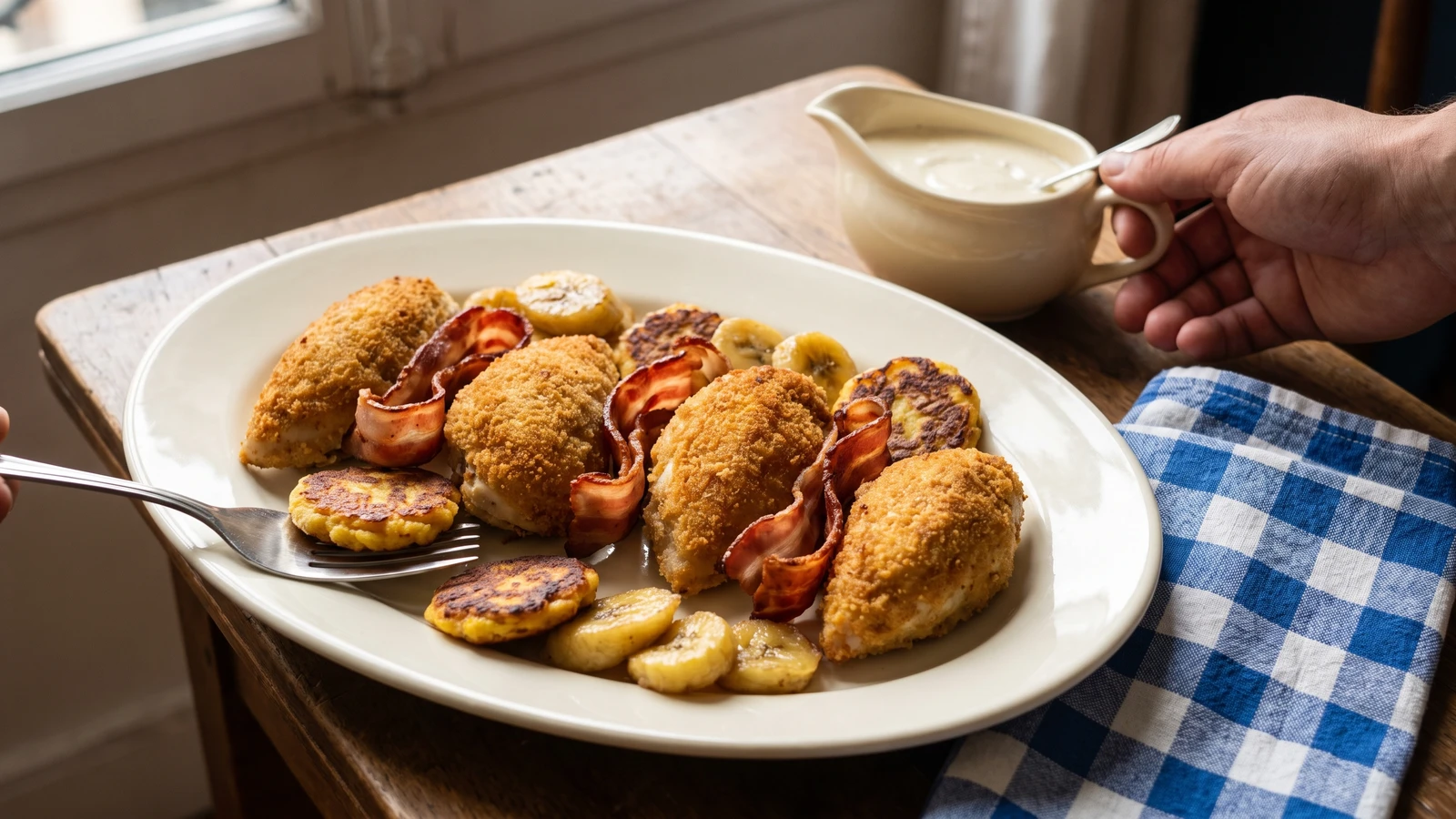
Butter-dipped, crumbed chicken suprêmes bronzed in clarified butter, then set with crisp bacon, maize galettes, fried banana, and horseradish cream: a generous French reading of Maryland for one home stove.
Suprêmes de Volaille Maryland (Maryland-style chicken breasts) teaches control rather than complication. Here sauté means cooking briskly in butter, yet the heat must remain measured: strong enough to bronze the crumbs, gentle enough to cook the breast before that crust burns. The pan temperature is the dish.
The classical kitchen assumed a saucier on staff, stock never off the fire, a salamander overhead, and separate hands tending chicken, galettes, banana, bacon, and sauce. This entry actually needs no stock, so none is invented. At home, one small saucepan handles the horseradish cream, the broiler replaces the salamander, and one skillet works through the fried garnishes before cooking the chicken last. Brigade quantities become four generous portions. One cook, one stove, one evening.
The staff was scaffolding and can go. The butter dip, fine breadcrumbs, clarified-butter sauté, grilled bacon, maize galettes, fried banana, and sauce served apart are the dish, and every one stays. Before you touch the pan, make each suprême an even thickness; that single preparation lets the crust and chicken finish together.
In the French classical repertoire, Maryland is an American-inspired garnish codified by Parisian grand kitchens: crumbed chicken cooked in butter with grilled bacon, maize cakes, fried banana, and horseradish cream. It is neither a regional French recipe nor a precise transcript of one Maryland household dish, but the canon's reading of the generous American hotel table. The suprême version exchanges jointed chicken for breast portions while preserving the Maryland garnish and its contrasts of crisp, sweet, salty, hot, and creamy.
Quantity
1 four-serving application (No. 1565)
Quantity
4, about 6 ounces each (680 g total)
trimmed and made an even ¾ inch (2 cm) thick
Quantity
2½ teaspoons (12.5 ml / 15 g)
divided
Quantity
½ teaspoon (2.5 ml / 1 g)
divided
Quantity
¼ cup (60 ml / 57 g)
melted and cooled until warm
Quantity
1½ cups (360 ml / 120 g)
Quantity
¾ cup (180 ml / 165 g)
divided; made from about 1 cup (240 ml / 227 g) unsalted butter
Quantity
4 long slices, about 4 ounces (115 g)
Quantity
¾ cup (180 ml / 105 g)
Quantity
¼ cup (60 ml / 30 g)
Quantity
1 teaspoon (5 ml / 4 g)
Quantity
⅔ cup plus up to 2 tablespoons (160 to 190 ml / 165 to 195 g)
Quantity
1
Quantity
1 tablespoon (15 ml / 14 g)
melted
Quantity
2, about 8 ounces (225 g) peeled
sliced diagonally
Quantity
2 tablespoons (30 ml / 28 g)
Quantity
2 tablespoons (30 ml / 16 g)
Quantity
1 cup (240 ml / 245 g)
Quantity
½ cup (120 ml / 120 g)
Quantity
3 tablespoons (45 ml / 40 g)
| Ingredient | Quantity |
|---|---|
| Poulet Sauté Maryland, governing preparation | 1 four-serving application (No. 1565) |
| skinless, boneless chicken suprêmestrimmed and made an even ¾ inch (2 cm) thick | 4, about 6 ounces each (680 g total) |
| fine sea saltdivided | 2½ teaspoons (12.5 ml / 15 g) |
| ground white pepperdivided | ½ teaspoon (2.5 ml / 1 g) |
| unsalted butter for coating the chickenmelted and cooled until warm | ¼ cup (60 ml / 57 g) |
| fine fresh white breadcrumbs | 1½ cups (360 ml / 120 g) |
| clarified butterdivided; made from about 1 cup (240 ml / 227 g) unsalted butter | ¾ cup (180 ml / 165 g) |
| thick-cut streaky bacon | 4 long slices, about 4 ounces (115 g) |
| fine yellow cornmeal or maize meal | ¾ cup (180 ml / 105 g) |
| all-purpose flour for the galettes | ¼ cup (60 ml / 30 g) |
| baking powder | 1 teaspoon (5 ml / 4 g) |
| whole milk for the galettes | ⅔ cup plus up to 2 tablespoons (160 to 190 ml / 165 to 195 g) |
| large egg | 1 |
| unsalted butter for the galettesmelted | 1 tablespoon (15 ml / 14 g) |
| firm-ripe bananassliced diagonally | 2, about 8 ounces (225 g) peeled |
| unsalted butter for the sauce | 2 tablespoons (30 ml / 28 g) |
| all-purpose flour for the sauce | 2 tablespoons (30 ml / 16 g) |
| whole milk for the sauce | 1 cup (240 ml / 245 g) |
| heavy cream | ½ cup (120 ml / 120 g) |
| well-drained prepared horseradish | 3 tablespoons (45 ml / 40 g) |
Use Poulet Sauté Maryland (No. 1565) as the governing preparation: seasoning, warm butter, fine crumbs, clarified-butter cooking, grilled bacon, maize galettes, fried banana, and horseradish cream passed separately. Place each suprême between two sheets of parchment and tap only the thick end until the breast is an even ¾ inch (2 cm) thick. Pat dry, season with 1½ teaspoons of the salt and half the white pepper, then keep cold while you prepare the accompaniments.
Melt the 2 tablespoons butter in a small saucepan over medium-low heat. Stir in the 2 tablespoons flour and cook for 2 minutes without letting the roux colour. Whisk in the 1 cup milk a little at a time, then add the cream and bring the sauce to the gentlest simmer. Cook for 5 to 7 minutes, whisking often, until it reaches nappe, a coating consistency that leaves a clean track when you draw a finger across the back of a spoon. Remove from the heat, whisk in the horseradish, ½ teaspoon salt, and the remaining white pepper. If it lumps, take it off the heat and whisk in a spoonful of cold milk; strain it if necessary. Ça se rattrape. Cover the surface directly and hold warm without boiling.
Whisk together the cornmeal, ¼ cup flour, baking powder, and ½ teaspoon salt. Beat the egg with ⅔ cup milk and the tablespoon of melted butter, then stir the liquid into the dry ingredients. Rest the batter for 10 minutes so the cornmeal hydrates. It should fall reluctantly from a spoon; if it stands like paste, loosen it with the reserved milk, one tablespoon at a time.
Set an oven rack about 6 inches (15 cm) below the broiler. Lay the bacon on a wire rack over a rimmed tray and broil until browned and crisp at the edges, about 3 to 5 minutes per side. This is the home salamander, direct overhead heat without another pan to tend. Drain the bacon on the rack so it stays crisp, then reduce the oven to 225°F (110°C) for holding the galettes.
Heat 3 tablespoons of the clarified butter in a heavy skillet over medium heat. Drop in 8 rounded tablespoons of batter, working in two batches if the pan crowds, and flatten them gently into small rounds. Cook for about 2 minutes per side, until the rims are crisp and both faces are deep maize-gold. If a galette breaks, make the remaining ones smaller and wait until the first face is fully set before turning. Transfer them to the wire rack and hold in the low oven.
Wipe loose crumbs from the skillet and add 2 tablespoons clarified butter. When it glistens, lay in the banana slices without overlapping them. Cook for 45 to 60 seconds per side, just until butter-gold at the edges while still holding their shape. Lift them onto a warm plate. A soft, heavily spotted banana will collapse here, so use fruit that is ripe but still firm.
Pour the warm melted butter into a shallow dish and spread the breadcrumbs in another. Dip each suprême in butter, coating every surface, then press it firmly into the crumbs. Let the coating settle for 5 minutes. Heat the remaining clarified butter over medium heat until a test crumb sizzles steadily and turns golden in about 30 seconds. Cook the chicken in two uncrowded batches for 4 to 5 minutes on the first side and 3 to 5 minutes on the second, adjusting the heat so the crumbs bronze gradually. The centre must reach 165°F (74°C). If the coating darkens before the chicken is cooked, lift the pan from the heat, add a little fresh clarified butter, lower the flame, and finish the suprêmes on a rack in the 350°F (175°C) oven. The crust is saved and the breast cooks through. Ça se rattrape.
Rest the suprêmes on a rack for 3 minutes, never on paper, which softens the underside. Arrange them across a warm oval platter with a crisp slice of grilled bacon between each portion, then surround them with the maize galettes and fried banana. Stir the horseradish cream over low heat, loosening it with a spoonful of milk if it has tightened, and pour it into a warm saucière, a sauce boat, to pass separately. Serve at once. À table!
1 serving (about 450g)
Culinary guides, cultural storytelling, and the editorial depth that makes cooking meaningful.
Discover Culinary ExplorerChef Juliette
John Dory has the delicacy of sole and the firmness of turbot. A light flouring, a quick butter sauté, and nut-brown beurre noisette show exactly why looks never mattered.

Chef Juliette
Fresh haddock proves its delicacy in the meunière pan: a fine flour crust, moist pearly flakes, and beurre noisette sharpened with lemon and parsley, ready from one skillet in half an hour.

Chef Juliette
Éperlans à l’Anglaise turns small fish into a lesson in disciplined coating: boned smelts under a close, crisp crumb, pan-fried in clarified butter and finished with bright, half-melted maître d’hôtel butter.

Chef Juliette
Tiny smelts, shallot, mushrooms, white wine, gratin sauce, and fine bread raspings meet a fierce oven, where the fish must turn tender in the same breath the buttered crust bronzes.