
Chef Juliette
John Dory (St. Pierre)
John Dory has the delicacy of sole and the firmness of turbot. A light flouring, a quick butter sauté, and nut-brown beurre noisette show exactly why looks never mattered.
A cooking platform built around craft, culture, and the stories behind what we eat.
Created by Chef Juliette
Based on No. 1604, Suprêmes de Volaille Jardinière, from Le Guide Culinaire (1907) by Auguste Escoffier
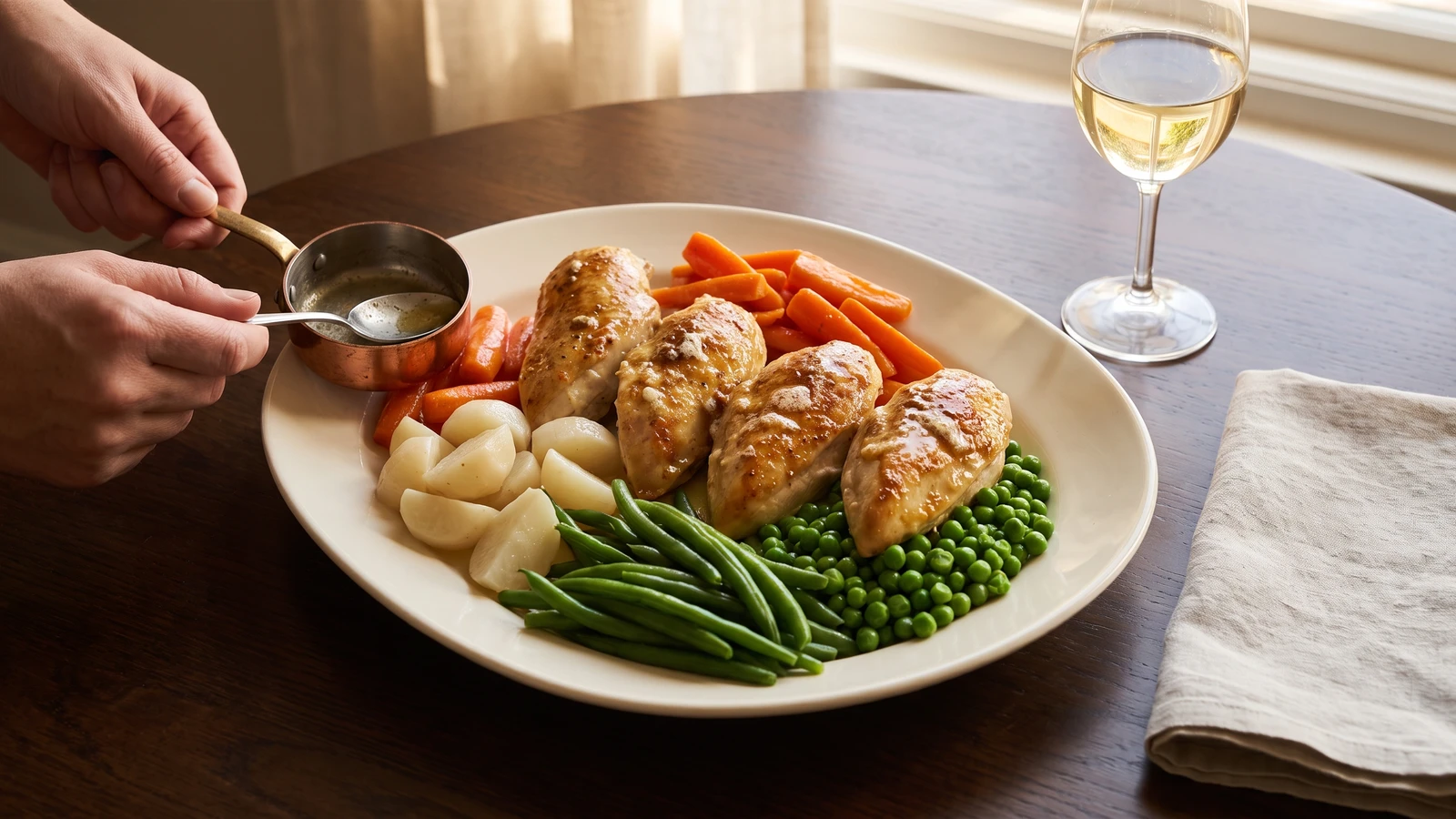
Four golden chicken suprêmes, four precise garden vegetables, and a final perfume of beurre noisette: a lesson in exact doneness, restraint, and the quiet grandeur of a well-timed supper.
Suprêmes de Volaille Jardinière teaches cuisson, exact doneness, more clearly than a heavily sauced dish ever could. Each suprême must be golden outside and juicy within; each carrot, turnip, bean, and pea must taste distinctly of itself. The neat little heaps aren't ceremony. They prove the cook hasn't sacrificed four vegetables to one clock.
The original kitchen assumed a vegetable cook tending several pans, a sauté cook waiting for service, and a hot platter ready at the pass. It calls for neither a saucier, a stockpot kept hot, nor a salamander, so the home version shouldn't invent them. One saucepan cooks the vegetables in sequence, one skillet sautés the chicken, and a warmed platter replaces the service line. The extra pans were brigade scaffolding. Separate cuisson, real butter, and those final drops of beurre noisette (nut-brown butter) are the dish itself, so they stay. One cook, one stove, one evening.
When it arrives, the chicken is burnished with butter, the vegetables sit in bright, separate heaps, and the beurre noisette gives the whole platter a warm scent of hazelnuts. Complete the vegetable work before the chicken meets the skillet. Once the suprêmes begin to sauté, nothing else should ask for your attention; that order is the one step that decides the dish.
Jardinière belongs not to one province but to the shared vocabulary of French cuisine bourgeoise and the classical Parisian dining room, where the best vegetables from the garden accompanied a roast or sauté. Carrots, turnips, French beans, and peas were cooked separately and arranged in distinct bouquets rather than tossed together, allowing each vegetable to keep its own colour, texture, and cuisson. The title names the garnish as much as the chicken, a reminder that the vegetables are not an afterthought but half the composition.
Quantity
4 fillets (about 6 ounces / 170 g each)
Quantity
¾ cup (180 ml / 105 g)
peeled and cut into 1½-inch by ¼-inch batons
Quantity
¾ cup (180 ml / 110 g)
peeled and cut into 1½-inch by ¼-inch batons
Quantity
¾ cup (180 ml / 90 g)
trimmed and cut into 1½-inch lengths
Quantity
¾ cup (180 ml / 100 g)
keep frozen peas frozen until blanching
Quantity
8 tablespoons (120 ml / 113 g)
divided, including 2 tablespoons held in reserve
Quantity
1 tablespoon plus 1 teaspoon (20 ml / 24 g)
divided
Quantity
½ teaspoon (2.5 ml / 1 g)
| Ingredient | Quantity |
|---|---|
| skinless, boneless chicken breast fillets (suprêmes) | 4 fillets (about 6 ounces / 170 g each) |
| carrotspeeled and cut into 1½-inch by ¼-inch batons | ¾ cup (180 ml / 105 g) |
| turnipspeeled and cut into 1½-inch by ¼-inch batons | ¾ cup (180 ml / 110 g) |
| slender green beanstrimmed and cut into 1½-inch lengths | ¾ cup (180 ml / 90 g) |
| shelled fresh peas or frozen peaskeep frozen peas frozen until blanching | ¾ cup (180 ml / 100 g) |
| unsalted butterdivided, including 2 tablespoons held in reserve | 8 tablespoons (120 ml / 113 g) |
| fine saltdivided | 1 tablespoon plus 1 teaspoon (20 ml / 24 g) |
| freshly ground white or black pepper | ½ teaspoon (2.5 ml / 1 g) |
Lay each suprême between two sheets of baking paper and tap only the thick end until the fillet has an even thickness of about ¾ inch. Keep its natural shape rather than flattening it into an escalope. Dry the chicken thoroughly, season with ½ teaspoon of the salt and the pepper, and leave it in the cold while you cut the vegetables into matching small batons. Even pieces are not decoration alone; they reach the same cuisson at the same moment.
Bring a medium saucepan of water to a lively boil and season it with 1 tablespoon of the salt. Cook each vegetable separately in the same water: carrots for 4 to 5 minutes, turnips for 3 to 4 minutes, beans for about 3 minutes, and peas for 45 to 60 seconds. Ignore the clock when the vegetable tells you otherwise. Each should be tender with a faint resistance under the teeth. Lift each batch into cold water to stop its cooking, drain it very well, and keep the vegetables in separate bowls. Reserve ½ cup of the cooking water.
Divide 2 tablespoons of the butter among the four vegetables. Reheat them one variety at a time in the emptied saucepan, adding a teaspoon of reserved cooking water and a small pinch of the remaining salt to each. Roll the vegetables through the butter until glossy, then transfer them to separate low heaps around the edge of a warmed oval platter. Cover loosely and keep beside the stove. If a butter glaze dries or turns greasy while it waits, add a teaspoon of the reserved water and swirl it over gentle heat. Ça se rattrape.
Heat a wide, heavy skillet over medium heat and add 3 tablespoons of the butter. Sauté here means cooking quickly in a shallow layer of hot fat, with enough room around every suprême for colour to form. When the butter foams, lay in the chicken smooth-side down. Cook without shifting it for 5 to 6 minutes, adjusting the heat so the butter stays golden rather than black, then turn and cook for another 4 to 6 minutes. Spoon the foaming butter over the breasts as they finish. The thickest point should reach 160°F / 71°C; rest the chicken for 5 minutes so carryover heat brings it to 165°F / 74°C. If the butter blackens before the chicken is done, lift out the breasts, wipe away the burnt solids, add 1 tablespoon of the reserved butter, lower the heat, and continue.
While the chicken rests, melt 1 tablespoon of the butter in a small, light-coloured saucepan over medium heat. Swirl as the foam rises and then thins. The milk solids at the bottom will turn the colour of hazelnuts and the butter will smell round and nutty; pour it immediately into a cool ramekin so it goes no darker. If those solids turn black or smell acrid, discard the butter and begin again with the remaining reserved tablespoon. Burnt butter can't be hidden, but the finish itself takes barely two minutes.
Set the rested suprêmes in the open centre of the warm platter, surrounded by the separate heaps of carrots, turnips, beans, and peas. Spoon only a few drops of beurre noisette, about ¼ teaspoon, over each breast just before serving. It should perfume the chicken and leave a fine gloss, not form a pool or become a sauce. Carry the platter straight to the table. À table!
1 serving (about 255g)
Culinary guides, cultural storytelling, and the editorial depth that makes cooking meaningful.
Discover Culinary ExplorerChef Juliette
John Dory has the delicacy of sole and the firmness of turbot. A light flouring, a quick butter sauté, and nut-brown beurre noisette show exactly why looks never mattered.

Chef Juliette
Fresh haddock proves its delicacy in the meunière pan: a fine flour crust, moist pearly flakes, and beurre noisette sharpened with lemon and parsley, ready from one skillet in half an hour.

Chef Juliette
Éperlans à l’Anglaise turns small fish into a lesson in disciplined coating: boned smelts under a close, crisp crumb, pan-fried in clarified butter and finished with bright, half-melted maître d’hôtel butter.

Chef Juliette
Tiny smelts, shallot, mushrooms, white wine, gratin sauce, and fine bread raspings meet a fierce oven, where the fish must turn tender in the same breath the buttered crust bronzes.