
Chef Juliette
John Dory (St. Pierre)
John Dory has the delicacy of sole and the firmness of turbot. A light flouring, a quick butter sauté, and nut-brown beurre noisette show exactly why looks never mattered.
A cooking platform built around craft, culture, and the stories behind what we eat.
Created by Chef Juliette
Based on No. 1599, Suprêmes de Volaille aux Fonds d’Artichauts, from Le Guide Culinaire (1907) by Auguste Escoffier
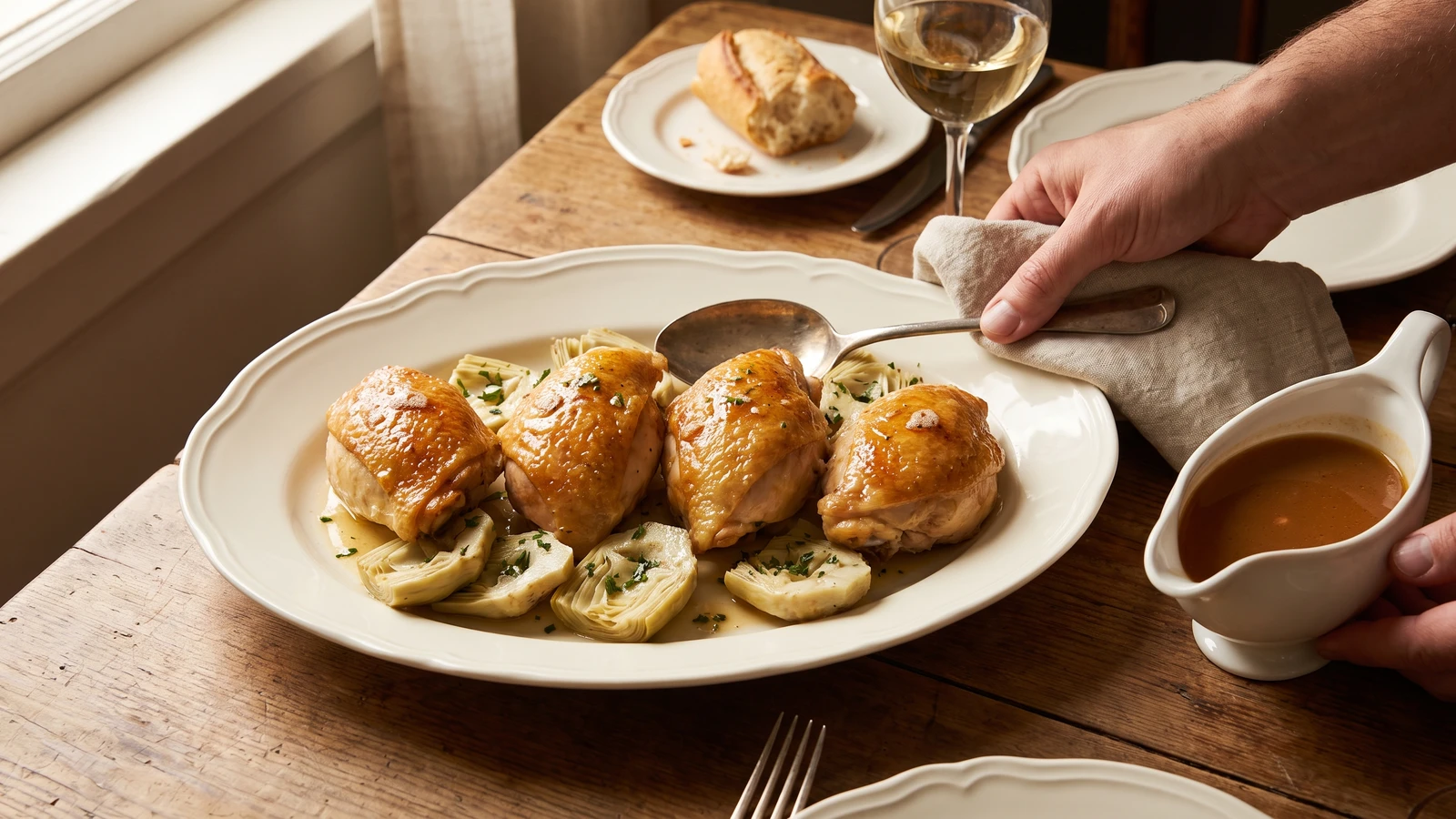
Golden chicken suprêmes, freshly turned artichoke bottoms tossed in butter and fines herbes, a few drops of beurre noisette, and glossy gravy alongside: three precise uses of butter brought to one generous home table.
Suprêmes de Volaille aux Fonds d’Artichauts (chicken breast fillets with buttered artichoke bottoms) teaches one exact thing: butter is not a single treatment. Clarified butter gives the suprêmes their clean golden sauté, fresh butter carries the artichokes, and beurre noisette (nut-brown butter) adds its hazelnut perfume in mere drops. Confuse those jobs and the dish turns greasy or bitter; keep them distinct and a short ingredient list becomes complete.
The original entry assumed a saucier on staff, stock never off the fire, hands working in parallel, and a salamander waiting for dishes that needed top heat. This dish asks nothing of the salamander. At home, the thickened gravy becomes a small jus lié (lightly thickened pan gravy) built from the chicken’s fond and good stock in the same pan, while the artichokes are prepared first and held briefly. The separate sauce station and simultaneous hands are brigade scaffolding, so they go; the three butter treatments and the separately served gravy are the dish, so they stay. One cook, one stove, one evening.
When it is right, the chicken is bronze at the edges and juicy within, the artichoke bottoms are pale and tender under green flecks of fines herbes, and the gravy pours with body but never sits like paste. The step that decides everything is the sauté: dry the suprêmes, heat the clarified butter properly, then lower the fire once the colour is established. Do that before you ask the sauce to save anything.
Suprêmes de volaille aux fonds d’artichauts belongs to the cuisine classique of Parisian dining rooms, where the prized breast fillet was cooked separately and matched with a composed vegetable garnish. Artichoke bottoms moved from market vegetable to formal garniture because their neat shape, tender flesh, and slight bitterness held butter and sauce without disappearing beneath them. Though artichokes grow famously around the Mediterranean and in Brittany, this preparation is claimed by neither Provence nor Brittany; clarified butter, fines herbes, and jus lié mark it as national classical grammar carried into the bourgeois home.
Quantity
4 (about 1½ lb / 680 g total)
Quantity
4 (about 3 lb / 1.35 kg whole)
Quantity
1
halved
Quantity
3 tablespoons (45 ml / 42 g)
Quantity
2 tablespoons (30 ml / 28 g)
Quantity
2 teaspoons (10 ml / 9 g)
softened
Quantity
2 teaspoons (10 ml / 5 g)
Quantity
1¼ cups (300 ml / 300 g)
Quantity
2 teaspoons (10 ml / 9 g)
Quantity
2 tablespoons (30 ml / 6 g)
finely chopped
Quantity
2 teaspoons (10 ml / 12 g)
divided
Quantity
½ teaspoon (2.5 ml / 1 g)
divided
| Ingredient | Quantity |
|---|---|
| skin-on, boneless chicken breast fillets (suprêmes) | 4 (about 1½ lb / 680 g total) |
| large globe artichokes | 4 (about 3 lb / 1.35 kg whole) |
| lemonhalved | 1 |
| clarified unsalted butter | 3 tablespoons (45 ml / 42 g) |
| unsalted butter for the artichokes | 2 tablespoons (30 ml / 28 g) |
| unsalted butter for the beurre maniésoftened | 2 teaspoons (10 ml / 9 g) |
| plain flour | 2 teaspoons (10 ml / 5 g) |
| unsalted chicken stock | 1¼ cups (300 ml / 300 g) |
| unsalted butter for the beurre noisette | 2 teaspoons (10 ml / 9 g) |
| fines herbes: equal parts flat-leaf parsley, chervil, tarragon, and chivesfinely chopped | 2 tablespoons (30 ml / 6 g) |
| fine sea saltdivided | 2 teaspoons (10 ml / 12 g) |
| finely ground white pepperdivided | ½ teaspoon (2.5 ml / 1 g) |
Fill a large bowl with cold water, squeeze in the lemon, and add the spent halves. Pull the leaves from each artichoke, cut the stem flush with the base, and use a sharp paring knife to tourner the artichoke, trimming away every tough green patch until only the pale bottom remains. Scoop out the fuzzy choke with a teaspoon or melon baller and place the bottom in the lemon water at once. Slice each raw bottom about ⅛ inch or 3 mm thick just before cooking.
Pat the suprêmes completely dry. If one end is much thicker than the other, place the breast between sheets of parchment and tap only the thick end until the meat is an even ¾ inch or 2 cm thick; this is evening the fillet, not turning it into an escalope. Season both sides with about 1¼ teaspoons of the salt and half the white pepper. Mash the softened butter with the flour to make a smooth beurre manié (kneaded butter and flour), then keep it beside the measured stock.
Drain the sliced artichoke bottoms and dry them thoroughly. Melt the butter for the artichokes in a wide skillet over medium heat, add the slices with ½ teaspoon salt and a pinch of white pepper, and toss until every surface shines. Cook for 8 to 10 minutes, turning often, until a knife enters without resistance but the slices still hold their shape. Keep the butter pale. If it begins browning before the artichokes are tender, lower the heat and add 1 tablespoon of water; ça se rattrape. Move the skillet off the heat and cover loosely.
Heat a heavy 12-inch or 30 cm sauté pan over medium-high heat and add the clarified butter. When it flows freely and looks bright, lay in the suprêmes skin side down, pressing them gently for the first 30 seconds so the skin meets the pan evenly. Sauté without shifting them for 5 to 7 minutes, until the skin is deep gold and releases cleanly. Turn, lower the heat to medium-low, and cook for another 5 to 7 minutes, until the thickest part reaches 160 to 162°F or 71 to 72°C. If the colour races ahead of the centre, pull the pan off the heat for 30 seconds, lower the flame, and continue gently. Transfer the suprêmes to a warm plate, skin side up, and rest them for 5 minutes; carryover heat will finish the cooking.
Spoon away all but about 1 teaspoon of fat from the sauté pan, leaving the brown fond untouched. Pour in the chicken stock and scrape the pan thoroughly with a wooden spoon. Boil until reduced by roughly one-third, about 5 minutes, then lower the heat to a bare simmer. Whisk in the beurre manié a small piece at a time and simmer for 2 minutes, stopping when the jus lié coats the back of a spoon yet still pours freely. Add the juices released by the resting chicken and taste for salt and white pepper. If the gravy tightens too far, whisk in hot water or stock 1 tablespoon at a time; if it is thin, reduce it another minute. If small lumps appear, whisk firmly and strain. Ça se rattrape. Pass the gravy through a fine sieve into a warmed sauceboat.
Return the artichokes to low heat only long enough to restore their butter sheen. Fold in the fines herbes off the heat so the chervil and tarragon keep their fragrance and the chives stay green. Taste one slice and correct the remaining salt and white pepper. Keep the garnish warm while you brown the finishing butter.
Put the finishing butter in the smallest light-coloured saucepan you own and melt it over medium heat, tilting the pan so this small quantity gathers at one side. The foam will rise, subside, and reveal milk solids turning hazelnut brown. The moment the butter smells nutty, pour it into a cool spoon or small bowl to stop the cooking. If the solids turn black and bitter, begin again; two teaspoons of butter are cheaper than carrying burnt flavour across four suprêmes.
Spread the buttered artichoke bottoms across a warm oval platter and arrange the suprêmes over them, skin side up. Sprinkle only a few small drops of beurre noisette over each piece, dividing the scant butter among them without flooding the crisp surface. Bring the warm jus lié to the table separately in its sauceboat, exactly as the dish requires. À table!
1 serving (about 265g)
Culinary guides, cultural storytelling, and the editorial depth that makes cooking meaningful.
Discover Culinary ExplorerChef Juliette
John Dory has the delicacy of sole and the firmness of turbot. A light flouring, a quick butter sauté, and nut-brown beurre noisette show exactly why looks never mattered.

Chef Juliette
Fresh haddock proves its delicacy in the meunière pan: a fine flour crust, moist pearly flakes, and beurre noisette sharpened with lemon and parsley, ready from one skillet in half an hour.

Chef Juliette
Éperlans à l’Anglaise turns small fish into a lesson in disciplined coating: boned smelts under a close, crisp crumb, pan-fried in clarified butter and finished with bright, half-melted maître d’hôtel butter.

Chef Juliette
Tiny smelts, shallot, mushrooms, white wine, gratin sauce, and fine bread raspings meet a fierce oven, where the fish must turn tender in the same breath the buttered crust bronzes.