
Chef Juliette
Filets
Filets de volaille sautés teach the discipline of even cutting and last-minute cooking: flour lightly, gild quickly in clarified butter, and serve before a tender chicken breast has time to harden.
A cooking platform built around craft, culture, and the stories behind what we eat.
Created by Chef Juliette
Based on No. 1596, Suprêmes de Volaille Écossaise, from Le Guide Culinaire (1907) by Auguste Escoffier
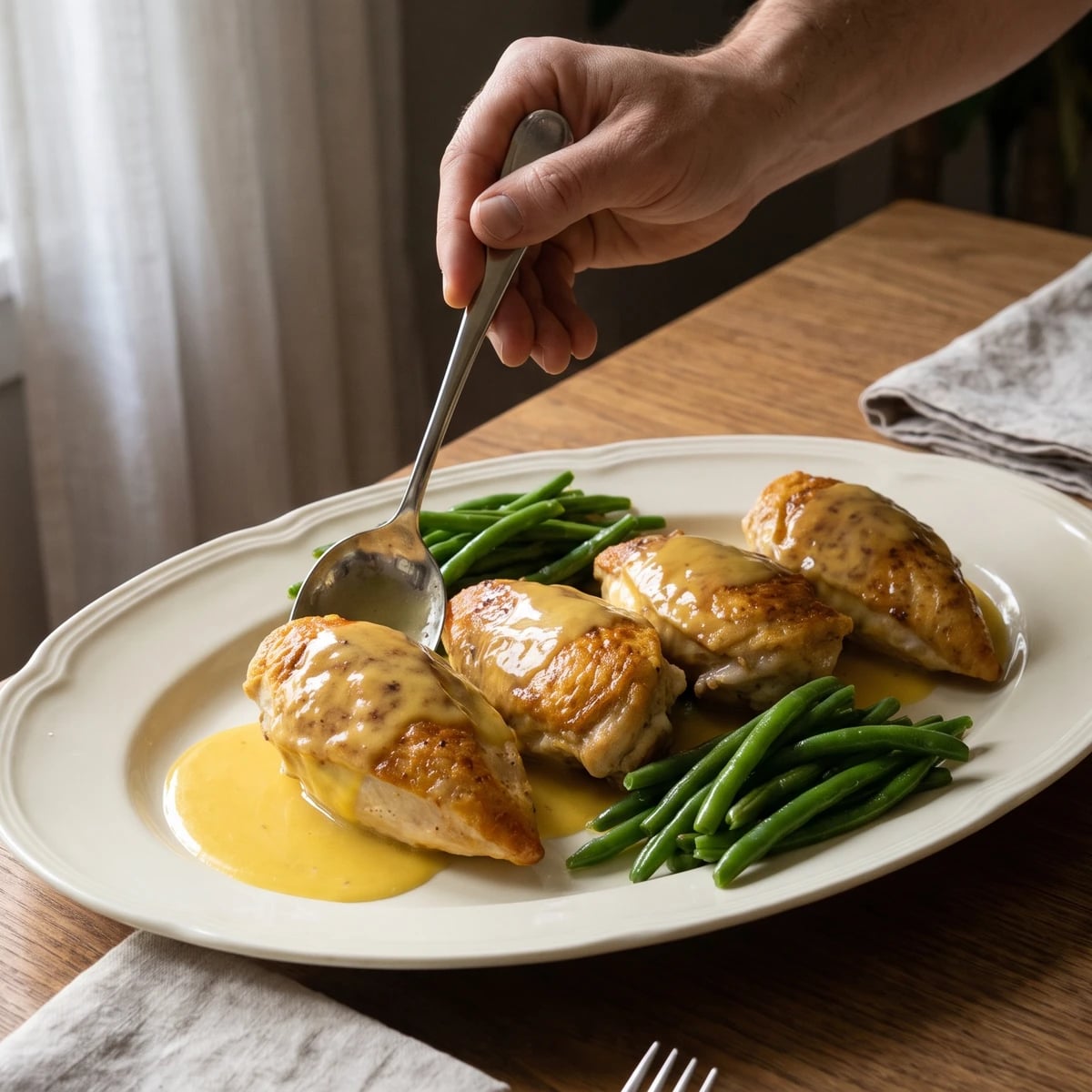
Suprêmes de Volaille Écossaise teaches the discipline of gentle poaching: tender chicken breasts beneath ivory Sauce Écossaise, ringed with small, glossy heaps of French beans bound with real butter.
Suprêmes de Volaille Écossaise (poached chicken breast fillets with Sauce Écossaise and butter-bound French beans) teaches one true thing: gentleness is an active technique. The poaching liquid must barely tremble. Let it boil and the delicate breast tightens before you have time to argue with it.
The original entry assumed a saucier tending the finished Sauce Écossaise, a stockpot never off the fire, and enough hands to poach the poultry while another cook finished the beans. At home, prepare the named sauce first, then use one wide pan, one saucepan, and an instant-read thermometer. The separate stations and holding pans were brigade scaffolding, so they can go. The gentle poach, the sauce kept whole, and the beans cohered with real butter are the dish, so they stay. A salamander has no work here; browning the top would betray the pale delicacy the recipe intends. One cook, one stove, one evening.
When it lands on the platter, the suprêmes should be tender and pearl-pale beneath a generous coat of sauce, with bright green beans gathered around them in buttery little heaps. Keep the poaching liquid below a simmer from the moment the chicken enters. That is the step that decides everything.
Suprêmes de Volaille Écossaise belongs to the grand-kitchen repertoire of Paris, where the most delicate breast fillet was paired with a named sauce and a precisely arranged vegetable garnish. Écossaise is a classical French title, not proof of a Scottish farmhouse origin; the composition and service remain thoroughly French. The dish passed naturally into cuisine bourgeoise because its formal arrangement needs no brigade once the sauce is ready, only careful poaching and a warm household platter.
Quantity
4, about 6 ounces / 170 g each (1½ pounds / 680 g total)
Quantity
4 cups (960 ml / 960 g)
divided
Quantity
1½ cups (360 ml / about 370 g)
prepared and warm
Quantity
1 pound (454 g)
trimmed
Quantity
2 quarts (1.9 L / 1.9 kg)
for blanching
Quantity
1 tablespoon (15 ml / 18 g)
for the blanching water
Quantity
1 teaspoon (5 ml / 6 g)
divided
Quantity
¼ teaspoon (1.25 ml / 0.6 g)
Quantity
4 tablespoons (60 ml / 56 g)
divided
| Ingredient | Quantity |
|---|---|
| skinless, boneless chicken breast suprêmes | 4, about 6 ounces / 170 g each (1½ pounds / 680 g total) |
| light chicken stockdivided | 4 cups (960 ml / 960 g) |
| Sauce Écossaiseprepared and warm | 1½ cups (360 ml / about 370 g) |
| slender French beanstrimmed | 1 pound (454 g) |
| waterfor blanching | 2 quarts (1.9 L / 1.9 kg) |
| fine saltfor the blanching water | 1 tablespoon (15 ml / 18 g) |
| fine saltdivided | 1 teaspoon (5 ml / 6 g) |
| finely ground white pepper | ¼ teaspoon (1.25 ml / 0.6 g) |
| unsalted butterdivided | 4 tablespoons (60 ml / 56 g) |
Take the suprêmes from the cold about twenty minutes before cooking. Pat them dry, trim away any loose sinew, and check that they are close in size so they finish together. Season both sides with ½ teaspoon of the fine salt and the white pepper. Keep the Sauce Écossaise ready in its own saucepan, but do not heat it yet.
Bring the water and the tablespoon of salt to a full boil. Blanchir means to boil briefly and drain: add the French beans and cook for 3 to 5 minutes, until vividly green and tender enough to bend without becoming limp. Drain them very well and spread them on a clean towel. Water left clinging to the beans will dilute the butter later.
Rub a wide, lidded sauté pan with 1 tablespoon of the butter. Add 3½ cups (840 ml / 840 g) of the stock and heat it to 175 to 180°F (79 to 82°C), when the surface quivers but produces no steady bubbles. Reserve the remaining cool stock. Lay in the suprêmes in one layer, cover, and hold the liquid in that quiet range for 12 to 18 minutes, turning the breasts once, until their centres reach 160 to 162°F (71 to 72°C). If the liquid begins to boil, lift the pan from the heat immediately, uncover it, and pour a little reserved cool stock down the side. Ça se rattrape. Return the pan only when the bubbling has stopped, then continue over lower heat. Lift the chicken to a warm plate, cover loosely, and rest for 5 minutes; verify that it reaches 165°F (74°C).
Warm the Sauce Écossaise over low heat, stirring gently until it flows in a broad ribbon and coats the back of a spoon. Do not let it boil. If it has tightened while waiting, whisk in the reserved stock or strained poaching liquid 1 tablespoon at a time. If greasy beads appear at the edge, take the pan off the heat and whisk in 1 tablespoon of cool stock until the sauce comes together again. Taste before adding any salt, since both sauce and poaching liquid already carry seasoning.
Melt the remaining 3 tablespoons of butter in the dried bean saucepan over medium-low heat. Add the beans and the remaining ½ teaspoon salt, then turn them through the butter for 2 to 3 minutes until hot, gleaming, and lightly cohered. Cohered means the butter clings well enough that the beans gather into small, tidy heaps instead of scattering dryly across the platter. If water collects in the pan, raise the heat briefly and toss until it evaporates.
Blot the rested suprêmes lightly so the sauce will cling, then arrange them on a warm oval platter. Coat each generously with the Sauce Écossaise, allowing a little to pool beneath. Surround the chicken with four to eight small heaps of the butter-bound French beans, preserving the arrangement of the original entry without turning dinner into geometry. Serve immediately. À table!
1 serving (about 345g)
Culinary guides, cultural storytelling, and the editorial depth that makes cooking meaningful.
Discover Culinary Explorer
Chef Juliette
Filets de volaille sautés teach the discipline of even cutting and last-minute cooking: flour lightly, gild quickly in clarified butter, and serve before a tender chicken breast has time to harden.

Chef Juliette
Suprêmes de volaille sautés teach the Paris rule of tender breast meat: flour lightly, gild quickly in clarified butter, add no liquid, and carry the plates straight from skillet to table.

Chef Juliette
Small chicken suprêmes, wing bone attached, take a veil of flour and a swift bath in clarified butter, turning golden at the exact moment their flesh becomes tender.

Chef Juliette
Ailerons de poulet teach the discipline of fast sautéing: small skinless breasts, wing bone attached, floured lightly and gilded in clarified butter, then carried straight from pan to warm platter before tenderness has time to leave.