
Chef Juliette
John Dory (St. Pierre)
John Dory has the delicacy of sole and the firmness of turbot. A light flouring, a quick butter sauté, and nut-brown beurre noisette show exactly why looks never mattered.
A cooking platform built around craft, culture, and the stories behind what we eat.
Created by Chef Juliette
Based on No. 1595, Suprêmes de Volaille Écarlate, from Le Guide Culinaire (1907) by Auguste Escoffier
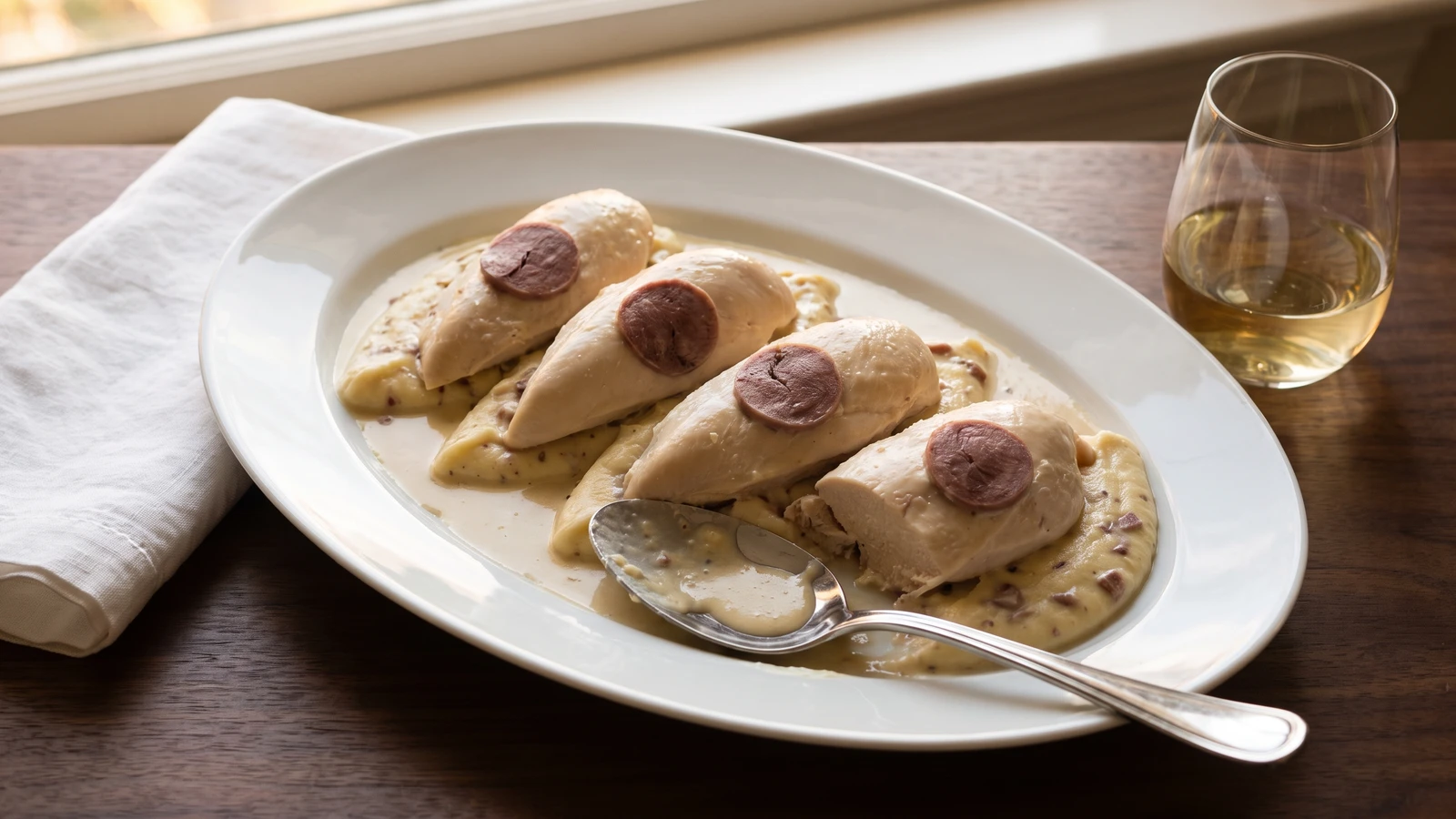
Scarlet tongue roundels glow through a finely strained sauce suprême, while each tender breast rests on its own tongue-flecked mousseline quenelle: disciplined contrast made possible for one attentive home cook.
Suprêmes de Volaille Écarlate (scarlet-garnished chicken breasts) teaches a severe and useful lesson: delicacy needs control, not timidity. Cured tongue must remain clean scarlet against tender white poultry, pale mousselines, and a clear sauce suprême. Clear here means finely strained and luminous, not transparent. Before you touch a pan, know the one true thing: the sauce is a veil, never a blanket.
The original entry assumed a saucier at the elbow, chicken stock never off the fire, trained hands understanding the instruction “incise as above,” and a salamander waiting above the range, though this dish must never go beneath it. At home, a food processor replaces repeated pounding, one fine sieve supplies the polish, a low covered oven gives the dry poach, and an instant-read thermometer guards the chicken. The brigade choreography is scaffolding and can go. The cold mousseline, scarlet tongue, colorless cooking, and carefully strained sauce are the dish, so they stay. One cook, one stove, one evening.
The mousseline may look more formidable than it is. Keep everything cold, add the cream gradually, and poach a teaspoon to test before shaping the four flat quenelles. The step that decides the finished plate comes last: loosen the sauce until it coats in a thin gloss through which every tongue roundel remains plainly visible.
Suprêmes de Volaille Écarlate belongs to the formal Parisian service repertoire, where dishes were often named for the color and geometry of their garnish rather than for a regional birthplace. Écarlate means scarlet, supplied here by cured tongue rather than tomato, paprika, or wine, while the word suprême identifies the prized breast fillet and mousselines describe individually molded portions of exceptionally light forcemeat. The preparation traveled to bourgeois dinner tables because its elaborate appearance depends less on specialized equipment than on cold mixing, gentle poaching, and exact assembly.
Quantity
4 (about 1½ lb / 680 g total)
evenly sized
Quantity
1½ cups diced (350 ml / 225 g)
very cold
Quantity
1 cup (240 ml / 170 g)
cut in ⅛-inch slices with trimmings reserved
Quantity
1 (about 2 tbsp / 30 ml / 30 g)
very cold
Quantity
1⅓ cups (320 ml / 320 g)
very cold and divided
Quantity
5 tbsp (75 ml / 71 g)
divided
Quantity
3 tbsp (45 ml / 24 g)
Quantity
2 cups (480 ml / 480 g)
chilled and divided
Quantity
2 tsp (10 ml / 12 g)
divided
Quantity
½ tsp (2.5 ml / 1 g)
divided
Quantity
1⁄16 tsp (0.3 ml / 0.1 g)
Quantity
2 tsp (10 ml / 10 g)
Quantity
8 cups (1.9 L / 1.9 kg)
| Ingredient | Quantity |
|---|---|
| boneless, skinless chicken breast suprêmesevenly sized | 4 (about 1½ lb / 680 g total) |
| boneless, skinless chicken breast for the mousselinevery cold | 1½ cups diced (350 ml / 225 g) |
| cooked cured red beef tonguecut in ⅛-inch slices with trimmings reserved | 1 cup (240 ml / 170 g) |
| large egg whitevery cold | 1 (about 2 tbsp / 30 ml / 30 g) |
| heavy creamvery cold and divided | 1⅓ cups (320 ml / 320 g) |
| unsalted butterdivided | 5 tbsp (75 ml / 71 g) |
| all-purpose flour | 3 tbsp (45 ml / 24 g) |
| clear unsalted chicken stockchilled and divided | 2 cups (480 ml / 480 g) |
| fine saltdivided | 2 tsp (10 ml / 12 g) |
| finely ground white pepperdivided | ½ tsp (2.5 ml / 1 g) |
| freshly grated nutmeg | 1⁄16 tsp (0.3 ml / 0.1 g) |
| fresh lemon juice | 2 tsp (10 ml / 10 g) |
| water for poaching | 8 cups (1.9 L / 1.9 kg) |
Chill the food-processor bowl and blade for 15 minutes. From the broadest tongue slices, cut 16 scarlet roundels about ⅝ inch (1.5 cm) across. A clean metal piping tip makes a perfectly good cutter. Finely chop ⅓ cup (80 ml / 55 g) of the remaining tongue for the mousselines, keeping the pieces distinct rather than mashed, then cover and chill both preparations.
Put the cold diced chicken, ¾ teaspoon salt, ⅛ teaspoon white pepper, and the nutmeg in the chilled processor. Pulse until very fine, scrape the bowl, then pulse in the egg white until the paste becomes cohesive. With the machine running in short bursts, add ¾ cup (180 ml / 180 g) cream gradually, stopping as soon as the mousseline is smooth, glossy, and softly mounded. Press it once through a fine sieve into a bowl set over ice. If it turns grainy or leaves greasy streaks, stop processing. Ça se rattrape: chill it over ice for 5 minutes, then work in 1 tablespoon of the reserved cold cream with a spatula. Never add flour, which saves the shape by sacrificing the mousseline.
Bring the measured water to 175 to 180°F (79 to 82°C) in a wide pan. Butter four squares of parchment with 1 tablespoon butter and spread one-quarter of the mousseline on each, making flat ovals about 4½ by 2¾ inches (11 by 7 cm) and ½ inch (1.25 cm) thick. Lower them parchment-side down into the water; after 2 minutes, peel away the paper with tongs. Poach without boiling until the centres reach 165°F (74°C), 8 to 10 minutes. A hard boil riddles mousselines with holes and toughens them. If the water boils, pull the pan off the heat, add a splash of cool water, and continue gently. Lift the quenelles onto a buttered shallow dish, cover, and hold.
Melt 3 tablespoons butter in a saucepan, stir in the flour, and cook this roux blanc (white roux) over low heat for 2 minutes without allowing it to color. Reserve ¼ cup (60 ml / 60 g) stock, then whisk the remainder into the roux a little at a time. Bring it to a bare simmer and cook for 15 minutes, skimming away any surface foam. Add ½ cup (120 ml / 120 g) cream and simmer gently for 5 minutes, until the sauce coats a spoon in a light film. Strain it through a fine sieve into a clean saucepan. If it is lumpy, do not fight it with furious whisking. Strain it, then continue. If the cream separates, take the pan off the heat and whisk in 1 tablespoon cold cream. Ça se rattrape.
Heat the oven to 325°F (165°C). Pat the four suprêmes dry and place them display-side up. Using the small cutter as a guide, mark four shallow circles across each breast, then lift away no more than ⅛ inch (3 mm) of flesh with the point of a paring knife. Press one tongue roundel into each pocket so it sits flush. This is the home translation of the book's terse instruction to incise the suprêmes: shallow inlay, not deep stuffing. Season the undersides with ½ teaspoon salt and ⅛ teaspoon white pepper, leaving the decorated surfaces clean.
Butter a wide lidded ovenproof sauté pan with the remaining 1 tablespoon butter. Arrange the suprêmes decorated-side up without crowding, cover them with a round of parchment, then close the lid. Cook in the oven without added liquid or browning for 15 to 20 minutes, until the thickest centre reaches 160 to 162°F (71 to 72°C). Place the covered dish of mousselines in the oven for the final 8 minutes. Transfer the suprêmes to a warm plate and rest them covered for 5 minutes, until carryover heat brings them to 165°F (74°C). If the butter at the pan edge starts to brown, lower the oven and add 1 tablespoon of reserved stock around the meat. The decorated tops must remain pale.
Pour the chicken's buttery cooking juices into the sauce and bring it to a full simmer for 2 minutes, then strain once more. Add the lemon juice and taste before adding more salt, because the tongue carries its own. The sauce should fall from the spoon in a thin, glossy sheet. If it sits heavily or hides the spoon beneath it, whisk in reserved stock a teaspoon at a time. If it runs like broth, simmer it briefly. The final consistency is not decoration; it is what lets the scarlet remain visible.
Set the four warm, flat mousseline quenelles on a heated oval platter. Sprinkle each with the finely chopped red tongue, then place one suprême directly on top. Spoon sauce suprême over each portion in a restrained, even veil, leaving every roundel legible beneath the gloss. Pass the remaining sauce separately. Do not brown, gratinate, or add herbs. The ivory and scarlet are complete. À table!
1 serving (about 430g)
Culinary guides, cultural storytelling, and the editorial depth that makes cooking meaningful.
Discover Culinary ExplorerChef Juliette
John Dory has the delicacy of sole and the firmness of turbot. A light flouring, a quick butter sauté, and nut-brown beurre noisette show exactly why looks never mattered.

Chef Juliette
Fresh haddock proves its delicacy in the meunière pan: a fine flour crust, moist pearly flakes, and beurre noisette sharpened with lemon and parsley, ready from one skillet in half an hour.

Chef Juliette
Éperlans à l’Anglaise turns small fish into a lesson in disciplined coating: boned smelts under a close, crisp crumb, pan-fried in clarified butter and finished with bright, half-melted maître d’hôtel butter.

Chef Juliette
Tiny smelts, shallot, mushrooms, white wine, gratin sauce, and fine bread raspings meet a fierce oven, where the fish must turn tender in the same breath the buttered crust bronzes.