
Chef Juliette
John Dory (St. Pierre)
John Dory has the delicacy of sole and the firmness of turbot. A light flouring, a quick butter sauté, and nut-brown beurre noisette show exactly why looks never mattered.
A cooking platform built around craft, culture, and the stories behind what we eat.
Created by Chef Juliette
Based on No. 1594, Suprêmes de Volaille Dreux, from Le Guide Culinaire (1907) by Auguste Escoffier
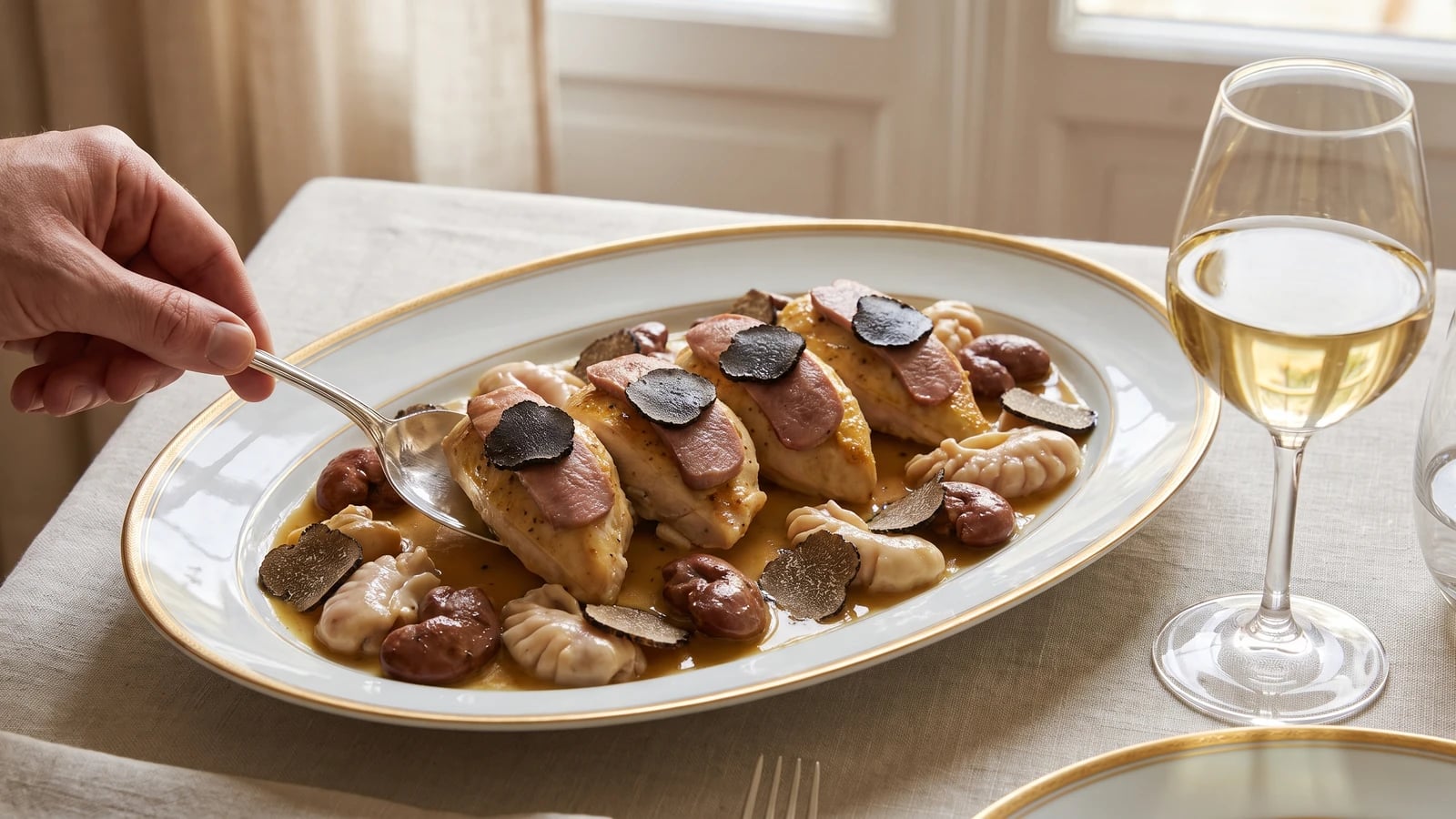
Black truffle and salted tongue stripe tender chicken breasts, while cocks' combs, kidneys, and ivory Allemande gather beneath: a grand-kitchen composition made workable for one careful home cook.
Suprêmes de Volaille Dreux (chicken breast fillets inlaid with truffle and salted tongue) teaches control. A suprême is the breast fillet of a fowl, and this delicate cut must stay moist and pale while its alternating roundels remain upright and distinct. Before you touch a pan, know the one true thing: shallow incisions preserve the breast; deep ones turn it into a bundle of loose slices.
The original entry assumed a saucier on staff, stock never off the fire, and another station delivering peeled cocks' combs and cleaned chicken kidneys. A salamander stood in that kitchen too, but Dreux has no use for it; these suprêmes are poached pale, not gratinéed. At home, prepared cocks' combs replace the brigade's peeling labor, one saucepan makes the Sauce Allemande (a velouté finished with egg yolk, cream, and lemon), and a covered skillet becomes the poaching pan. The separate stations are scaffolding and can go. The truffle and tongue inlays, poultry-offal garnish, pocher à sec, and Sauce Allemande are the dish and must stay. One cook, one stove, one evening.
When it is right, the chicken is tender and butter-sheened, black truffle and rose-colored tongue mark its surface, and the ivory sauce gathers the cocks' combs and kidneys without burying them. The decisive step is pocher à sec (gentle covered cooking in butter without added liquid). Check the temperature early and lift each suprême the moment it is done; sauce can wait a few minutes, lean chicken cannot.
Suprêmes de Volaille Dreux belongs to the Parisian grand-kitchen repertory of named poultry garnishes, although Dreux itself lies west of Paris in Eure-et-Loir; the surviving formula records a service composition more securely than a household specialty of that town. Alternating black truffle and salted tongue made the pale suprême immediately recognizable, while cocks' combs, chicken kidneys, and Sauce Allemande announced the poultry-centered abundance of the banquet table. As the preparation passed into home manuals, the brigade stations could disappear, but those inlays and that garnish remained its identity.
Quantity
4, about 1½ pounds (680 g) total
trimmed to an even shape
Quantity
1, about 1½ ounces (40 g)
cut into 12 small roundels; remainder thinly sliced
Quantity
8 thin slices, about 2 ounces (60 g)
cut into 12 roundels matching the truffle
Quantity
8, about 4 ounces (115 g)
peeled and ready to heat
Quantity
12, about 4 ounces (115 g)
trimmed of connective tissue and dried
Quantity
2 cups (480 ml / 480 g)
divided
Quantity
5 tablespoons (75 ml / 70 g)
divided
Quantity
2 tablespoons (30 ml / 16 g)
Quantity
½ cup (120 ml / 120 g)
reserve 1 tablespoon for correcting the sauce
Quantity
2
Quantity
2 teaspoons (10 ml / 10 g)
Quantity
¾ teaspoon (3.75 ml / 4 g)
divided
Quantity
¼ teaspoon (1.25 ml / 0.5 g)
| Ingredient | Quantity |
|---|---|
| skinless, boneless chicken breast fillets (suprêmes)trimmed to an even shape | 4, about 1½ pounds (680 g) total |
| whole black truffle, fresh or preservedcut into 12 small roundels; remainder thinly sliced | 1, about 1½ ounces (40 g) |
| langue écarlate (cooked salted beef tongue)cut into 12 roundels matching the truffle | 8 thin slices, about 2 ounces (60 g) |
| prepared, fully cooked cocks' combspeeled and ready to heat | 8, about 4 ounces (115 g) |
| chicken kidneystrimmed of connective tissue and dried | 12, about 4 ounces (115 g) |
| light unsalted chicken stockdivided | 2 cups (480 ml / 480 g) |
| unsalted butterdivided | 5 tablespoons (75 ml / 70 g) |
| plain flour | 2 tablespoons (30 ml / 16 g) |
| heavy creamreserve 1 tablespoon for correcting the sauce | ½ cup (120 ml / 120 g) |
| large egg yolks | 2 |
| fresh lemon juice | 2 teaspoons (10 ml / 10 g) |
| fine saltdivided | ¾ teaspoon (3.75 ml / 4 g) |
| finely ground white pepper | ¼ teaspoon (1.25 ml / 0.5 g) |
Put the prepared cocks' combs in a small saucepan with ½ cup (120 ml) of the stock and 1 tablespoon of the butter. Cover and hold at a bare simmer for 8 to 10 minutes, until thoroughly hot and supple but still intact. Lift them out carefully and cover them. Measure the cooking liquor, then add enough unused stock to make 1½ cups (360 ml) for the sauce; this carries the poultry flavor forward instead of sending it down the sink.
Melt 2 tablespoons of the butter in a saucepan over medium-low heat. Stir in the flour and cook this roux blond (pale roux) for 2 minutes without letting it color. Add the measured stock gradually, whisking until smooth after each addition, then simmer gently for 12 to 15 minutes. Skim if necessary. The base is ready when it lightly nappes the back of a spoon and tastes of chicken rather than flour. If it lumps, whisk firmly and pass it through a fine sieve; the sauce is not lost.
Heat the oven to 325°F (165°C). Pat the suprêmes dry and season them lightly with half the salt and white pepper; the tongue will bring more salt later. Across the rounded face of each breast, cut 6 short, parallel incisions at intervals of about ½ inch (1.25 cm). Angle the knife slightly and stop halfway through the flesh. Half-insert alternating roundels of truffle and tongue, leaving the upper half of each visible like a row of small coins. If one incision passes through, close the underside with a short wooden pick and remove it before serving. Ça se rattrape.
Coat a lidded ovenproof sauté pan with 1 tablespoon of the butter and arrange the suprêmes in one layer, inlaid sides up. Lay a buttered round of parchment directly over them, cover the pan, and warm it over low heat just until the butter melts without coloring. Transfer the covered pan to the oven and pocher à sec for 16 to 22 minutes, checking early and lifting each breast as soon as its thickest part reaches 165°F (74°C). The surface should remain pale and moist, with the inlays held neatly in place. Set the suprêmes on a warm plate, cover loosely, and pour their clear cooking juices into the velouté base.
Return the sauté pan to medium heat and melt 1 tablespoon of the butter. Add the dried chicken kidneys and sauté them for 3 to 5 minutes, turning frequently, until lightly bronzed, firm, and cooked to 165°F (74°C). Add the warmed cocks' combs and 2 tablespoons of the remaining stock, cover for 1 minute, then take the pan from the heat. Keep the garnish warm. Do not leave the kidneys over heat while the sauce is finished; these small pieces turn firm quickly.
Bring the velouté base and chicken cooking juices just to a simmer, then remove the pan from the heat. Whisk the egg yolks with all but the reserved tablespoon of cream. Whisk in a ladleful of hot velouté, then another, before returning this liaison (egg-yolk-and-cream thickening) to the saucepan. Stir over very low heat until Sauce Allemande becomes glossy, lightly coats a spoon, and reaches about 170°F (77°C); never let it boil. Add the lemon juice and taste before adding the remaining salt. If grains appear, take the pan off the heat immediately, whisk in the reserved cold cream, and strain into a clean warm pan. If the sauce is too thick, loosen it with stock one spoonful at a time.
Arrange the suprêmes on a warmed oval platter with their alternating truffle and tongue roundels fully visible. Surround them with the cocks' combs and chicken kidneys, then place the remaining truffle slices among the garnish. Spoon a moderate quantity of Sauce Allemande over the garnish and around the lower edges of the chicken, leaving the decorated faces uncovered. Serve immediately. À table!
1 serving (about 350g)
Culinary guides, cultural storytelling, and the editorial depth that makes cooking meaningful.
Discover Culinary ExplorerChef Juliette
John Dory has the delicacy of sole and the firmness of turbot. A light flouring, a quick butter sauté, and nut-brown beurre noisette show exactly why looks never mattered.

Chef Juliette
Fresh haddock proves its delicacy in the meunière pan: a fine flour crust, moist pearly flakes, and beurre noisette sharpened with lemon and parsley, ready from one skillet in half an hour.

Chef Juliette
Éperlans à l’Anglaise turns small fish into a lesson in disciplined coating: boned smelts under a close, crisp crumb, pan-fried in clarified butter and finished with bright, half-melted maître d’hôtel butter.

Chef Juliette
Tiny smelts, shallot, mushrooms, white wine, gratin sauce, and fine bread raspings meet a fierce oven, where the fish must turn tender in the same breath the buttered crust bronzes.