
Chef Juliette
Filets
Filets de volaille sautés teach the discipline of even cutting and last-minute cooking: flour lightly, gild quickly in clarified butter, and serve before a tender chicken breast has time to harden.
A cooking platform built around craft, culture, and the stories behind what we eat.
Created by Chef Juliette
Based on No. 1591, Suprêmes de Volaille Chimay, from Le Guide Culinaire (1907) by Auguste Escoffier
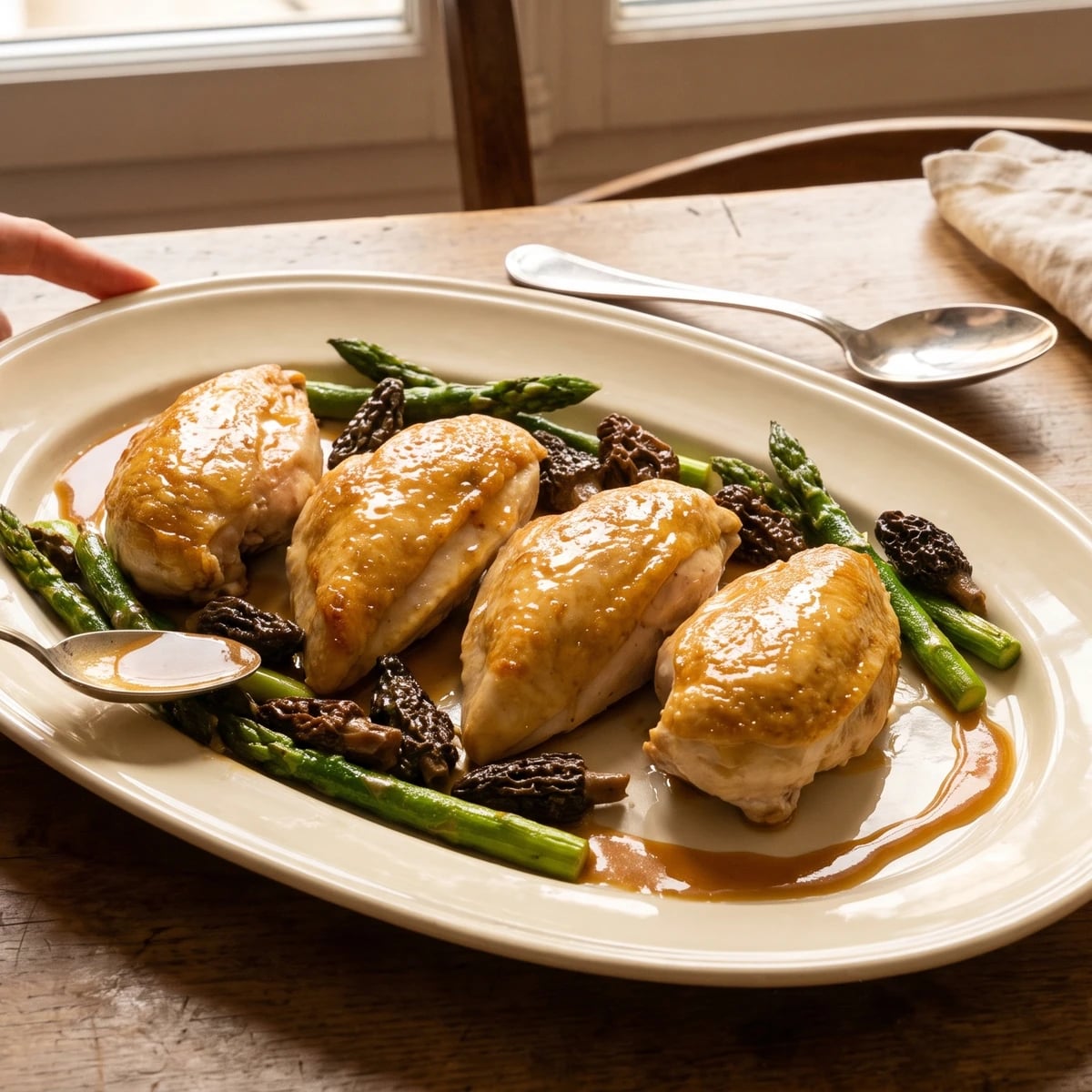
Golden suprêmes meet spring morels and asparagus tips, all held by butter and a narrow ribbon of glossy chicken gravy: a Parisian lesson in timing, restraint, and the power of a proper fond.
Suprêmes de Volaille Chimay (chicken breast fillets with morels, asparagus tips, and gravy) teaches coordination. The chicken, spring garnish, and gravy must arrive together, because none improves by waiting. A suprême is the tender breast fillet, and the one true thing to know before touching the pan is this: even thickness matters more than pedigree. Shape the breasts evenly and they will gild without drying.
The original entry assumed a saucier at the cook's elbow, stock never off the fire, and enough hands to tend each component separately. A salamander stood above the same range, but Chimay does not use it, so your broiler stays cold. The honest home equivalent is four evenly sized breasts, a saucepan of reduced chicken stock, and the fond from one skillet turned into a quick jus lié, a lightly thickened gravy. What changed is the scale and the service machinery, not the dish.
Separate holding pans and a gravy station were brigade scaffolding, and they can go. Clarified butter for the suprêmes, morels and asparagus bound with whole butter, and a narrow thread of proper gravy are the dish itself, and they stay. Watch the chicken after you turn it: the second side decides whether the centre remains succulent.
Suprêmes de Volaille Chimay belongs to the composed poultry repertoire of Paris, where the breast fillet was treated as the finest portion and paired with a named garnish. Chimay here signifies the classical combination recorded for the dish, buttered morels and asparagus heads with a narrow border of thickened gravy, rather than a rustic preparation from the Belgian town. From formal dining rooms it passed naturally to the bourgeois dinner table because its luxury lies in spring produce and exact timing, not in a vast list of ingredients.
Quantity
4, about 6 oz / 170 g each
Quantity
10 tablespoons (150 ml / 142 g)
divided
Quantity
4 loosely packed cups (950 ml / 225 g)
split lengthwise and cleaned
Quantity
2 cups (475 ml / 250 g)
cut about 2 inches / 5 cm long
Quantity
2 cups (475 ml / 475 g)
Quantity
1 tablespoon (15 ml / 8 g)
Quantity
1 tablespoon plus 1 teaspoon (20 ml / 24 g)
divided
Quantity
1/2 teaspoon (2.5 ml / 1 g)
| Ingredient | Quantity |
|---|---|
| boneless, skinless chicken suprêmes (breast fillets) | 4, about 6 oz / 170 g each |
| unsalted butterdivided | 10 tablespoons (150 ml / 142 g) |
| fresh morelssplit lengthwise and cleaned | 4 loosely packed cups (950 ml / 225 g) |
| asparagus tipscut about 2 inches / 5 cm long | 2 cups (475 ml / 250 g) |
| unsalted, full-bodied chicken stock | 2 cups (475 ml / 475 g) |
| all-purpose flour | 1 tablespoon (15 ml / 8 g) |
| fine sea saltdivided | 1 tablespoon plus 1 teaspoon (20 ml / 24 g) |
| finely ground white pepper | 1/2 teaspoon (2.5 ml / 1 g) |
Trim away any loose tissue and tuck the narrow tenderloin flap beneath each suprême. Place the breasts between sheets of parchment and tap only the thick ends until every piece is about 3/4 inch / 2 cm thick. You are evening them, not making escalopes. Dry them thoroughly, then season with the remaining 1 teaspoon (5 ml / 6 g) salt and the white pepper.
Melt 6 tablespoons (90 ml / 85 g) of the butter very gently in a small saucepan. Let the white milk solids settle and the foam rise, then skim the foam and pour the clear golden fat through a fine strainer, leaving the pale sediment behind. This clarified butter can gild the chicken without scorching. If a few solids begin to colour, take the pan off the heat and strain immediately; pale gold is usable, dark brown belongs to another dish.
Bring the chicken stock to a lively simmer in the same clean saucepan and reduce it to about 3/4 cup (180 ml / 180 g), which should take 15 to 20 minutes. It must taste distinctly of chicken before it meets the pan fond. Meanwhile, knead 1 tablespoon (15 ml / 14 g) of the remaining soft butter with the flour to make a beurre manié, a kneaded butter thickener, and reserve it for the finish.
Bring a saucepan of water to the boil and season it with 1 tablespoon (15 ml / 18 g) of the salt. Blanch the asparagus tips for 2 minutes, just until vivid green and barely tender, then chill them in cold water and drain them very thoroughly. Melt 2 tablespoons (30 ml / 28 g) butter in a separate sauté pan, add the cleaned morels, and cook over medium heat for 8 to 10 minutes. They will first release liquid, then begin to sizzle again as it evaporates. Cook them fully, because morels must never be eaten raw or undercooked, then take the pan off the heat and keep the asparagus separate until the final binding.
Heat a heavy skillet over medium heat and add 3 tablespoons (45 ml / about 40 g) of the clarified butter. When it moves freely across the pan, lay in the suprêmes smooth-side down. They should answer with a steady, gentle sizzle. Cook without nudging for 5 to 6 minutes, until evenly golden, then turn and lower the heat slightly. Cook for another 4 to 6 minutes, until the thickest part reaches 160 to 162°F / 71 to 72°C. If the surface colours before the centre is ready, lift the pan off the heat for 30 seconds, lower the flame, and continue gently. Transfer the suprêmes to a warm platter and rest them loosely covered until they reach 165°F / 74°C.
Pour off excess butter from the chicken skillet, leaving the browned fond. Add the reduced stock and scrape the pan clean with a wooden spoon, then simmer for 2 minutes. Whisk in the beurre manié a pea-sized piece at a time and cook for 3 to 4 minutes, stopping when the jus lié lightly coats a spoon but still pours in a narrow thread. Add the chicken's resting juices and taste. If the gravy becomes too thick, whisk in hot water 1 tablespoon (15 ml / 15 g) at a time; if it remains thin, simmer it a little longer. If it lumps, strain it and return it to the heat. Ça se rattrape. If the original fond burned black, leave it behind and finish the reduced stock in a clean saucepan rather than carrying bitterness to the plate.
Return the morels to gentle heat, add the drained asparagus tips and the final 1 tablespoon (15 ml / 14 g) butter, then toss until the butter and mushroom juices form a thin glaze around the vegetables. This is lier au beurre, binding with butter. If the butter sits in a greasy puddle, add 1 teaspoon (5 ml / 5 g) hot water and toss again until it coheres. Set one suprême on each warm plate, arrange the morels and asparagus around it, and surround everything with a narrow thread of jus lié. Do not cover the golden chicken. À table!
1 serving (about 325g)
Culinary guides, cultural storytelling, and the editorial depth that makes cooking meaningful.
Discover Culinary Explorer
Chef Juliette
Filets de volaille sautés teach the discipline of even cutting and last-minute cooking: flour lightly, gild quickly in clarified butter, and serve before a tender chicken breast has time to harden.

Chef Juliette
Suprêmes de volaille sautés teach the Paris rule of tender breast meat: flour lightly, gild quickly in clarified butter, add no liquid, and carry the plates straight from skillet to table.

Chef Juliette
Small chicken suprêmes, wing bone attached, take a veil of flour and a swift bath in clarified butter, turning golden at the exact moment their flesh becomes tender.

Chef Juliette
Ailerons de poulet teach the discipline of fast sautéing: small skinless breasts, wing bone attached, floured lightly and gilded in clarified butter, then carried straight from pan to warm platter before tenderness has time to leave.