
Chef Juliette
John Dory (St. Pierre)
John Dory has the delicacy of sole and the firmness of turbot. A light flouring, a quick butter sauté, and nut-brown beurre noisette show exactly why looks never mattered.
A cooking platform built around craft, culture, and the stories behind what we eat.
Created by Chef Juliette
Based on No. 1587, Suprêmes de Volaille Arlésienne, from Le Guide Culinaire (1907) by Auguste Escoffier
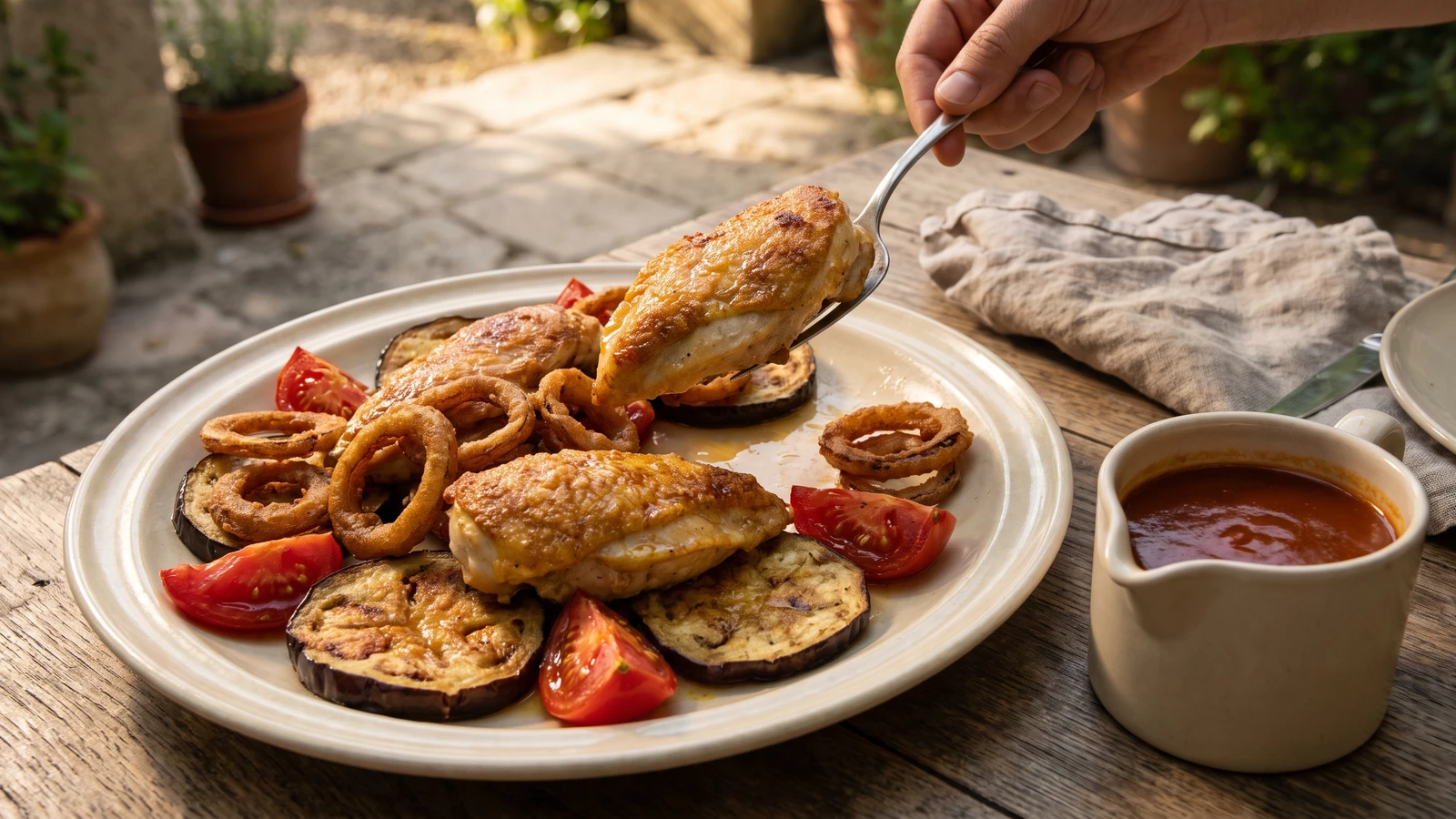
Crisp-edged chicken suprêmes rest on aubergine roundels with oil-glossed tomatoes and fried onion above, while a delicate tomatéd half-glaze waits in its sauceboat: Arles translated for one stove.
Suprêmes de Volaille Arlésienne (chicken breast fillets with Arles garnish) teaches separation. The aubergine and onion must stay crisp at their edges, the tomatoes must remain bright and whole, and the delicate sauce belongs beside the chicken rather than poured over all that careful frying. Arles brings olive oil to the garnish, while clarified butter gives the floured suprêmes their golden crust.
The original kitchen assumed a saucier on staff, a stock never off the fire, several cooks tending separate pans, and a salamander waiting above the range. This entry never calls upon that salamander, because frying makes the crust. At home, good unsalted chicken and veal stocks are reduced together, with a little gelatin restoring the body that long extraction once supplied, then tomatéd with enough purée to be distinctly seen and tasted. A rack in a low oven replaces the brigade's hot pass, and the whole arrangement is scaled to four. One cook, one stove, one evening.
Multiple hands and a ready-made half-glaze were brigade scaffolding, so those can go. The order of the garnish cannot: aubergine below, suprêmes above, tomatoes and fried onion in small heaps, sauce served separately. Before the first roundel meets the pan, bring the oil fully to temperature and keep it there. Lukewarm oil makes greasy vegetables; steady heat makes Arlésienne.
Arlésienne points precisely to Arles in Provence, where aubergine, tomato, onion, and olive oil belong naturally to the local larder. In the classical canon, the name describes a composed garnish rather than claiming that the entire chicken preparation began as an Arles household recipe. Grand kitchens carried the produce of Provence into their national vocabulary, pairing the oil-cooked vegetables with a restrained tomatéd half-glaze while keeping clarified butter beneath the poultry.
Quantity
4 (about 6 ounces / 170 g each; 1½ pounds / 680 g total)
trimmed to even suprêmes
Quantity
¾ cup (180 ml / 90 g)
divided
Quantity
1¾ teaspoons (9 ml / 10 g)
divided
Quantity
1 teaspoon (5 ml / 2 g)
divided
Quantity
3 tablespoons (45 ml / 42 g)
Quantity
1 large (about 1 pound / 450 g)
cut crosswise into ⅓-inch / 8 mm roundels
Quantity
1 large (about 8 ounces / 225 g)
cut crosswise into ¼-inch / 6 mm roundels and separated into rings
Quantity
4 medium (about 1 pound / 450 g)
quartered and seeded
Quantity
1¼ cups (300 ml / 275 g)
divided
Quantity
2 cups (480 ml / 480 g)
Quantity
1 cup (240 ml / 240 g)
Quantity
1½ teaspoons (7.5 ml / 5 g)
Quantity
2 tablespoons (30 ml / 30 g)
Quantity
1 tablespoon (15 ml / 14 g)
diced
| Ingredient | Quantity |
|---|---|
| boneless, skinless chicken breast filletstrimmed to even suprêmes | 4 (about 6 ounces / 170 g each; 1½ pounds / 680 g total) |
| all-purpose flourdivided | ¾ cup (180 ml / 90 g) |
| fine sea saltdivided | 1¾ teaspoons (9 ml / 10 g) |
| freshly ground black pepperdivided | 1 teaspoon (5 ml / 2 g) |
| clarified butter | 3 tablespoons (45 ml / 42 g) |
| auberginecut crosswise into ⅓-inch / 8 mm roundels | 1 large (about 1 pound / 450 g) |
| yellow onioncut crosswise into ¼-inch / 6 mm roundels and separated into rings | 1 large (about 8 ounces / 225 g) |
| plum tomatoesquartered and seeded | 4 medium (about 1 pound / 450 g) |
| olive oildivided | 1¼ cups (300 ml / 275 g) |
| unsalted chicken stock | 2 cups (480 ml / 480 g) |
| unsalted veal stock | 1 cup (240 ml / 240 g) |
| unflavored powdered gelatin | 1½ teaspoons (7.5 ml / 5 g) |
| smooth tomato purée | 2 tablespoons (30 ml / 30 g) |
| cold unsalted butterdiced | 1 tablespoon (15 ml / 14 g) |
Heat the oven to 200°F / 95°C and set a wire rack over a sheet pan inside. Divide the flour between two shallow dishes, reserving about one-third for the onion and the rest for the chicken. Pat the aubergine, onion, tomatoes, and suprêmes thoroughly dry. If a chicken fillet is much thicker at one end, flatten that end gently until the piece is an even ¾ inch / 2 cm thick; even suprêmes brown without leaving the centre raw.
Reserve ¼ cup / 60 ml of the chicken stock. Put 2 tablespoons / 30 ml of that reserve in a small bowl and sprinkle the gelatin over it. Leave it to bloom. Combine the remaining chicken stock and all the veal stock in a 2-quart saucepan, bring to a lively simmer, and reduce to about ¾ cup / 180 ml, roughly 25 to 30 minutes. Whisk in the tomato purée and simmer for 3 minutes, until the sauce is a clear red-brown and the tomato is distinctly perceptible without overwhelming the stocks. Remove from the heat, whisk in the bloomed gelatin, and hold the sauce warm. Keep the remaining reserved stock for the final adjustment.
Reserve 2 tablespoons / 30 ml of the olive oil for the tomatoes. Heat the remaining oil in a wide heavy skillet to 350°F / 175°C. Fry the aubergine in a single layer, working in batches, until tender within and crisp gold around the edges, about 2 minutes per side. Let the oil return to temperature between batches. Drain the roundels on the rack in the low oven and season them lightly while hot. If they emerge pale and oily, raise the oil to temperature before continuing and refresh the limp pieces on the rack in a 425°F / 220°C oven for 4 minutes. Ça se rattrape.
Season the onion roundels with a little salt and pepper, then coat them thinly in their portion of flour and shake away every loose patch. Fry in small batches at 350°F / 175°C until deep gold and crisp, about 2 to 3 minutes, turning once. Transfer them to the rack with the aubergine. Do not pile them while hot, because trapped moisture softens the flour crust.
Carefully drain the frying oil from the skillet and wipe the pan clean. Season the suprêmes on both sides with salt and pepper, dredge them in the reserved flour, and shake off the excess. Heat the clarified butter over medium-high heat until shimmering, then sauté the chicken, meaning cook it briskly in shallow fat, in two uncrowded batches. Brown the first side for 4 to 5 minutes without disturbing it, turn, and cook the second side until golden and the thickest part reaches 160 to 162°F / 71 to 72°C. Rest the suprêmes for 5 minutes so carryover heat brings them to 165°F / 74°C. If the flour darkens before the centre is ready, lower the heat and turn the chicken every minute until it is cooked; the crust will survive, but scorched flour will not.
Wipe the skillet clean again so the tomatoes meet olive oil, not browned butter. Heat the reserved 2 tablespoons / 30 ml olive oil over medium-high heat. Add the tomato quarters, season lightly, and toss them for 1 to 2 minutes, just until glossy and warmed through with their edges beginning to relax. Keep their shape. Arlésienne wants tomatoes, not a pan of collapsed pulp.
Return the tomatéd half-glaze to gentle heat. If it is thin, simmer it briefly until it naps the back of a spoon; if it is too tight, whisk in the reserved stock a spoonful at a time. Remove the pan from the heat and whisk in the cold butter until the sauce gleams. If the butter separates, whisk in a teaspoon of cold water off the heat until smooth. Pour the sauce into a warmed sauceboat rather than over the garnish.
Arrange the aubergine roundels in an overlapping circle on a warmed round serving dish. Set the suprêmes upon them, then place the oil-tossed tomatoes and crisp onion roundels in small, generous heaps over the chicken, exactly in the order that defines the dish. Carry the sauceboat alongside and let each guest add the delicate tomatéd half-glaze without drowning the crisp garnish. À table!
1 serving (about 440g)
Culinary guides, cultural storytelling, and the editorial depth that makes cooking meaningful.
Discover Culinary ExplorerChef Juliette
John Dory has the delicacy of sole and the firmness of turbot. A light flouring, a quick butter sauté, and nut-brown beurre noisette show exactly why looks never mattered.

Chef Juliette
Fresh haddock proves its delicacy in the meunière pan: a fine flour crust, moist pearly flakes, and beurre noisette sharpened with lemon and parsley, ready from one skillet in half an hour.

Chef Juliette
Éperlans à l’Anglaise turns small fish into a lesson in disciplined coating: boned smelts under a close, crisp crumb, pan-fried in clarified butter and finished with bright, half-melted maître d’hôtel butter.

Chef Juliette
Tiny smelts, shallot, mushrooms, white wine, gratin sauce, and fine bread raspings meet a fierce oven, where the fish must turn tender in the same breath the buttered crust bronzes.