
Chef Juliette
John Dory (St. Pierre)
John Dory has the delicacy of sole and the firmness of turbot. A light flouring, a quick butter sauté, and nut-brown beurre noisette show exactly why looks never mattered.
A cooking platform built around craft, culture, and the stories behind what we eat.
Created by Chef Juliette
Based on No. 1586, Suprêmes de Volaille Ambassadrice, from Le Guide Culinaire (1907) by Auguste Escoffier
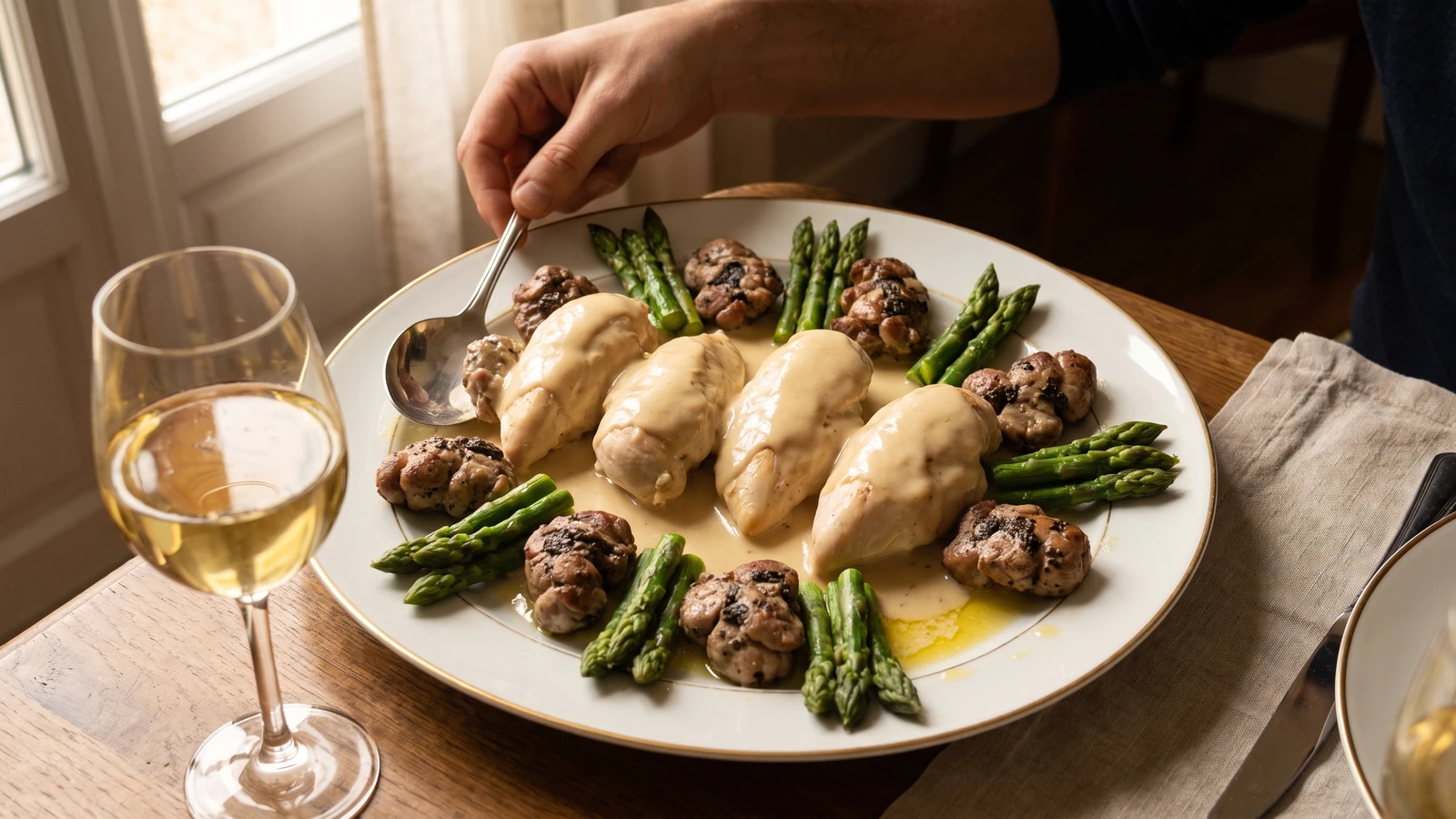
Pale, tender chicken under an ivory sauce suprême, with truffle-studded lamb sweetbreads and asparagus faggots around the platter: a lesson in gentle heat, exact timing, and the discipline of no browning.
Suprêmes de Volaille Ambassadrice (dry-poached chicken breasts with truffled lamb sweetbreads and asparagus) teaches the discipline of cooking without colour. A suprême is the fillet of a fowl's breast, and the one true thing to know before touching a pan is this: nothing may brown. The chicken, sauce, and lamb sweetbreads must remain pearl-pale, leaving the natural green asparagus and black truffle as deliberate punctuation.
The original entry assumes a saucier tending sauce suprême, a stock never off the fire, separate hands preparing sweetbreads and asparagus, and a salamander available for finishing, though Ambassadrice must never go beneath it. At home, one pale stock, a small saucepan, a lidded sauté pan, and a gentle oven do the same work. Separate cooks and holding pans are brigade scaffolding and can go; the soaking and pressing of the sweetbreads, the roux blanc, the covered poach, and the alternating garniture are the dish and must stay. The brigade-sized ring becomes eight sweetbread pieces and eight asparagus bundles for four people. One cook, one stove, one evening.
When it lands correctly, the platter is ivory, green, and black: tender chicken beneath a gleaming cream sauce, truffle showing through the sweetbreads, asparagus tips aligned like little sheaves. The decisive moment is pocher à sec (dry-poach): cover the buttered chicken tightly, keep the oven gentle, and stop at tenderness before either butter or meat takes colour.
Suprêmes de Volaille Ambassadrice belongs to the named garniture system of Parisian grand kitchens, where a title told every station how a plate was to be dressed. Ambassadrice is not a regional farmhouse preparation or the biography of one ambassador; it is brigade shorthand for a formal pale poultry dish with truffled sweetbreads, asparagus tips, and sauce suprême, carried from diplomatic and hotel dining rooms to bourgeois dinner tables. In the book's glossary, suprême means the fillet of a fowl's breast, a vocabulary point easily missed because the same word also names the cream-finished chicken sauce.
Quantity
4, about 1½ pounds (680 g) total
trimmed evenly
Quantity
12 ounces (340 g)
Quantity
1 ounce (28 g)
cut into 16 slender batons
Quantity
24, about 8 ounces (225 g)
cut 3 to 4 inches long
Quantity
½ cup (120 ml / 113 g)
divided
Quantity
2 tablespoons (30 ml / 16 g)
Quantity
2½ cups (600 ml / 600 g)
divided
Quantity
¾ cup (180 ml / 180 g)
divided
Quantity
2 tablespoons (30 ml / 36 g)
divided
Quantity
½ teaspoon (2.5 ml / 1 g)
| Ingredient | Quantity |
|---|---|
| boneless, skinless chicken breast suprêmestrimmed evenly | 4, about 1½ pounds (680 g) total |
| lamb sweetbreads | 12 ounces (340 g) |
| fresh or whole preserved black trufflecut into 16 slender batons | 1 ounce (28 g) |
| medium asparagus tipscut 3 to 4 inches long | 24, about 8 ounces (225 g) |
| unsalted butterdivided | ½ cup (120 ml / 113 g) |
| all-purpose flour | 2 tablespoons (30 ml / 16 g) |
| pale chicken stock, unsalted or low-sodiumdivided | 2½ cups (600 ml / 600 g) |
| heavy creamdivided | ¾ cup (180 ml / 180 g) |
| fine sea saltdivided | 2 tablespoons (30 ml / 36 g) |
| finely ground white pepper | ½ teaspoon (2.5 ml / 1 g) |
Submerge the lamb sweetbreads in a bowl of very cold water for 2 hours, changing the water twice, until they look clean and pale. Transfer them to a small saucepan, cover with fresh cold water, season lightly with the measured salt, and bring up slowly to the barest simmer. Cook for 3 minutes, then lift them into ice water. Peel away the outer membrane, fat, and obvious tubes while the lobes remain pliable, taking care not to tear them. Set the cleaned sweetbreads between two small trays, place a 2-pound (900 g) weight on top, and refrigerate for 30 minutes. Blanching firms them enough to trim; pressing gives the neat, even pieces this garniture requires.
Divide the pressed sweetbreads into 8 compact pieces. Make two narrow slits in each piece and insert a truffle baton into each slit, leaving a little black visible at the surface. Bring a narrow saucepan of salted water to a lively boil and blanch the asparagus tips for 2 to 3 minutes, just until tender when pierced but still upright. Cool them briefly in ice water, drain, and dry thoroughly. Group the tips into 8 faggots, small bundles of three, aligning their heads neatly; tie each loosely with fine kitchen twine so it holds during reheating.
Melt 2 tablespoons (28 g) of the butter in a 2-quart saucepan over low heat. Stir in the flour and cook this roux blanc (white roux) for 2 minutes, stirring constantly; it should smell softly of butter and warm flour without taking even a tan edge. Gradually whisk in 2 cups (480 ml) of the chicken stock, smoothing each addition before adding the next. Simmer very gently for 15 to 20 minutes, skimming as needed, then whisk in ⅝ cup (150 ml) of the cream and simmer until the sauce coats the back of a spoon in an even ivory film. Strain it into a clean saucepan and cover its surface with parchment. If the stock goes in too quickly and the sauce lumps, lift it from the heat, whisk firmly, and strain it. Ça se rattrape.
Melt 1 tablespoon (14 g) of the butter with ¼ cup (60 ml) of the chicken stock in a small sauté pan. Add the truffle-studded sweetbreads in one layer, cover them with a parchment round and a lid, and cook over very low heat for 12 to 15 minutes, turning once, until tender and 160°F (71°C) at the centre. The liquid should barely tremble. If it evaporates and the butter begins to sizzle, add a tablespoon of the reserved stock and lower the heat immediately; ça se rattrape before colour takes hold. Keep the cooked sweetbreads covered in their pale cooking liquor.
Heat the oven to 300°F (150°C). Pat the chicken suprêmes completely dry, season them evenly with salt and white pepper, and fold any thin tail underneath so each piece has an even thickness. Spread 2 tablespoons (28 g) of the butter over the base of a 12-inch ovenproof sauté pan, arrange the chicken presentation-side up, and rub the surface with some of the butter. Cover directly with a buttered parchment round, add the tight lid, and cook in the oven without added liquid for 22 to 30 minutes. This is pocher à sec: the chicken cooks in its own enclosed moisture while the butter protects the surface. Remove it when the thickest part reaches 160°F (71°C), then rest it covered for 5 minutes so carryover heat brings it to 165°F (74°C). The breasts should feel springy and remain uniformly pale.
Pour the clear chicken juices from the poaching pan into the sauce suprême and bring it only to a bare simmer. If it seems thin, reduce it before adding the final butter; if it is too tight, loosen it with the remaining stock. Take the sauce off the heat and whisk in 2 tablespoons (28 g) of cold butter a little at a time. If the butter floats in greasy beads, whisk in the reserved 2 tablespoons (30 ml) of cold cream until the sauce comes together again. Warm the asparagus bundles in the remaining 1 tablespoon (14 g) butter and 2 tablespoons (30 ml) stock over low heat, turning them gently without frying. Rewarm the sweetbreads in their covered pan if necessary, then remove every piece of twine from the asparagus.
Arrange the four suprêmes down the centre of a warm oval platter. Spoon the sauce suprême over them until every surface is coated in a smooth ivory layer, allowing a modest pool around the base. Surround the chicken with the 8 truffle-studded sweetbread pieces, alternating each one with an asparagus faggot. Do not add parsley, pastry, or an ornamental border; the black truffle, green tips, and pale sauce are the full design. Bring the remaining sauce separately and serve at once. À table!
1 serving (about 370g)
Culinary guides, cultural storytelling, and the editorial depth that makes cooking meaningful.
Discover Culinary ExplorerChef Juliette
John Dory has the delicacy of sole and the firmness of turbot. A light flouring, a quick butter sauté, and nut-brown beurre noisette show exactly why looks never mattered.

Chef Juliette
Fresh haddock proves its delicacy in the meunière pan: a fine flour crust, moist pearly flakes, and beurre noisette sharpened with lemon and parsley, ready from one skillet in half an hour.

Chef Juliette
Éperlans à l’Anglaise turns small fish into a lesson in disciplined coating: boned smelts under a close, crisp crumb, pan-fried in clarified butter and finished with bright, half-melted maître d’hôtel butter.

Chef Juliette
Tiny smelts, shallot, mushrooms, white wine, gratin sauce, and fine bread raspings meet a fierce oven, where the fish must turn tender in the same breath the buttered crust bronzes.