
Chef Juliette
John Dory (St. Pierre)
John Dory has the delicacy of sole and the firmness of turbot. A light flouring, a quick butter sauté, and nut-brown beurre noisette show exactly why looks never mattered.
A cooking platform built around craft, culture, and the stories behind what we eat.
Created by Chef Juliette
Based on No. 1585, Suprêmes de Volaille Alexandra, from Le Guide Culinaire (1907) by Auguste Escoffier
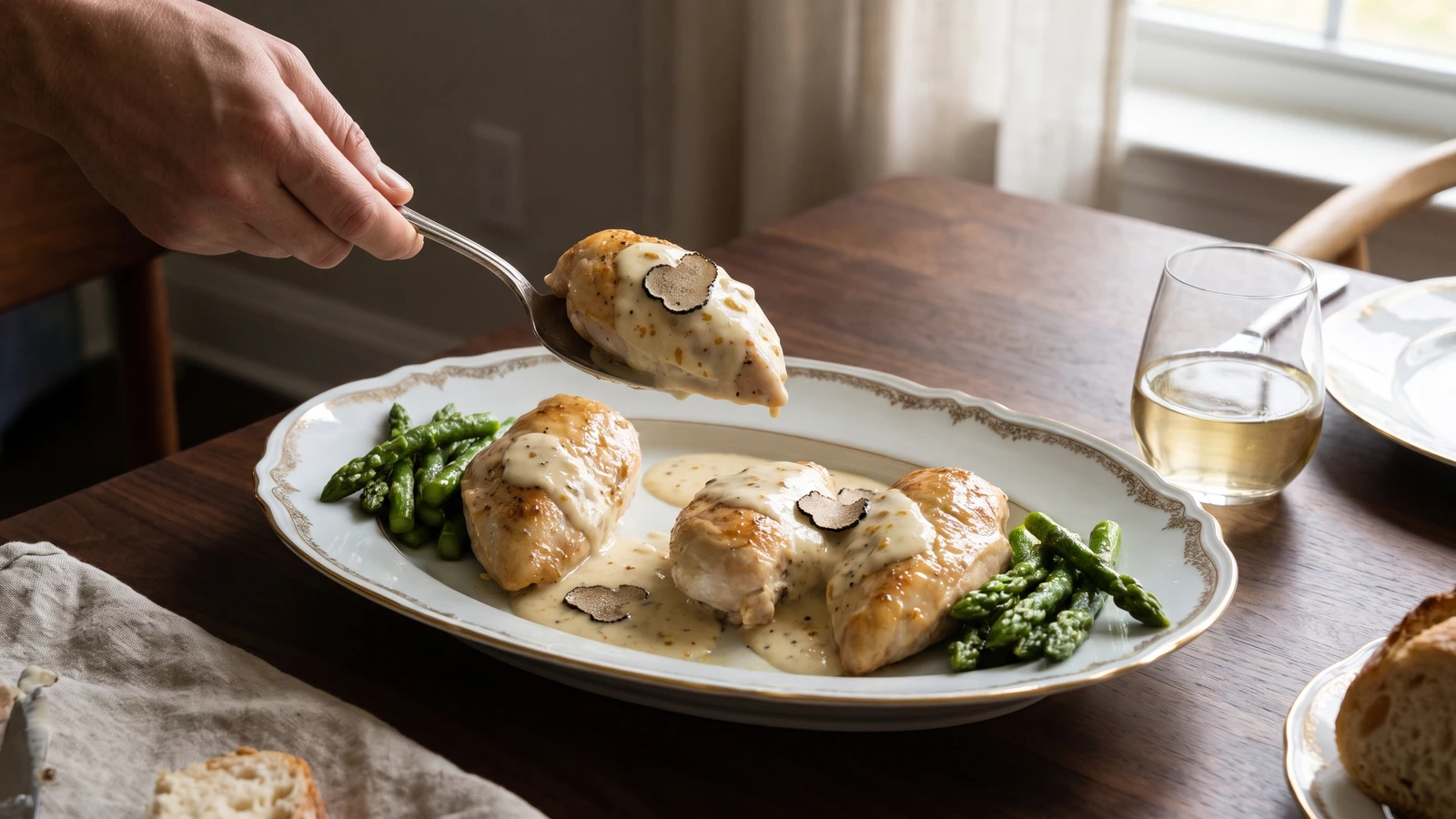
Dry-poached suprêmes under truffle and chicken-deepened Mornay, glazed to pale gold and ringed with buttered asparagus tips: a grand-kitchen composition translated faithfully for four at home.
Suprêmes de Volaille Alexandra (dry-poached chicken breast fillets with truffle, Mornay cheese sauce, and buttered asparagus tips) teaches the discipline of finishing before the meat is finished. A suprême is the breast fillet of a fowl, and here it is cooked without browning, veiled with black truffle and Mornay, then glazed just long enough for the surface to catch gold. The one true thing to know before touching a pan is this: the chicken must leave its dry poach a little shy of done, because the glaze supplies the final heat.
The original recipe assumed a saucier on staff, chicken essence drawn from a stock never off the fire, and a salamander fierce enough to color sauce in moments. At home, reduce one cup of unsalted stock to a concentrated spoonful, make a small Mornay in one saucepan, and use a fully heated broiler over a broiler-safe platter. The brigade's holding pans and service quantities are scaffolding and can go; the dry poach, truffle, chicken-flavored Mornay, fast glaze, and asparagus heads bound with butter are the dish and must stay. This version feeds four, one cook, one stove, one evening.
When it lands correctly, the suprêmes are ivory and succulent beneath a thin golden veil, black truffle showing through, with bright green asparagus tips gathered around the edge in buttery little heaps. Watch the thermometer and the broiler, not the clock. Overcooked breast cannot be uncooked, but a thick or split Mornay can be brought back before glazing. Ça se rattrape, and the method tells you where.
Suprêmes de Volaille Alexandra belongs to the Parisian grand-kitchen repertoire, where a personal name signaled a fixed garnish as clearly as a regional title signaled a particular larder. Alexandra joins the most delicate poultry cut with black truffle, Mornay flavored with chicken essence, and buttered asparagus tips, a composition built for formal service rather than a regional farmhouse table. It passed into bourgeois home kitchens through the classical cookbooks, with the domestic broiler taking the salamander's place while the garnish and sequence remained intact.
Quantity
1 cup (240 ml / 240 g)
for the chicken essence
Quantity
4 (about 1½ lb / 680 g total)
of even size
Quantity
1¼ teaspoons (6 ml / 7.5 g)
divided
Quantity
¼ teaspoon (1.25 ml / 0.5 g)
Quantity
2 tablespoons (30 ml / 28 g)
Quantity
2 tablespoons (30 ml / 28 g)
Quantity
3 tablespoons (45 ml / 24 g)
Quantity
1¼ cups (300 ml / 310 g)
divided
Quantity
5 tablespoons (75 ml / 75 g)
divided
Quantity
½ cup (120 ml / 50 g)
finely grated
Quantity
¼ cup (60 ml / 20 g)
finely grated
Quantity
1 small truffle (about 20 g)
fresh or whole preserved, thinly sliced
Quantity
24 (about 8 oz / 225 g)
trimmed to 2½-inch lengths
Quantity
2 tablespoons (30 ml / 28 g)
| Ingredient | Quantity |
|---|---|
| unsalted chicken stockfor the chicken essence | 1 cup (240 ml / 240 g) |
| boneless, skinless chicken breast filletsof even size | 4 (about 1½ lb / 680 g total) |
| fine saltdivided | 1¼ teaspoons (6 ml / 7.5 g) |
| ground white pepper | ¼ teaspoon (1.25 ml / 0.5 g) |
| unsalted butter for dry-poaching | 2 tablespoons (30 ml / 28 g) |
| unsalted butter for the Mornay | 2 tablespoons (30 ml / 28 g) |
| plain flour | 3 tablespoons (45 ml / 24 g) |
| whole milkdivided | 1¼ cups (300 ml / 310 g) |
| heavy creamdivided | 5 tablespoons (75 ml / 75 g) |
| Gruyèrefinely grated | ½ cup (120 ml / 50 g) |
| Parmesanfinely grated | ¼ cup (60 ml / 20 g) |
| black trufflefresh or whole preserved, thinly sliced | 1 small truffle (about 20 g) |
| asparagus tipstrimmed to 2½-inch lengths | 24 (about 8 oz / 225 g) |
| unsalted butter for the asparagus | 2 tablespoons (30 ml / 28 g) |
Pour the unsalted chicken stock into a small, wide saucepan and bring it to a lively simmer. Reduce it to exactly ¼ cup (60 ml / 60 g), about 10 to 15 minutes, until its aroma is distinctly chicken-rich and its surface looks lightly syrupy. This is the home equivalent of chicken essence from the stockpot. If it slips past the mark, add hot water a teaspoon at a time until you have ¼ cup again. Ça se rattrape.
Reserve 2 tablespoons of the milk and 1 tablespoon of the cream for adjustments. Melt the Mornay butter in a medium heavy saucepan over gentle heat, stir in the flour, and cook the roux for 2 minutes without letting it color. Remove the pan from the heat and whisk in the remaining milk gradually, working smooth after every addition. Return it to a bare simmer and cook for 5 minutes, whisking along the corners, then add the chicken essence and 4 tablespoons of cream. Simmer for another 2 minutes. Take the pan off the heat and whisk in the Gruyère and Parmesan until smooth, then season cautiously with some of the salt and white pepper. The Mornay should coat a spoon in an even ivory layer and fall in a broad ribbon. If it tightens, loosen it with the reserved milk; if it turns greasy after the cheese goes in, remove it from the heat and whisk in the reserved cold cream a teaspoon at a time. Strain out any stubborn lumps rather than fighting them.
Bring a wide saucepan of well-salted water to a boil. Add the asparagus tips and blanch until brilliant green and just tender when pierced, about 2 minutes for slender tips or 3 minutes for thick ones. Lift them straight into cold water to stop the cooking, then drain and dry them thoroughly. They will be warmed in butter at the finish, so leave a little firmness in them now.
Heat the oven to 325°F (165°C). Rub a shallow 12-inch ovenproof pan with half the poaching butter. Season the suprêmes evenly with about ¾ teaspoon of the salt and the white pepper, then arrange them rounded side up without crowding. Dot them with the remaining butter. Lay a buttered round of baking parchment directly over the chicken and cover the pan tightly with its lid or foil. Poach in the oven without liquid and without browning until the center of the thickest suprême reaches 155°F (68°C), checking after 12 minutes; evenly sized pieces usually need 15 to 18 minutes. If one reaches 165°F (74°C) before glazing, remove it at once, keep it uncovered, and give it only the briefest flash beneath the broiler later.
Move an oven rack about 5 inches beneath the broiler and heat the broiler fully. Rewarm the Mornay over the gentlest heat, loosening it with a little reserved milk if it no longer falls in a broad ribbon. Transfer the suprêmes, rounded side up, to a broiler-safe oval platter. Lay several thin truffle slices over each breast, then coat each one completely with Mornay, giving it a veil rather than a lake. If the sauce slides straight off, return it to low heat and simmer for a minute before trying again. Broil for 1 to 3 minutes, watching without turning away, until the coating catches small pale-gold flecks and the chicken reaches 165°F (74°C) at the center. The salamander worked through fierce, immediate top heat; your broiler must do the same job quickly, so don't wait for a dark crust.
Melt the asparagus butter in a skillet over medium heat. Add the dried tips with the remaining salt and toss for 1 to 2 minutes, only until warmed through. Remove the pan from the heat and swirl until the butter clings to the asparagus, lier au beurre, binding with butter, rather than sitting as loose fat beneath it. Arrange the tips in four small heaps around the edge of the glazed suprêmes and carry the platter straight to the table. À table!
1 serving (about 325g)
Culinary guides, cultural storytelling, and the editorial depth that makes cooking meaningful.
Discover Culinary ExplorerChef Juliette
John Dory has the delicacy of sole and the firmness of turbot. A light flouring, a quick butter sauté, and nut-brown beurre noisette show exactly why looks never mattered.

Chef Juliette
Fresh haddock proves its delicacy in the meunière pan: a fine flour crust, moist pearly flakes, and beurre noisette sharpened with lemon and parsley, ready from one skillet in half an hour.

Chef Juliette
Éperlans à l’Anglaise turns small fish into a lesson in disciplined coating: boned smelts under a close, crisp crumb, pan-fried in clarified butter and finished with bright, half-melted maître d’hôtel butter.

Chef Juliette
Tiny smelts, shallot, mushrooms, white wine, gratin sauce, and fine bread raspings meet a fierce oven, where the fish must turn tender in the same breath the buttered crust bronzes.