
Chef Juliette
John Dory (St. Pierre)
John Dory has the delicacy of sole and the firmness of turbot. A light flouring, a quick butter sauté, and nut-brown beurre noisette show exactly why looks never mattered.
A cooking platform built around craft, culture, and the stories behind what we eat.
Created by Chef Juliette
Based on No. 1584, Suprêmes de Volaille Agnès Sorel, from Le Guide Culinaire (1907) by Auguste Escoffier
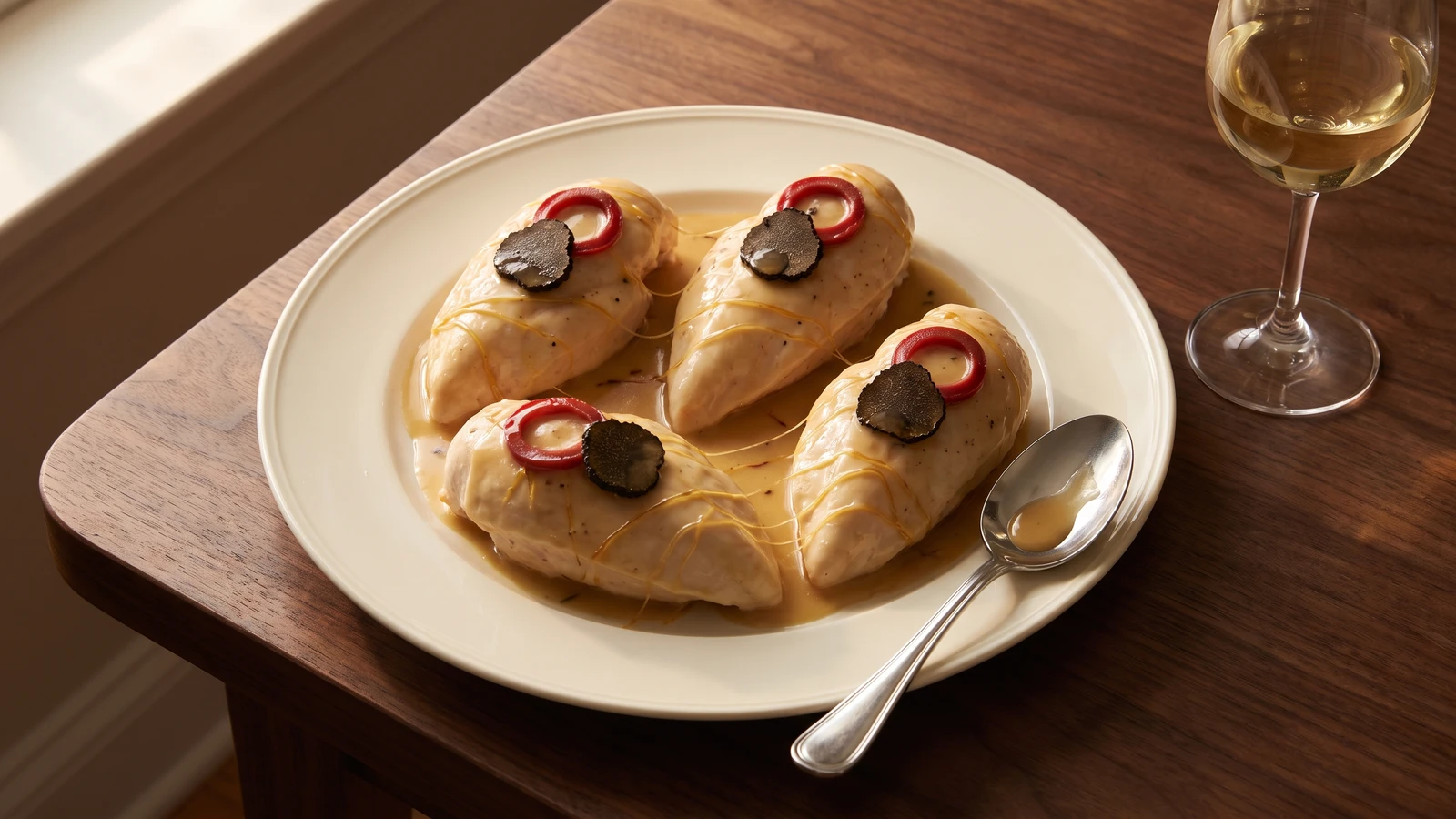
A poached chicken suprême over mushroom-filled mousseline, veiled in sauce Allemande and finished with truffle, red tongue, and pale meat glaze: grand-kitchen precision translated for four at home.
Suprêmes de Volaille Agnès Sorel (poached chicken breast fillets over mushroom-filled chicken mousseline) teaches orchestration. Several quiet preparations must arrive together, each delicate, none allowed to bully the next. The one true thing to know before touching a pan is that temperature governs everything: the mousseline must stay cold enough to bind, the bain-marie must remain gentle, and sauce Allemande, a chicken velouté finished with egg yolk and cream, must never boil after its liaison.
The grand kitchen around this entry assumed a saucier on staff, a stock never off the fire, trays of cold forcemeat, and a salamander within reach. Here one light chicken stock becomes poaching liquor, sauce foundation, and pale glaze; a processor and fine sieve replace the mortar and tamis; four little moulds replace banquet quantities; cooked cured tongue and a whole preserved truffle replace the cold larder when necessary. The salamander goes entirely because nothing here should brown. Those things were brigade scaffolding. The cold mousseline, buttered mushrooms, poached suprêmes, Allemande, truffle, red tongue, and thread of glaze are the dish, so every one stays.
At the table, the ivory ovals sit in a circle beneath pale, tender chicken, their sauce gleaming around a black truffle centre and its red ring of tongue. It is intricate, certainly, but cooking well is not cooking fancy. Chill the chicken, cream, processor bowl, and blade before making the mousseline. That cold bind is the step that decides the whole arrangement.
Suprêmes de Volaille Agnès Sorel belongs to the Parisian grand-cuisine repertoire, where a fixed garnish could identify a named dish as readily as the meat beneath it. Agnès Sorel, remembered at the court of Charles VII, gave her name here to a composition of poultry, mushrooms, truffle, tongue, Allemande sauce, and pale glaze, not to a regional recipe from her household. The moulded mousseline and precise decoration carried the composition from banquet service into bourgeois cookery books, preserving a presentation meant to be recognized at a glance.
Quantity
4 (about 20 ounces / 560 grams total)
trimmed into neat, evenly sized ovals
Quantity
8 ounces / 225 grams
cut into small cubes and thoroughly chilled
Quantity
4 cups (960 ml / 960 g)
divided
Quantity
1¼ cups (300 ml / 300 g)
thoroughly chilled and divided: 1 cup for the mousseline and ¼ cup for the sauce
Quantity
1
Quantity
2
Quantity
1⅓ cups (320 ml / 120 g)
thinly sliced
Quantity
5 tablespoons plus 1 teaspoon (80 ml / 76 g)
divided
Quantity
3 tablespoons (45 ml / 24 g)
Quantity
2 teaspoons (10 ml / 12 g)
divided
Quantity
¾ teaspoon (3.75 ml / 1.5 g)
divided
Quantity
1 tablespoon (15 ml / 15 g)
Quantity
1 small (about ¾ ounce / 20 g)
cut into 4 clean round slices
Quantity
4 very thin slices (about 1½ ounces / 40 g)
cut into narrow rings sized to encircle the truffle slices
| Ingredient | Quantity |
|---|---|
| skinless, boneless chicken breast filletstrimmed into neat, evenly sized ovals | 4 (about 20 ounces / 560 grams total) |
| skinless chicken breast meat for the mousselinecut into small cubes and thoroughly chilled | 8 ounces / 225 grams |
| light unsalted chicken stockdivided | 4 cups (960 ml / 960 g) |
| heavy creamthoroughly chilled and divided: 1 cup for the mousseline and ¼ cup for the sauce | 1¼ cups (300 ml / 300 g) |
| large egg white | 1 |
| large egg yolks | 2 |
| small button mushroomsthinly sliced | 1⅓ cups (320 ml / 120 g) |
| unsalted butterdivided | 5 tablespoons plus 1 teaspoon (80 ml / 76 g) |
| plain flour | 3 tablespoons (45 ml / 24 g) |
| fine saltdivided | 2 teaspoons (10 ml / 12 g) |
| ground white pepperdivided | ¾ teaspoon (3.75 ml / 1.5 g) |
| fresh lemon juice | 1 tablespoon (15 ml / 15 g) |
| fresh or whole preserved black trufflecut into 4 clean round slices | 1 small (about ¾ ounce / 20 g) |
| cured cooked red beef tonguecut into narrow rings sized to encircle the truffle slices | 4 very thin slices (about 1½ ounces / 40 g) |
Pour 1½ cups (360 ml) of the chicken stock into your smallest saucepan. Hold it at a quiet simmer until it reduces to about 3 tablespoons (45 ml), clear amber and lightly syrupy rather than dark, about 25 minutes. Skim any foam instead of stirring it back in. If it becomes tacky, loosen it immediately with a spoonful of unused stock; the glaze should leave a fine line from a spoon, not pull like caramel. Set it aside and reserve 1 teaspoon of the butter for its final finish.
Melt 1 tablespoon of the butter in a wide pan over medium-high heat. Add the sliced mushrooms with a small pinch of salt and toss for 2 to 3 minutes, just until flexible and glossed with butter. Keep them pale. If they release liquid, raise the heat briefly until the pan is dry, because wet mushrooms would loosen the mousseline around them. Spread them on a cold plate and chill completely.
Chill the food processor bowl and blade for 15 minutes. Measure 1 cup (240 ml) of the cold cream for the mousseline, keeping the remaining ¼ cup (60 ml) cold for the sauce. Process the cubed chicken with ½ teaspoon salt and ¼ teaspoon white pepper until smooth and tacky. Add the egg white and process only until absorbed. With the machine running, pour in three-quarters of the measured mousseline cream in a thin stream, then add the rest gradually until the forcemeat is glossy, soft, and able to hold a rounded peak. Push it once through a fine-mesh sieve for the proper silken texture. Poach a teaspoonful in barely simmering water for 2 minutes. It should be tender and spring softly under a finger. If it is firm, work another spoonful of the withheld mousseline cream into the bowl. If the mixture shows beads of fat or loses its body, it has warmed. Ça se rattrape: stop, nest the bowl over ice for 10 minutes, then pulse briefly with the remaining cold cream, one spoonful at a time. Never try to force a warm mousseline back together.
Heat the oven to 325°F (165°C). Butter four 4-inch (10 cm), roughly ½-cup (120 ml) oval tartlet moulds with 1 tablespoon butter. Spoon mousseline across each base and press it up the sides in an even layer about ⅜ inch (1 cm) thick. Divide the cold mushrooms among the hollow centres, keeping them away from the edges, then cover completely with the remaining mousseline and level the tops. Tap each mould once against a folded towel to settle hidden air pockets. Set the moulds in a deep roasting pan and add hot water to reach halfway up their sides. This is the bain-marie, a hot-water bath that poaches the mousseline gently. Cook for 22 to 28 minutes, until the centres feel just firm and register 160°F (71°C). The water may tremble but must not bubble; if it begins to boil, add a little cool water at once. Lift the moulds from the bath, rest them for 5 minutes, and keep them loosely covered.
Begin when the mousselines have been in the oven for about 10 minutes. Season the four suprêmes with 1 teaspoon salt and ¼ teaspoon white pepper. Melt 1 tablespoon butter in a lidded sauté pan just large enough to hold them in one layer, then lay them in without browning. Pour 1¼ cups (300 ml) stock around them, bring the liquid only to a tremble, and cover with a round of parchment and the lid. Poach gently for 10 to 14 minutes, according to thickness, until the centres reach 160 to 162°F (71 to 72°C). If the liquid boils, pull the pan off the heat and add a splash of cold reserved stock. Rest the suprêmes covered for 5 minutes and confirm they reach 165°F (74°C). Strain and reserve every drop of the poaching liquor.
Melt 2 tablespoons butter in a clean saucepan, stir in the flour, and cook for 2 minutes over gentle heat without allowing the roux to colour. Measure the strained chicken poaching liquor and add enough unused stock to make 2 cups (480 ml). Whisk this liquid into the roux a little at a time, bring it to a bare simmer, and cook for 8 to 10 minutes, whisking often, until the velouté coats the back of a spoon. Whisk the egg yolks with the reserved ¼ cup (60 ml) cream. Slowly whisk about one-third of the hot velouté into this liaison, then return everything to the saucepan. Stir over very low heat for 2 to 3 minutes, until the sauce becomes glossy and slightly fuller, but never let it boil. Remove it from the heat, add the lemon juice, and correct the salt and white pepper. If fine egg threads appear, lift the pan from the heat, whisk in a spoonful of cold cream or stock, and strain into a clean warm pan. If the sauce is too thick, loosen it with hot stock; if thin, stir it longer over the gentlest heat.
Cut the truffle into four even round slices. Trim each tongue slice into a narrow band and form it into a neat ring around a truffle slice, overlapping the ends underneath. Keep the garnishes covered at room temperature while the sauce finishes. The red tongue is not a stray flourish: its colour and savoury depth are part of the Agnès Sorel composition.
Warm a round serving platter. Run a thin knife around the moulds only if necessary, then turn the four mousselines out in a circle. Place one poached suprême squarely on each. Spoon sauce Allemande generously over the chicken and down the sides, allowing it to pool around the bases. Set one truffle slice on the crown of each suprême and fit its red tongue ring around it. Warm the pale meat glaze and whisk in the reserved teaspoon of butter. Using the tip of a teaspoon or a small paper cone, draw a fine thread of glaze around each sauced suprême, following the book's arrangement rather than making a decorative smear. Carry the platter straight to the table. À table!
1 serving (about 400g)
Culinary guides, cultural storytelling, and the editorial depth that makes cooking meaningful.
Discover Culinary ExplorerChef Juliette
John Dory has the delicacy of sole and the firmness of turbot. A light flouring, a quick butter sauté, and nut-brown beurre noisette show exactly why looks never mattered.

Chef Juliette
Fresh haddock proves its delicacy in the meunière pan: a fine flour crust, moist pearly flakes, and beurre noisette sharpened with lemon and parsley, ready from one skillet in half an hour.

Chef Juliette
Éperlans à l’Anglaise turns small fish into a lesson in disciplined coating: boned smelts under a close, crisp crumb, pan-fried in clarified butter and finished with bright, half-melted maître d’hôtel butter.

Chef Juliette
Tiny smelts, shallot, mushrooms, white wine, gratin sauce, and fine bread raspings meet a fierce oven, where the fish must turn tender in the same breath the buttered crust bronzes.