Culinary Explorer

A cooking platform built around craft, culture, and the stories behind what we eat.
Discover Culinary Explorer
Filets

Filets

Created by Chef Juliette

Based on No. 1580, Filets, from Le Guide Culinaire (1907) by Auguste Escoffier

Filets de volaille sautés teach the discipline of even cutting and last-minute cooking: flour lightly, gild quickly in clarified butter, and serve before a tender chicken breast has time to harden.

Main Dishes
French
Weeknight
Quick Meal
20 min
Active Time
10 min cook30 min total
Yield4 servings

Filets de volaille sautés (sautéed chicken breast fillets) teach one exact lesson: cut evenly and they cook evenly. A suprême, the skinless breast fillet of a fowl, is tender enough to gild in the same minutes it cooks through. Leave one end thick and the other thin, and the pan makes you choose between raw and dry.

The original formula assumed whole birds entering a brigade, a cook to split the breasts along the sternum, minion fillets lifted clear, clarified butter ready, and plates leaving the instant the pan was done. It needed neither a saucier nor the stockpot that never left the fire, and it called for no salamander, because this is a dry pan formula with no sauce or gratin. At home, four small breasts replace the whole birds, a heavy skillet replaces the vegetable pan, and wooden picks hold the truffle-contised minions in their crescents. Buying the breasts already divided is scaffolding we can remove; even thickness, dry sautéing, clarified butter, and immediate service are the dish and must stay. One cook, one stove, one evening.

Flour only at the last moment and don't crowd the pan. If a piece colors before its center is ready, lower the heat and turn it more often; ça se rattrape. Once cooked, however, a suprême cannot wait, so have the table and side dish ready before the butter grows hot.

In the Parisian classical kitchen, filet and suprême became synonymous menu terms for the skinless breast half of a fowl, composed of the large fillet and its smaller minion fillet. Côtelettes and ailerons were related cuts with the wing's humerus left attached, while the croquette-like cutlet made from cooked meat was a different preparation entirely. The breast passed from the poultry bench to the sauté pan as an à la minute, cooked-to-order formula, prized for precise trimming, quick gilding, and immediate service rather than an elaborate sauce.

The technique, the tradition, and the story behind every dish.

Discover Culinary Explorer

Ingredients

small skinless, boneless chicken breasts with tenderloins attached

Quantity

4 (about 1½ lb / 680 g total)

whole truffle, fresh or preserved in its own juice

Quantity

1 small (about ½ oz / 15 g)

very thinly sliced

plain flour

Quantity

¼ cup (60 ml / 30 g)

clarified unsalted butter

Quantity

4 tablespoons (60 ml / 56 g)

fine sea salt

Quantity

1¼ teaspoons (6 ml / 7 g)

Equipment Needed

  • 12-inch (30 cm) heavy skillet
  • Small sharp knife
  • Flat meat mallet or small heavy saucepan
  • Instant-read thermometer
  • 4 wooden cocktail picks

Instructions

  1. 1

    Prepare the service

    Finish the accompanying vegetables or salad before beginning the chicken. Warm four plates in the lowest oven, or fill them briefly with hot water and dry them well. Arrange the flour, salt, butter, thermometer, and serving fork beside the stove. This mise en place, work put in order, protects the defining demand of the recipe: once the suprêmes are cooked, nothing may keep them waiting.

  2. 2

    Trim the suprêmes

    Pull the minion fillet, the small tenderloin, from the underside of each breast. Grip its white tendon through a clean towel, hold a small knife almost flat against it, and scrape the flesh away while pulling the tendon free. Set the minions aside. Place each large fillet between sheets of parchment and flatten only the thickest part until the meat is an even ⅝ inch (1.5 cm) thick. Keep the natural oval shape and don't pound it into a thin escalope.

    If one end remains distinctly thicker, correct it now with two or three gentle taps. Evenness is the one true thing to settle before the chicken touches the pan.
  3. 3

    Contise the minions

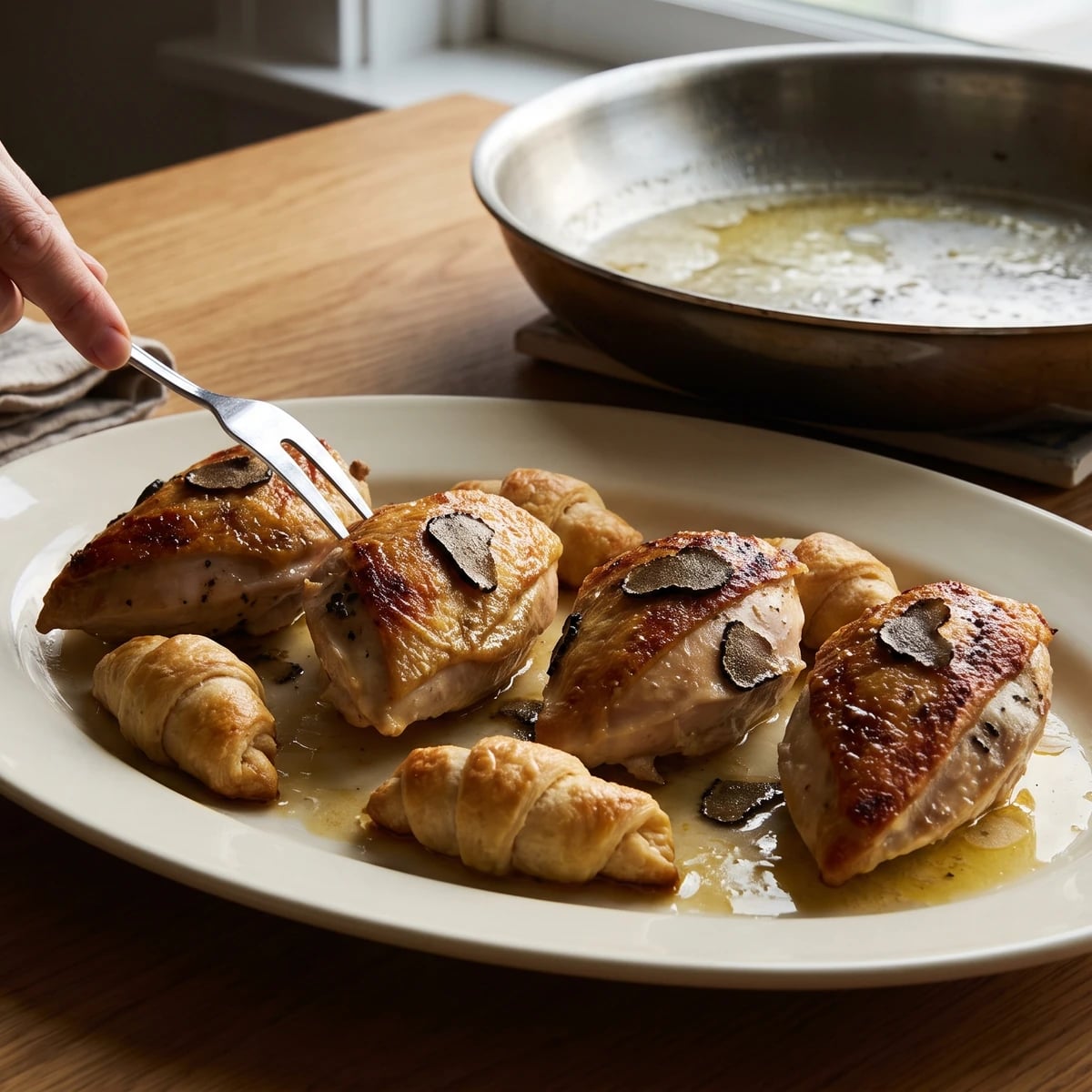
    Contise each minion by making three tiny, regularly spaced incisions across its smooth side and half-inserting a thin slice of truffle into every cut. Curve each minion into a crescent with the truffle showing and secure the ends with a wooden pick. This keeps the book's truffle garnish without requiring a brigade cook to shape it at service. Keep the crescents cold while you prepare the large fillets.

  4. 4

    Flour them lightly

    Dry every piece of chicken thoroughly and season both sides with the salt. Spread the flour on a plate, pass each suprême and minion through it, then tap and brush away everything that does not cling as a fine veil. Flour only when the skillet is nearly ready; left standing, it draws moisture from the meat and turns pasty instead of gilding.

  5. 5

    Sauté and gild

    Heat the clarified butter in a heavy 12-inch (30 cm) skillet over medium-high heat until it shimmers freely across the surface. If it begins smoking, lift the pan from the heat; if it smells scorched, wipe the skillet carefully and begin with fresh clarified butter. Ça se rattrape. Lay in the four suprêmes, smooth side down, without letting them overlap. Sauté undisturbed for 2 to 3 minutes, until evenly gilded, then turn and cook the second side for about 2 minutes. The meat should feel resilient, not hard, and register 160 to 162°F (71 to 72°C) at its thickest point.

    If the surface gilds before the center is warm enough, lower the heat and turn the suprêmes every 30 seconds until they reach temperature. Add no liquid and don't cover the pan; moistening near a boil hardens this tender cut.
  6. 6

    Finish and serve

    Transfer the suprêmes directly to the warm plates. During their brief carryover rest, sauté the minion crescents in the same butter for 45 to 60 seconds per side, until white throughout and registering 165°F (74°C). Remove the wooden picks and place one crescent beside each suprême. Confirm that the large fillets have reached 165°F (74°C); if not, return them to gentle heat for 20 to 30 seconds per side. Serve immediately. À table!

Chef Tips

  • Choose small breasts weighing about 5 to 6 ounces (140 to 170 g) each, with the tenderloins still attached. If the market offers only very large breasts, divide them horizontally into even portions rather than trying to cook a thick club of meat through.
  • Clarified butter matters because its milk solids have been removed, allowing the pan to grow hot enough to gild the flour without burning. We don't apologize for butter, and we don't replace it with margarine.
  • Fresh truffle is splendid when available, but a sound whole preserved truffle is the classical pantry's honest answer outside its season. Pat it dry and slice it thinly. Synthetic truffle oil cannot be contised into the meat and does not belong here.
  • Do not deglaze the skillet for an improvised sauce. This entry is deliberately a master method for the fillet itself, and its warning against moistening is precise. Serve with buttered spinach, haricots verts, or peas already waiting on the plate.
  • A dry white Burgundy or a restrained white from the Loire suits the mild chicken and truffle without smothering them. Pour it before the suprêmes enter the pan, because these fillets wait for no corkscrew.

Advance Preparation

  • Clarified butter can be prepared several days ahead and kept covered in the refrigerator. Measure it before cooking so it can melt evenly in the skillet.
  • The chicken may be trimmed and the minion fillets contised up to 4 hours ahead, then covered and refrigerated. Bring the pieces out about 15 minutes before cooking, but dry, season, and flour them only at the last moment.
  • The cooked suprêmes cannot be made ahead or held warm without losing the tenderness this method is designed to protect. Prepare every accompaniment first and sauté the chicken only when everyone is ready to eat.

Frequently Asked Questions

Nutrition Information

1 serving (about 155g)

Calories
360 calories
Total Fat
19 g
Saturated Fat
10 g
Trans Fat
0 g
Unsaturated Fat
9 g
Cholesterol
160 mg
Sodium
800 mg
Total Carbohydrates
6 g
Dietary Fiber
0 g
Sugars
0 g
Protein
39 g

Note: Chef personas and recipes are created with AI assistance. Cook with care: follow safe food-handling practices, check doneness with a thermometer when needed, and adapt for allergies and your kitchen.

Where cooking meets culture.

Culinary guides, cultural storytelling, and the editorial depth that makes cooking meaningful.

Discover Culinary Explorer

More from Poultry (Volaille) - Suprêmes de Volaille

Browse the full collection