Culinary Explorer

A cooking platform built around craft, culture, and the stories behind what we eat.
Discover Culinary Explorer
Poulet Sauté Verdi

Poulet Sauté Verdi

Created by Chef Juliette

Based on No. 1579, Poulet Sauté Verdi, from Le Guide Culinaire (1907) by Auguste Escoffier

Butter-sautéed chicken rises inside a Parmesan-rich Piedmontese rizotto border, ringed with seared foie gras and black truffle, then glossed with Asti and veal-stock sauce for a true celebration centerpiece.

Main Dishes
French
Special Occasion
Celebration
Dinner Party
45 min
Active Time
1 hr 10 min cook1 hr 55 min total
Yield4 servings

Poulet Sauté Verdi (butter-sautéed chicken with Piedmontese rizotto, foie gras, truffle, and Asti sauce) teaches orchestration. Sauté means cooking the bird in a shallow pan with butter until deeply bronzed, without burying it in liquid. The one true thing to know before touching the pan is that every garnish must be measured, sliced, and waiting before the foie gras begins to cook.

The brigade entry assumes a cook for the rizotto, a saucier beside a stockpot never off the fire, and a metal border mould waiting on a hot plate. At home, one saucepan makes the rizotto, concentrated veal stock supplies the three spoonfuls the sauce needs, an ordinary bowl guides the border, and the chicken pan becomes the saucier. Those separate stations and the special mould are scaffolding. The rizotto border, butter Sauté, foie gras and truffle crown, Asti reduction, and final mounting with real butter are the dish, so every one stays.

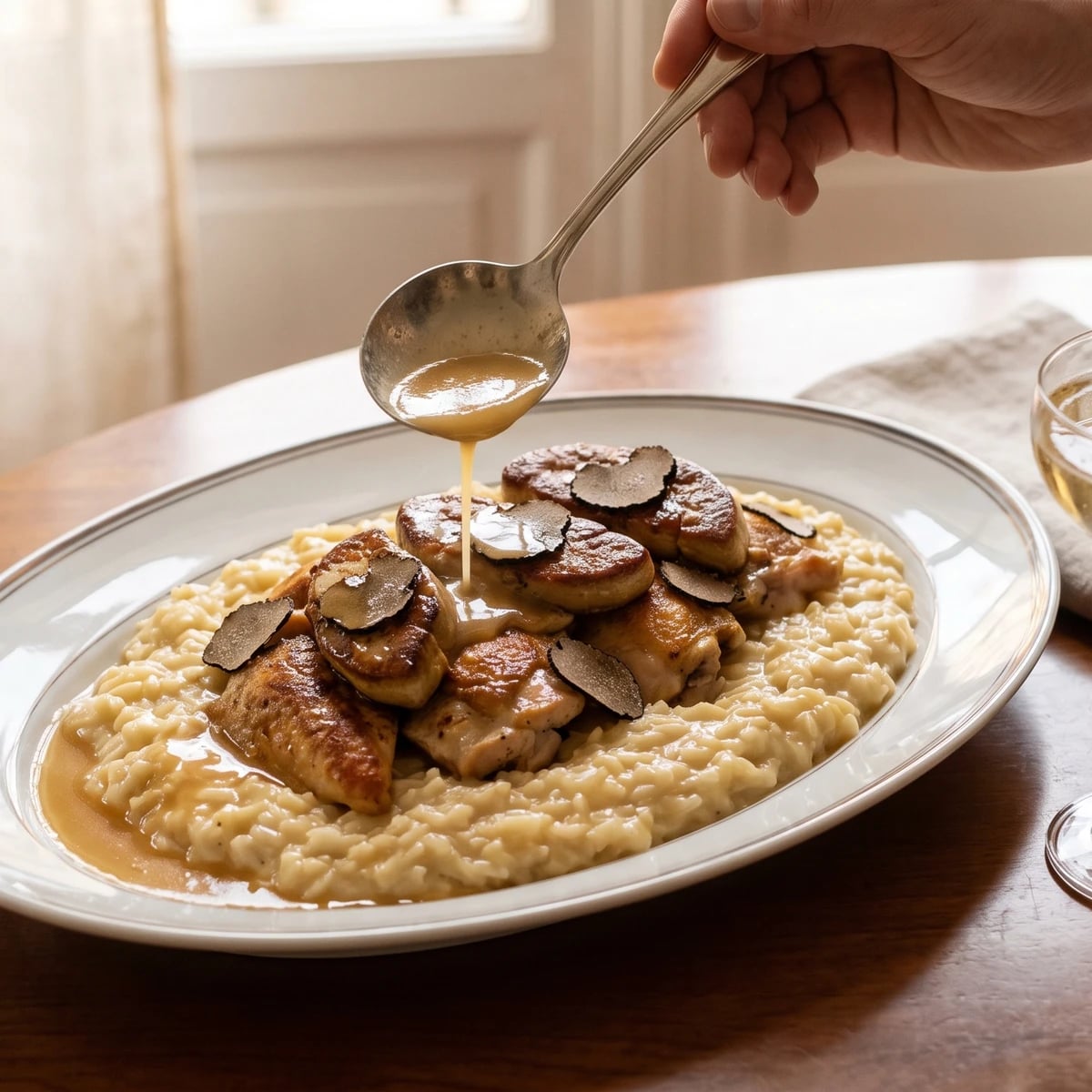
The finished platter is generous and unapologetically formal: bronzed chicken in the centre, ivory-gold rizotto around it, black truffle and foie gras leaning against the bird, and a pale Asti sauce gleaming over the chicken. Timing decides whether it arrives splendid or merely expensive. Warm the platter and slice the truffle before you start the foie gras, because that final sear and assembly cannot wait.

Poulet Sauté Verdi belongs to the Parisian grand-kitchen repertoire of named celebration dishes, where familiar techniques were composed into formal centrepieces with architectural borders and costly garnishes. Its dedication to Giuseppe Verdi is carried through Piedmontese rizotto and Asti wine, while foie gras, truffle, fond, and mounted butter speak the language of the French classical table. It is not a regional Italian chicken recipe, but an Italian homage expressed through French sauce work.

The technique, the tradition, and the story behind every dish.

Discover Culinary Explorer

Ingredients

small chicken

Quantity

1, 3 to 3½ lb (1.4 to 1.6 kg)

cut into 8 pieces

fine sea salt

Quantity

2 teaspoons (10 ml / 12 g)

divided

freshly ground white pepper

Quantity

¾ teaspoon (3.75 ml / 1.5 g)

divided

Carnaroli or Arborio rice

Quantity

1¼ cups (300 ml / 250 g)

yellow onion

Quantity

½ cup (120 ml / 75 g)

very finely chopped

unsalted chicken stock

Quantity

3½ cups (830 ml / 830 g)

kept hot

unsalted butter for the rizotto

Quantity

4 tablespoons (60 ml / 56 g)

divided

Parmigiano-Reggiano

Quantity

¾ cup (180 ml / 70 g)

finely grated

unsalted butter for sautéing the chicken

Quantity

3 tablespoons (45 ml / 42 g)

fresh duck foie gras

Quantity

6 oz (170 g)

cut into 6 chilled escalopes

unsalted butter for finishing the foie gras

Quantity

1 teaspoon (5 ml / 5 g)

whole black truffle

Quantity

1 small, about 1 oz (28 g)

thinly sliced

Asti wine

Quantity

½ cup (120 ml / 120 g)

concentrated veal stock

Quantity

3 tablespoons (45 ml / 45 g)

cold unsalted butter for the sauce

Quantity

3 tablespoons (45 ml / 1½ oz / 42 g)

cut into small cubes

Equipment Needed

  • 3-quart heavy saucepan
  • 12-inch ovenproof skillet
  • 8-inch heavy skillet for the foie gras
  • Large oval serving platter
  • 6-inch heatproof bowl to guide the rizotto border
  • Instant-read thermometer
  • Small whisk

Instructions

  1. 1

    Set the kitchen

    Heat the oven to 400°F (200°C). Dry the chicken thoroughly, then season it with 1½ teaspoons of the salt and ½ teaspoon of the white pepper. Keep the foie gras cold, slice the truffle, measure the Asti and veal stock, and return the sauce butter to the refrigerator. Set a large oval serving platter in hot water, then dry it just before shaping the rizotto. This mise en place is not fussiness. Once the foie gras meets its pan, the dish moves without pause.

  2. 2

    Cook the rizotto

    Melt 2 tablespoons of the rizotto butter in a heavy saucepan over medium-low heat. Add the onion and cook without colouring until soft and translucent, about 5 minutes. Stir in the rice and cook for 2 minutes, turning every grain through the butter until the edges look translucent. Add the hot chicken stock a ladle at a time, stirring regularly and waiting until each addition is nearly absorbed before adding the next. After 18 to 20 minutes, the grains should be tender with a slight firmness at their centres and the rizotto should hold a soft mound.

  3. 3

    Shape the border

    Take the rizotto off the heat and beat in the remaining 2 tablespoons rizotto butter, the Parmigiano-Reggiano, and most of the remaining salt and pepper. Taste before adding the rest. The border needs to be firmer than a bowl of risotto but still creamy inside. If it spreads, cook it for another minute; if it has tightened into a paste, beat in hot stock one tablespoon at a time. Ça se rattrape. Place a heatproof 6-inch bowl upside down in the centre of the warmed platter, spoon the rizotto around it in a broad even ring, then lift away the bowl. Cover the border with buttered parchment and keep it beside the stove for no longer than 35 minutes.

  4. 4

    Sauté the chicken

    Melt 2 tablespoons of the chicken butter in a large ovenproof skillet over medium-high heat, keeping the final tablespoon in reserve. When the foam subsides, brown the chicken in uncrowded batches, skin-side first, until every piece is a deep butter-gold. Begin with the legs, which need the longer cooking. Return all the pieces to the skillet skin-side up, baste them with the butter, and finish in the oven for 15 to 22 minutes. Remove the breast pieces when they reach 165°F (74°C); let the legs continue to about 175°F (79°C), when their joints move easily. If the butter turns black rather than nut-brown, lift out the chicken, wipe away the bitter solids, and continue with the reserved butter. Ça se rattrape, but scorched butter cannot build a good sauce.

  5. 5

    Build the centre

    Rest the chicken for 5 minutes. Remove the parchment from the rizotto and arrange the chicken compactly in the open centre, building a little height without hiding the browned skin. Pour excess fat from the chicken skillet into a bowl, leaving the brown fond attached to the pan. Keep a folded towel around the skillet handle, which will remain very hot from the oven.

  6. 6

    Sear the foie gras

    Heat a clean dry skillet until properly hot. Pat the cold foie gras dry and sear the escalopes for 20 to 30 seconds on each side, just until their faces take a dark caramel colour. Turn off the heat, add the teaspoon of butter, and tilt the pan so the butter glosses the slices. This is the home correction to the source's butter-tossed foie gras: foie gras supplies ample fat of its own, so butter goes in after the sear, where it flavours without burning. If a slice softens and begins shedding heavily, lift it out at once. A cracked escalope can be tucked behind a truffle slice in the crown. Never apologize at your own table.

  7. 7

    Crown the chicken

    Lean the foie gras escalopes against the chicken around the inner edge of the rizotto border, alternating each piece with several overlapping slices of black truffle. Keep the caramel faces visible and make a complete crown rather than scattering the garnish. The geometry has a purpose: the rice catches the sauce while the foie gras and truffle perfume the chicken.

  8. 8

    Mount the Asti sauce

    Set the chicken skillet over medium-high heat and swill it with the Asti, pouring in the wine and scraping until every soluble brown speck of fond releases from the pan. Reduce the Asti to about 2 tablespoons, glossy and lightly syrupy, then add exactly 3 tablespoons of veal stock and simmer for 1 minute. Remove the pan from the heat. Monter au beurre, whisk in the cold butter, one cube at a time, until the sauce is smooth, lightly thickened, and gleaming. Do not boil after the butter enters. If the sauce turns greasy, put a teaspoon of cold water in a clean warm bowl and whisk the broken sauce into it in a thin stream. Ça se rattrape.

  9. 9

    Sauce and serve

    Taste the sauce for salt and white pepper, remembering that the veal stock and Parmigiano-Reggiano already carry seasoning. Spoon the Asti sauce over the pieces of chicken as the source directs, allowing a little to pool against the inner edge of the rizotto while leaving the seared foie gras and truffle crown visible. Carry the platter straight to the table. This dish waits for no speech. À table!

Chef Tips

  • The three tablespoons of veal stock look modest because the stock must be concentrated. Use homemade brown veal stock reduced until lightly gelatinous, or reduce a good unsalted prepared stock by half. A thin carton poured straight into the pan gives volume, not backbone.
  • Use fresh black truffle when its scent is full, or a whole preserved black truffle drained and dried carefully. The classical pantry has always understood preservation. Truffle oil cannot supply the slices, texture, or clean aroma this crown requires.
  • Keep the foie gras cold until the skillet is ready, and use a dry pan. The source tosses it in butter, but fresh foie gras renders immediately; the small off-heat addition of butter preserves the intended flavour without scorching either fat.
  • Asti brings sweetness as well as perfume, so reduce it carefully and use unsalted stock. If your bottle is particularly sweet, stop the reduction when it becomes lightly syrupy rather than forcing it toward caramel.
  • Serve with a dry Champagne or a firm, mineral white Burgundy. The dish already has richness and fragrance enough; the glass should clear the palate, not compete with the truffle.

Advance Preparation

  • Cut and season the chicken up to 8 hours ahead, then keep it covered in the refrigerator. Dry the skin again before it enters the butter.
  • The chicken and veal stocks can be prepared and portioned up to 3 days ahead. Keep the concentrated veal stock separate so its exact three-tablespoon measure is ready for the sauce.
  • Grate the Parmigiano-Reggiano, chop the onion, measure the rice, and cube the sauce butter earlier in the day. Keep the butter cold and the foie gras colder.
  • Do not fully cook the rizotto hours ahead, and do not make the mounted sauce in advance. The border tolerates a brief warm hold, but the foie gras and Asti butter sauce belong to the final minutes.

Frequently Asked Questions

Nutrition Information

1 serving (about 530g)

Calories
1115 calories
Total Fat
68 g
Saturated Fat
31 g
Trans Fat
1 g
Unsaturated Fat
36 g
Cholesterol
390 mg
Sodium
1750 mg
Total Carbohydrates
58 g
Dietary Fiber
1 g
Sugars
4 g
Protein
66 g

Note: Chef personas and recipes are created with AI assistance. Cook with care: follow safe food-handling practices, check doneness with a thermometer when needed, and adapt for allergies and your kitchen.

Where cooking meets culture.

Culinary guides, cultural storytelling, and the editorial depth that makes cooking meaningful.

Discover Culinary Explorer

More from Poultry (Volaille) - Poulets Sautés

Browse the full collection