Culinary Explorer

A cooking platform built around craft, culture, and the stories behind what we eat.
Discover Culinary Explorer
Poulet Sauté Van Dyck

Poulet Sauté Van Dyck

Created by Chef Juliette

Based on No. 1577, Poulet Sauté Van Dyck, from Le Guide Culinaire (1907) by Auguste Escoffier

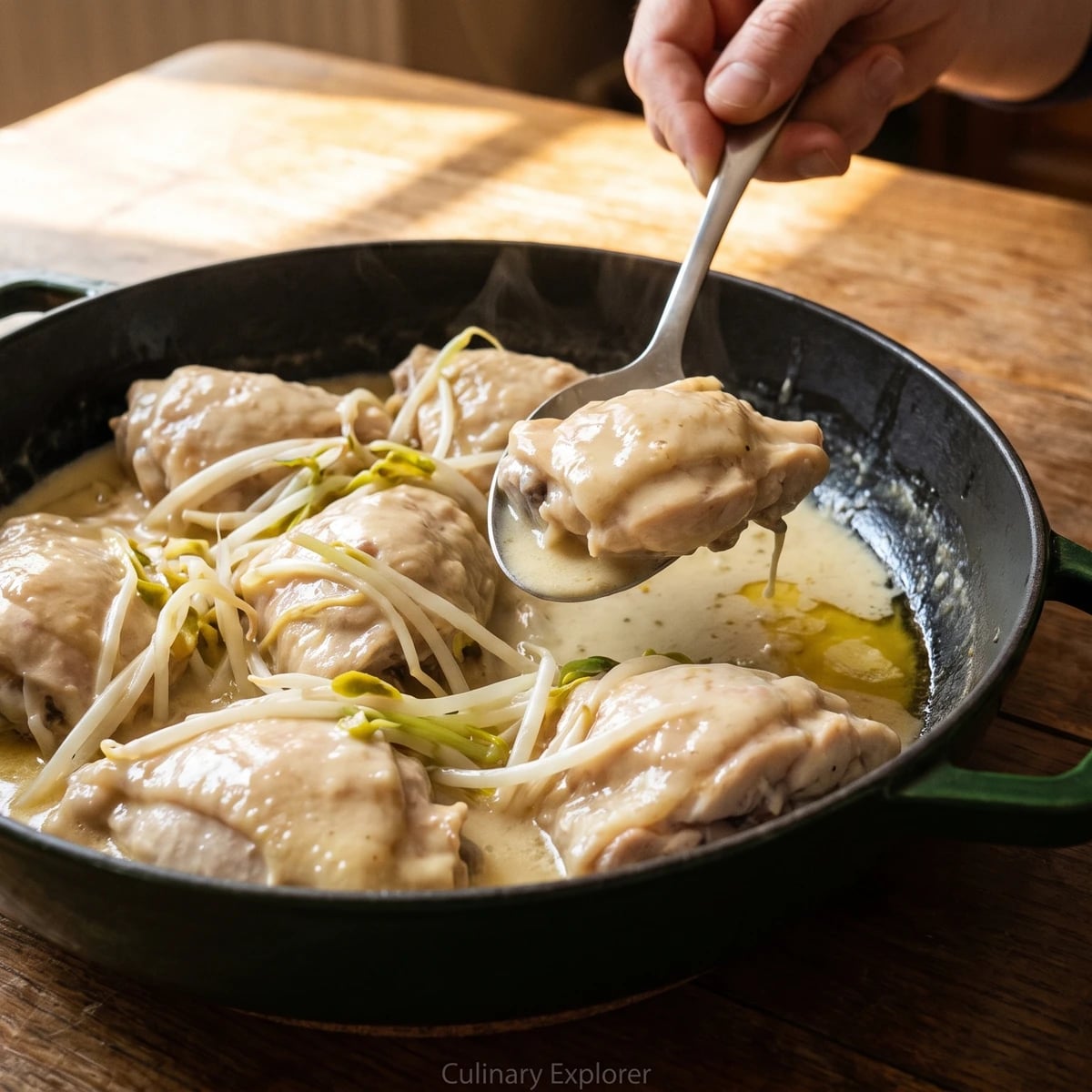
Poulet Sauté Van Dyck keeps chicken pale and lets spring hop shoots speak, binding cream and Suprême Sauce into an ivory gloss before the shoots receive their exact two-minute finish.

Main Dishes
French
Dinner Party
Special Occasion
25 min
Active Time
40 min cook1 hr 5 min total
Yield4 servings

Poulet Sauté Van Dyck (chicken cooked pale in butter with creamy hop sprouts) teaches a rarer lesson than browning: delicacy must still have structure. The one true thing to know before touching the pan is that the chicken must cook through without taking color. Brown butter or bronzed skin would bully the tender shoots and ivory sauce; pale is the dish, not a timid version of it.

The original kitchen assumed a saucier on staff, stock never off the fire, and finished Suprême Sauce ready at service. No salamander belongs here, because all the work happens in the pan. Your home equivalent is one jointed chicken, 95 ml each of cream and finished Suprême Sauce, 227 g of hop sprouts, one sauté pan, and a warmed cocotte. Keeping several pans hot and holding sauce in brigade quantities are scaffolding, so they can go. The pale butter cooking, the one-third reduction, and the final two minutes for the shoots are the dish itself, so they stay exactly where the entry puts them.

Done properly, the chicken arrives under a glossy ivory sauce, with the young hop shoots still distinct and faintly bitter against the cream. Have everything measured before the chicken meets the butter. The final two minutes decide the dish, and they are not approximate.

Poulet Sauté Van Dyck belongs to the French grand-kitchen repertoire of named sautés, while its hop sprouts place its flavor firmly in the spring larder of French Flanders and neighboring Belgian Flanders. The title invokes the Antwerp-born Flemish painter Anthony van Dyck, reflecting the canon's habit of naming formal compositions for cultural figures rather than recording them as regional farmhouse dishes. The shoots are not a decorative green garnish; they are the seasonal identity of the preparation.

The technique, the tradition, and the story behind every dish.

Discover Culinary Explorer

Ingredients

whole chicken

Quantity

1 chicken, 3½ to 4 lb (1.6 to 1.8 kg)

cut into 8 pieces and patted dry

young hop sprouts

Quantity

8 oz (227 g)

fibrous ends trimmed and shoots washed

unsalted butter

Quantity

3 tbsp (45 ml / 42 g)

fine salt

Quantity

2 tsp (10 ml / 12 g)

divided

ground white pepper

Quantity

¼ tsp (1.25 ml / 0.6 g)

heavy cream, preferably 35% fat

Quantity

⅓ cup plus 1 tbsp (95 ml / 95 g)

finished Suprême Sauce

Quantity

⅓ cup plus 1 tbsp (95 ml / about 100 g)

warmed until fluid

Equipment Needed

  • 12-inch (30 cm) heavy lidded sauté pan
  • 3-quart (2.8-liter) shallow serving cocotte
  • Wide saucepan for parboiling
  • Instant-read thermometer
  • Skimmer or kitchen spider

Instructions

  1. 1

    Parboil the hop shoots

    Bring a wide saucepan of water to a lively boil and season it with 1 teaspoon of the measured salt. Add the hop sprouts and parboil them for 60 to 90 seconds, just until they bend without becoming soft. Lift them immediately into cold water, then drain and blot them thoroughly. If they have already softened too far, chill them at once and give them only 30 seconds in the final sauce. Ça se rattrape, but properly parboiled shoots will take the full two minutes.

  2. 2

    Cook the chicken pale

    Season the chicken with the remaining salt and the white pepper. Melt the butter in a wide, heavy lidded sauté pan over medium-low heat until it foams, keeping it well below the point where it colors. Add the thighs, drumsticks, and wings in one layer and cook gently for 6 minutes, turning once. Add the breast pieces, cover, lower the heat, and continue for 18 to 22 minutes, turning everything every 4 minutes. Maintain only a quiet sizzle. Remove each breast piece when its thickest part reaches 165°F (74°C); let the legs continue until they reach at least 170°F (77°C). If the butter begins to tan, lift the pan from the heat immediately and lower the burner before continuing. The chicken may be butter-gold, but it must not brown.

  3. 3

    Hold in the cocotte

    Warm a shallow serving cocotte with hot water, dry it thoroughly, and arrange the cooked chicken inside. Cover loosely while you finish the sauce, no longer than 10 minutes. Leave the butter and pale chicken juices in the sauté pan; they are the foundation the cream must gather up.

  4. 4

    Reduce the ivory sauce

    Pour the cream into the sauté pan and swirl it through the butter and chicken juices, scraping gently to recover everything without beating air into the sauce. Add the warm finished Suprême Sauce and bring the mixture to a gentle simmer. Reduce it by one-third, from about 190 ml to roughly 125 ml, until it is nappant, meaning it lays a light, glossy coat over the back of a spoon. Do not boil it hard. If butter begins to bead around the edge, remove the pan from the heat and whisk in 1 teaspoon of cold water until smooth, then resume over gentler heat. Ça se rattrape.

  5. 5

    Give hops two minutes

    Return the sauce to the barest simmer, add the drained hop sprouts, and set a timer for exactly 2 minutes. Fold them through once so every shoot is coated, but do not stir them into submission. Taste the sauce and correct the seasoning. At two minutes, take the pan off the heat at once; another several minutes turns the shoots limp and lets their bitterness dominate.

  6. 6

    Sauce and serve

    Pour the hop sprouts and glossy sauce over the chicken in the warmed cocotte, working the sauce between the pieces rather than hiding them completely. Bring it straight to the table while the shoots still hold themselves. À table!

Chef Tips

  • Hop sprouts are a true spring ingredient. Buy young white or pale green shoots that feel crisp and snap cleanly; mature hop vines and hop cones are fibrous, aggressively bitter, and cannot replace them.
  • If hop sprouts cannot be found, wait for their season if you want Poulet Sauté Van Dyck. Tender asparagus tips make a pleasant cousin cooked by the same method, but the result is another dish, and there is no dignity in pretending otherwise.
  • The Suprême Sauce must be finished before this recipe begins and warm enough to flow. This preparation reaches for it as a complete component; its own method remains with its own entry, just as the classical kitchen intended.
  • Butter, not oil; heavy cream, not a reduced-fat substitute. Their fat holds the pale sauce together and rounds the clean bitterness of the shoots.
  • A dry bière de garde from French Flanders is particularly good with the hop sprouts. For wine, pour an unoaked Chardonnay with enough acidity to carry the cream.

Advance Preparation

  • The finished Suprême Sauce can be prepared up to 2 days ahead, covered and chilled. Rewarm it over the gentlest heat until fluid before measuring it for this dish.
  • The chicken can be jointed up to 1 day ahead and kept covered in the cold. Pat it dry and season it shortly before cooking.
  • Trim and wash the hop sprouts up to 6 hours ahead. They may be parboiled up to 2 hours before serving, then drained, dried, and chilled.
  • Do not finish the assembled dish early. The chicken can wait in its covered cocotte while the sauce reduces, but the hop sprouts must receive their two minutes immediately before serving.

Frequently Asked Questions

Nutrition Information

1 serving (about 320g)

Calories
705 calories
Total Fat
48 g
Saturated Fat
20 g
Trans Fat
1 g
Unsaturated Fat
24 g
Cholesterol
250 mg
Sodium
1550 mg
Total Carbohydrates
5 g
Dietary Fiber
1 g
Sugars
2 g
Protein
60 g

Note: Chef personas and recipes are created with AI assistance. Cook with care: follow safe food-handling practices, check doneness with a thermometer when needed, and adapt for allergies and your kitchen.

Where cooking meets culture.

Culinary guides, cultural storytelling, and the editorial depth that makes cooking meaningful.

Discover Culinary Explorer

More from Poultry (Volaille) - Poulets Sautés

Browse the full collection