
Chef Juliette
John Dory (St. Pierre)
John Dory has the delicacy of sole and the firmness of turbot. A light flouring, a quick butter sauté, and nut-brown beurre noisette show exactly why looks never mattered.
A cooking platform built around craft, culture, and the stories behind what we eat.
Created by Chef Juliette
Based on No. 1576, Poulet Sauté aux Truffes, from Le Guide Culinaire (1907) by Auguste Escoffier
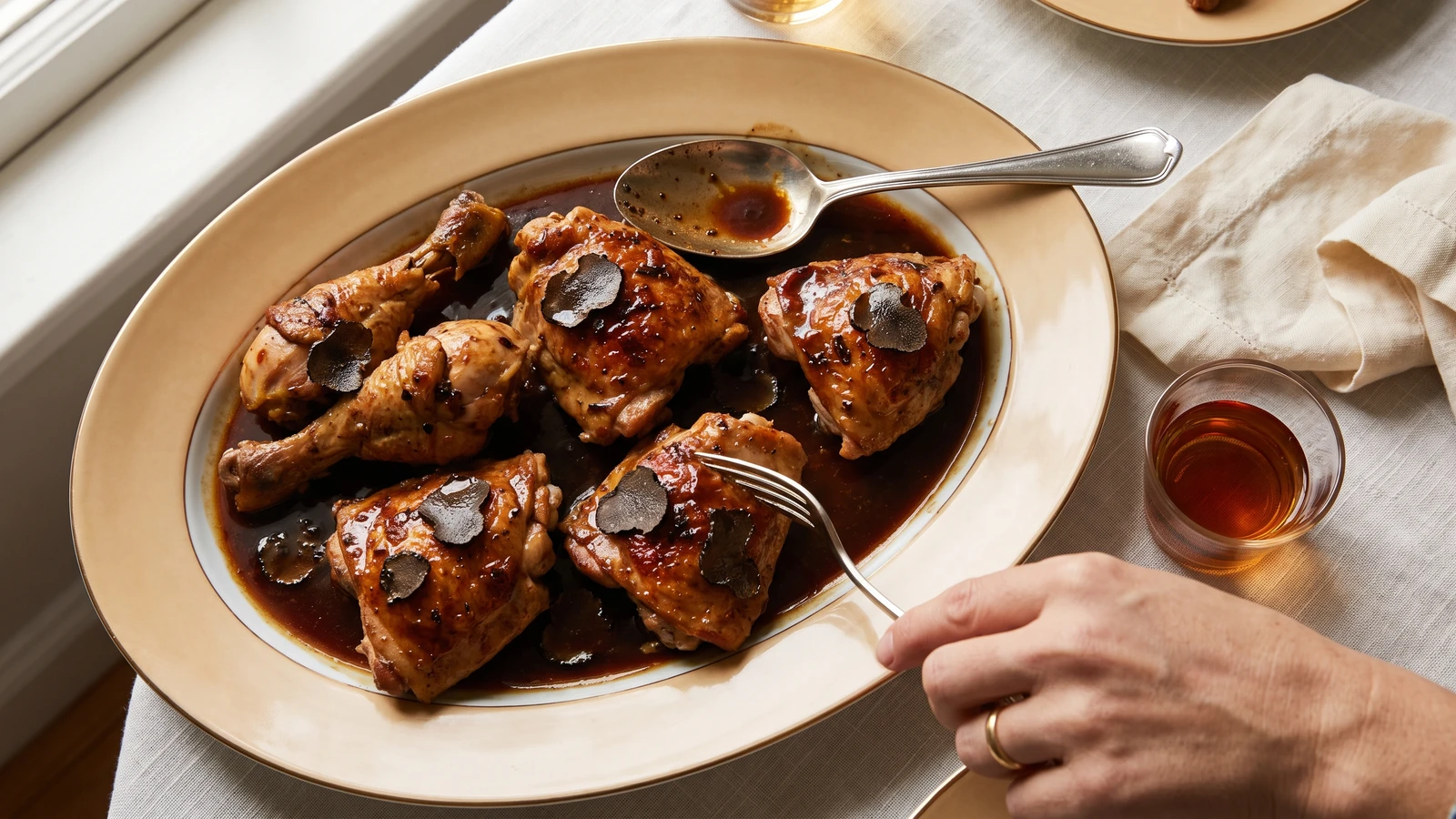
Raw black truffle enters the butter-browned chicken halfway through, lending its perfume without surrendering it, before Madeira, sauce demi-glace, and cold butter turn the pan fond into a dark gloss.
Poulet Sauté aux Truffes (butter-sautéed chicken with black truffles) teaches one exact restraint: truffle must cook long enough to perfume the butter, but not so long that the pan spends its scent. The slices enter only when the chicken is half-sautéed. Then the covered pan holds their aroma close while the flesh finishes gently.
The original entry assumed a saucier on staff and a stockpot of Sauce demi-glace never off the fire. At home, three tablespoons of a good real-stock demi-glace provide the honest equivalent, and one broad lidded skillet does the work of the sauté station. A salamander has no place in this method, so your broiler stays cold. The entry is already centered on one chicken, exactly right for four; its full six ounces of truffle and three tablespoons of half-glaze remain because those proportions are the dish. What disappears is brigade scaffolding, not the Madeira reduction or the monter au beurre (whisking in cold butter) that gives the sauce its gloss. One cook, one stove, one evening.
The finished chicken should be deeply bronzed, the truffle visible among the pieces, and the sauce dark, glossy, and generous enough to pool beneath them. The decisive step is simple: add the sliced truffle halfway through, never at the beginning.
Poulet sauté aux truffes belongs to the grand kitchens of Paris, which drew black truffles north from Périgord and folded them into the national sauce repertoire. Madeira and Sauce demi-glace reveal its dining-room lineage: the bird is cooked to order while the stockpot supplies concentrated depth at once. It is often mistaken for a rustic Périgord preparation, but its identity lies in the classical sauté sequence and the lavish quantity of fresh truffle, not in a regional farmhouse garnish.
Quantity
1 chicken (about 3½ lb / 1.6 kg)
cut into 8 serving pieces
Quantity
1¾ teaspoons (8.5 ml / 10 g)
Quantity
¾ teaspoon (3.75 ml / 1.5 g)
Quantity
3 tablespoons (45 ml / 43 g)
Quantity
about 1 cup loosely packed (240 ml / 6 oz / 170 g)
brushed clean and thinly sliced at the last moment
Quantity
3 tablespoons (45 ml / 44 g)
Quantity
3 tablespoons (45 ml / 50 g)
warmed
Quantity
3 tablespoons (45 ml / 1½ oz / 43 g)
cut into small cubes
Quantity
1 teaspoon (5 ml / 5 g)
| Ingredient | Quantity |
|---|---|
| whole chickencut into 8 serving pieces | 1 chicken (about 3½ lb / 1.6 kg) |
| fine sea salt | 1¾ teaspoons (8.5 ml / 10 g) |
| freshly ground black pepper | ¾ teaspoon (3.75 ml / 1.5 g) |
| unsalted butter for sautéing | 3 tablespoons (45 ml / 43 g) |
| fresh raw black Périgord trufflesbrushed clean and thinly sliced at the last moment | about 1 cup loosely packed (240 ml / 6 oz / 170 g) |
| medium-dry Madeira | 3 tablespoons (45 ml / 44 g) |
| Sauce demi-glace (half-glaze sauce)warmed | 3 tablespoons (45 ml / 50 g) |
| cold unsalted buttercut into small cubes | 3 tablespoons (45 ml / 1½ oz / 43 g) |
| cold water (optional) | 1 teaspoon (5 ml / 5 g) |
Pat every chicken piece completely dry, then season with the salt and pepper. Set the breast pieces apart from the legs so you can judge each properly. Brush the truffles clean without soaking them, but leave them whole until the pan is ready; once sliced, their perfume begins escaping into the room instead of the butter.
Melt 2 tablespoons of the sautéing butter in a 12-inch (30 cm) lidded skillet over medium-high heat. When the foam subsides, lay in half the chicken without crowding it and sauté, skin-side first, until deep golden on both sides but still undercooked near the bone, about 7 to 9 minutes. Sauté means cooking in a shallow film of hot fat, so the pieces need direct contact with the pan, not a heap. Transfer the first batch to a tray, add the remaining tablespoon of butter, and repeat. Keep the fond brown, never black; if the butter darkens too quickly, lower the heat before the second batch.
Thinly slice the truffles now. Return all the chicken to the skillet, scatter the truffle slices over and between the pieces, and spoon the truffle-scented butter across the top. Cover, lower the heat to medium-low, and complete the cooking gently, about 10 to 16 minutes. Remove the breast pieces as soon as their thickest part reaches 165°F (74°C); let the legs continue until they reach at least 165°F (74°C), preferably nearer 175°F (79°C) for tenderness. If one piece finishes early, lift it out rather than spending the truffles' scent while the rest catches up. Transfer the chicken and every truffle slice to a warm platter.
Spoon off excess fat if more than about 2 tablespoons remain, taking care not to disturb the brown fond. Add the Madeira and raise the heat, scraping the skillet firmly until every caramelized trace dissolves. Reduce until the Madeira is syrupy and only about a tablespoon remains. If it vanishes before the fond has released, add the teaspoon of cold water and scrape again. Ça se rattrape.
Add the warmed Sauce demi-glace (half-glaze sauce) and simmer briefly until the sauce is glossy and coats the back of a spoon. Take the skillet completely off the heat, then monter au beurre by whisking in the cold butter one cube at a time. Do not boil after the butter goes in. If the sauce separates into greasy streaks, stop adding butter, whisk in a few drops of cold water, and continue only when it is smooth again. Taste before adding any more salt, then pour the sauce over the chicken and truffles. À table!
1 serving (about 275g)
Culinary guides, cultural storytelling, and the editorial depth that makes cooking meaningful.
Discover Culinary ExplorerChef Juliette
John Dory has the delicacy of sole and the firmness of turbot. A light flouring, a quick butter sauté, and nut-brown beurre noisette show exactly why looks never mattered.

Chef Juliette
Fresh haddock proves its delicacy in the meunière pan: a fine flour crust, moist pearly flakes, and beurre noisette sharpened with lemon and parsley, ready from one skillet in half an hour.

Chef Juliette
Éperlans à l’Anglaise turns small fish into a lesson in disciplined coating: boned smelts under a close, crisp crumb, pan-fried in clarified butter and finished with bright, half-melted maître d’hôtel butter.

Chef Juliette
Tiny smelts, shallot, mushrooms, white wine, gratin sauce, and fine bread raspings meet a fierce oven, where the fish must turn tender in the same breath the buttered crust bronzes.