Culinary Explorer

A cooking platform built around craft, culture, and the stories behind what we eat.
Discover Culinary Explorer
Poulet Sauté Stanley

Poulet Sauté Stanley

Created by Chef Juliette

Based on No. 1575, Poulet Sauté Stanley, from Le Guide Culinaire (1907) by Auguste Escoffier

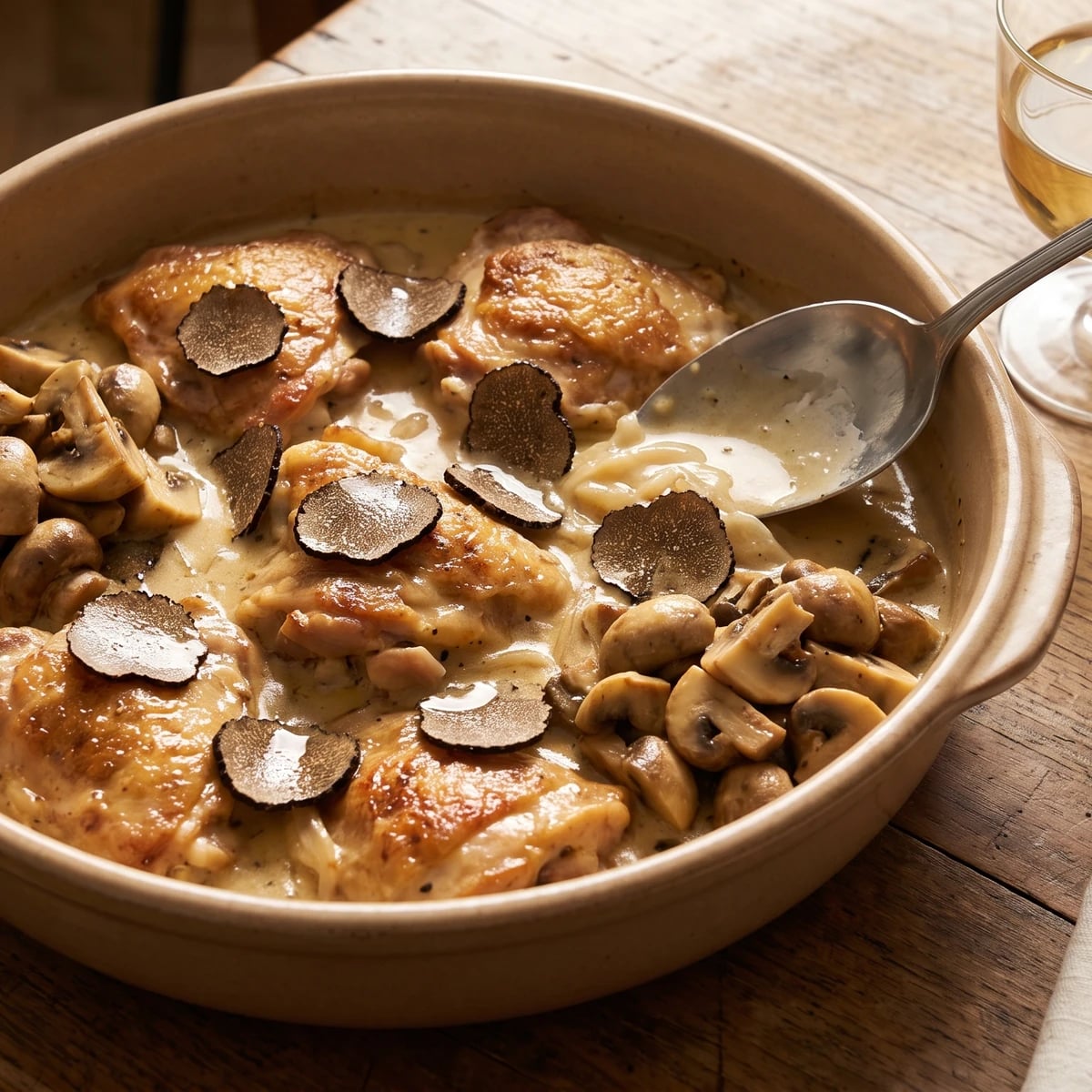
Butter-browned chicken, pale onion cooked beneath it, and cream rubbed to silk with a whisper of curry: Poulet Sauté Stanley teaches that a sauce may taste deeply of onion without one piece remaining.

Main Dishes
French
Comfort Food
Dinner Party
25 min
Active Time
50 min cook1 hr 15 min total
Yield4 servings

Poulet Sauté Stanley (butter-browned chicken with onion cream) teaches one true thing: onion can give a sauce its whole body and still disappear. Half a pound cooks pale beneath the bird, then meets cream, a whisper of curry, and cold butter. The finished sauce should taste deeply savory and softly spiced, with no onion left to chew.

The grand-kitchen repertoire around this dish assumed a saucier on staff, a stockpot never cold, and a salamander ready. This formula uses neither stock nor overhead heat, but it did assume a saucier could rub the onions through a tammy while the chicken waited in a warmed flat cocotte. At home, an immersion blender begins the work and a fine-mesh sieve finishes it. Blending replaces the commis's arm; the sieve remains the dish.

The book's one-bird formula is already the right scale for four, so I have kept its half-pound onions, one-third pint cream, one-ounce finishing butter, and ten truffle slices, quantifying only the chicken and mushroom garnish. One cook, one stove, one evening. The step that matters is keeping the onions pale under the chicken; once they brown, the sauce loses its quiet creaminess.

Poulet Sauté Stanley belongs to the Parisian grand-kitchen repertoire, not to the larder of a particular French region. Its surname joins the family of dishes named for the explorer Henry Morton Stanley, and its restrained curry reflects the cosmopolitan pantry of Parisian dining rooms while cream, reduction, sieving, and mounting with butter keep the technique firmly French. It is sometimes mistaken for a curry, but curry is only the accent; the defining act is rubbing the onion smooth so it flavors the sauce without remaining as garnish.

The technique, the tradition, and the story behind every dish.

Discover Culinary Explorer

Ingredients

whole chicken

Quantity

1 whole (3½ to 4 lb / 1.6 to 1.8 kg)

cut into 8 serving pieces

fine salt

Quantity

2 teaspoons (10 ml / 12 g)

divided

freshly ground black pepper

Quantity

½ teaspoon (2.5 ml / 1 g)

unsalted butter for the chicken

Quantity

4 tablespoons (60 ml / 56 g)

divided

yellow onions

Quantity

2 cups (475 ml / 225 g)

very finely minced

small white button mushrooms

Quantity

4 cups (950 ml / 340 g)

quartered

unsalted butter for the mushrooms

Quantity

2 tablespoons (30 ml / 28 g)

heavy cream

Quantity

¾ cup plus 1 tablespoon (190 ml / 190 g)

mild curry powder

Quantity

¼ teaspoon (1.25 ml / 0.5 g)

cold unsalted butter for finishing

Quantity

2 tablespoons (30 ml / 28 g)

diced

fresh or preserved black truffle

Quantity

1 small (about ¾ oz / 20 g)

cut into exactly 10 thin slices

Equipment Needed

  • Heavy 12-inch sauté pan with a lid
  • Wide 10-inch skillet for the mushrooms
  • Shallow 2-quart earthenware cocotte or ovenproof serving dish
  • Immersion blender
  • Fine-mesh sieve and flexible spatula
  • Instant-read thermometer

Instructions

  1. 1

    Warm and prepare

    Warm a shallow earthenware cocotte or ovenproof serving dish in a 200°F (95°C) oven. Pat the chicken completely dry, then season it with 1½ teaspoons of the salt and all the pepper. Keep the breast pieces separate from the legs and thighs because they will enter the covered pan later and leave sooner.

    Dry chicken browns; damp chicken turns pale beneath its own moisture. Give every piece a thorough blot before seasoning.
  2. 2

    Sauté the mushrooms

    Melt the 2 tablespoons of mushroom butter in a wide skillet over medium-high heat. Add the quartered mushrooms in one layer and leave them alone until their undersides color, then toss and cook until their released liquid has evaporated and their edges are butter-gold, 7 to 9 minutes. Season with a pinch of the remaining salt and set aside. They remain distinct heaps in this dish, not pieces lost in the sauce.

  3. 3

    Colour the chicken

    Melt 3 tablespoons of the chicken butter in a heavy 12-inch sauté pan over medium heat. When the foam subsides, brown the chicken in batches, skin-side first, until each piece is an even deep gold, 8 to 10 minutes per batch. Adjust the heat so the butter smells nutty but never scorched, then transfer the pieces to a tray. If the butter blackens, pour it away, wipe out the bitter specks, and continue with the reserved tablespoon of butter. The color is recoverable; burnt fat is not worth defending.

  4. 4

    Cook over onions

    Lower the heat and add the reserved tablespoon of chicken butter if the pan looks dry. Stir in the onions and the remaining salt, coating them in the golden fond without letting them color. Set the legs, thighs, and wings over the onions, cover, and cook gently for 8 minutes. Add the breast pieces skin-side up, cover again, and cook for 12 to 18 minutes, until the breasts reach 165°F (74°C) and the thighs reach at least 175°F (79°C). Remove any breast piece as soon as it is ready. If the onions begin sticking, pull the pan from the heat and add a spoonful of water around the edge; if one patch has gone dark, move the chicken and pale onions to a clean pan without scraping up that patch. Patience, not browned onion.

    The covered cooking softens the chicken skin, and that is correct here. Poulet Sauté Stanley is decided by its onion cream, not by the brittle skin of a roast.
  5. 5

    Dish with mushrooms

    Remove the warmed cocotte from the oven and turn the oven off. Arrange the chicken pieces through the center of the cocotte, then set one generous heap of mushrooms on either side, exactly as the dish requires. Cover loosely and hold it in the turned-off oven while the sauce is finished.

  6. 6

    Simmer the cream

    Pour the cream over the onions left in the sauté pan, scraping up every golden trace of fond. Bring it only to a gentle simmer and cook for the full 10 minutes, stirring often, until the onions are completely tender and the cream has taken their sweetness. Blend directly in the pan until smooth, then force the sauce through a fine-mesh sieve with a flexible spatula. Press firmly until only dry onion fiber remains. The blender is convenience; this final sieving is what makes Stanley.

  7. 7

    Reduce and mount

    Return the strained sauce to the cleaned pan and reduce it over medium-low heat until it naps the back of a spoon, leaving a clear line when you draw a finger through it. Whisk in the curry powder and taste. It should register as warmth behind the onion, never as the first flavor. Take the pan off the heat and whisk in the cold finishing butter a few pieces at a time. Do not boil after the butter enters. If the sauce turns oily, stop adding butter and whisk in a teaspoon of cold water away from the heat until it comes together, then finish the remaining butter. Ça se rattrape.

  8. 8

    Sauce and finish

    Pour the glossy onion cream over the chicken, leaving the browned contours of the pieces visible and keeping the two mushroom heaps distinct. Lay exactly 10 thin truffle slices across the chicken so the warmth releases their perfume without cooking them into silence. Bring the cocotte straight to the table. À table!

Chef Tips

  • Use small white button mushrooms rather than cremini. Their mildness belongs beside the pale onion cream, while a darker mushroom can pull the whole dish toward earthiness and obscure the truffle.
  • A good preserved whole truffle is the honest answer when fresh truffle is out of season. Drain and blot it before slicing. Truffle oil supplies perfume but not the 10 slices the formula calls for, so it does not replace them.
  • Choose a mild, fresh curry powder and measure it. The curry is a background note in a French cream sauce, not an invitation to improvise with a hotter spice mixture.
  • A broad dry Chardonnay or white Burgundy has enough weight for the cream, mushrooms, and truffle. Leftovers keep for 2 days in the refrigerator; reheat them covered over very low heat and never let the sauce boil.

Advance Preparation

  • The chicken can be cut into pieces, salted lightly, and left uncovered on a rack in the refrigerator for up to 24 hours. Its dry surface will brown more readily.
  • The onions may be minced and the mushrooms quartered up to 8 hours ahead. Keep both covered and refrigerated in separate containers.
  • The mushrooms can be sautéed up to 2 hours before serving and warmed gently. Finish the onion sauce, mount it with butter, and slice the truffle only when the chicken is ready for the table.

Frequently Asked Questions

Nutrition Information

1 serving (about 375g)

Calories
945 calories
Total Fat
71 g
Saturated Fat
34 g
Trans Fat
2 g
Unsaturated Fat
31 g
Cholesterol
310 mg
Sodium
1390 mg
Total Carbohydrates
10 g
Dietary Fiber
2 g
Sugars
6 g
Protein
66 g

Note: Chef personas and recipes are created with AI assistance. Cook with care: follow safe food-handling practices, check doneness with a thermometer when needed, and adapt for allergies and your kitchen.

Where cooking meets culture.

Culinary guides, cultural storytelling, and the editorial depth that makes cooking meaningful.

Discover Culinary Explorer

More from Poultry (Volaille) - Poulets Sautés

Browse the full collection