
Chef Juliette
John Dory (St. Pierre)
John Dory has the delicacy of sole and the firmness of turbot. A light flouring, a quick butter sauté, and nut-brown beurre noisette show exactly why looks never mattered.
A cooking platform built around craft, culture, and the stories behind what we eat.
Created by Chef Juliette
Based on No. 1572, Poulet Sauté Piémontaise, from Le Guide Culinaire (1907) by Auguste Escoffier
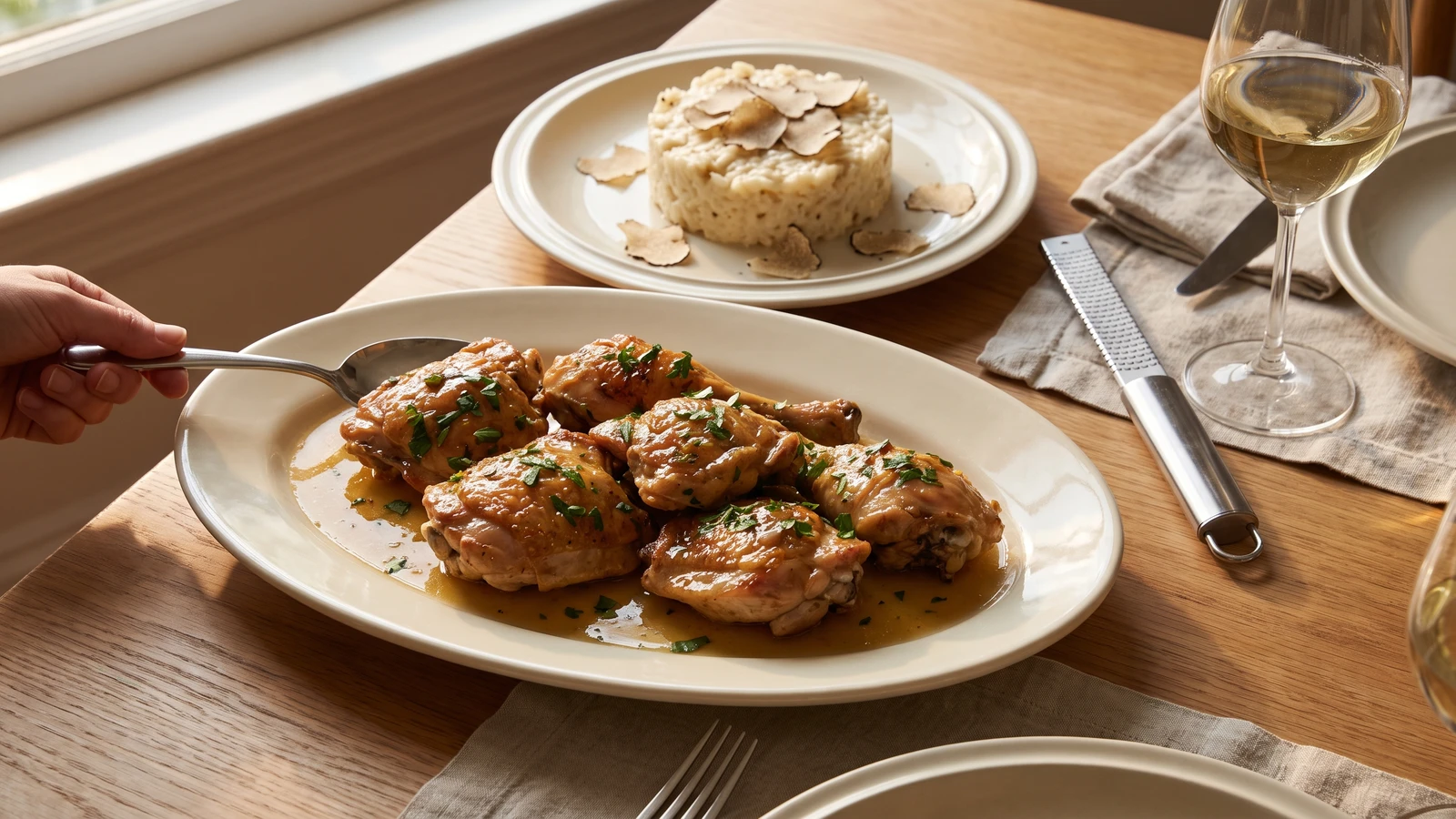
Butter-sautéed chicken, a white-wine and pale meat glaze, then beurre noisette at the last: Poulet Sauté Piémontaise teaches that timing, not complication, gives a short sauce its authority.
Poulet Sauté Piémontaise (Piémontaise-style butter-sautéed chicken) teaches one exact thing: a short pan sauce succeeds only when each layer keeps its proper moment. The chicken is sautéed in butter until bronze, the pan is swilled with white wine and strengthened with glace de viande blonde (pale meat glaze), then beurre noisette (nut-brown butter) goes over the bird at the last. Stir that final butter into the glaze or make it early, and you lose the clean toasted perfume that defines the finish.
The old entry assumed a saucier with meat glaze warm at hand and another pair of hands tending the truffled risotto. At home, one cup of unsalted gelatin-rich stock reduced to a spoonful replaces the stockpot that never went cold, while two adjacent pans bring the chicken and rice together. The brigade scale becomes one young chicken and one modest timbale for four. A salamander would add nothing because this dish is neither glazed beneath fierce heat nor gratinéed. The scaffolding goes; the sequence stays: sauté, dish, deglaze, glaze, beurre noisette.
The chicken should arrive glossy with its pale amber reduction, the brown butter pooling around it in fragrant spoonfuls, while the white-truffle risotto stands apart as the source directs. The one step that decides everything comes last: take the beurre noisette off the heat at hazelnut brown, before brown races to black. Have the platter waiting before the butter meets the pan.
In the language of the French classical menu, à la Piémontaise points across the Alps to Piedmont, specifically the pairing of risotto with the white truffles associated with Alba. It does not mean the chicken sauté began as a Piedmontese farmhouse dish; the name belongs chiefly to the garnish, while the butter sauté, white-wine deglazing, and pale meat glaze follow French sauce grammar. Served with its truffled risotto apart, the dish records how the French canon welcomed a neighboring larder without blurring the two traditions.
Quantity
1, about 3½ to 4 pounds (1.6 to 1.8 kg)
cut into 8 pieces
Quantity
2 teaspoons (10 ml / 12 g)
divided
Quantity
½ teaspoon (2.5 ml / 1 g)
Quantity
4 tablespoons (60 ml / 57 g), clarified to yield about 3 tablespoons (45 ml / 42 g)
Quantity
3 tablespoons (45 ml / 45 g)
Quantity
1 tablespoon (15 ml / 15 g), made by reducing 1 cup (240 ml / 240 g) unsalted gelatin-rich chicken or light veal stock
Quantity
5 tablespoons (75 ml / 71 g), yielding about 2 ounces (57 g) when browned
Quantity
1 tablespoon (15 ml / 4 g)
finely chopped
Quantity
3 cups (720 ml / 720 g)
Quantity
3 tablespoons (45 ml / 42 g)
divided
Quantity
¼ cup (60 ml / 55 g)
finely chopped
Quantity
1 cup (240 ml / 200 g)
Quantity
¼ cup (60 ml / 60 g)
Quantity
½ cup (120 ml / 45 g)
finely grated
Quantity
1 small truffle (15 to 20 g)
gently brushed clean
| Ingredient | Quantity |
|---|---|
| whole young chickencut into 8 pieces | 1, about 3½ to 4 pounds (1.6 to 1.8 kg) |
| fine sea saltdivided | 2 teaspoons (10 ml / 12 g) |
| freshly ground white pepper | ½ teaspoon (2.5 ml / 1 g) |
| unsalted butter for sautéing | 4 tablespoons (60 ml / 57 g), clarified to yield about 3 tablespoons (45 ml / 42 g) |
| dry white wine for deglazing | 3 tablespoons (45 ml / 45 g) |
| melted pale meat glaze | 1 tablespoon (15 ml / 15 g), made by reducing 1 cup (240 ml / 240 g) unsalted gelatin-rich chicken or light veal stock |
| unsalted butter for beurre noisette | 5 tablespoons (75 ml / 71 g), yielding about 2 ounces (57 g) when browned |
| flat-leaf parsleyfinely chopped | 1 tablespoon (15 ml / 4 g) |
| unsalted chicken stock for the risotto | 3 cups (720 ml / 720 g) |
| unsalted butter for the risotto and molddivided | 3 tablespoons (45 ml / 42 g) |
| yellow onionfinely chopped | ¼ cup (60 ml / 55 g) |
| Carnaroli or Arborio rice | 1 cup (240 ml / 200 g) |
| dry white wine for the risotto | ¼ cup (60 ml / 60 g) |
| Parmigiano-Reggianofinely grated | ½ cup (120 ml / 45 g) |
| fresh white trufflegently brushed clean | 1 small truffle (15 to 20 g) |
Pour the gelatin-rich stock into a small, wide saucepan and hold it at a quiet simmer until it reduces to 1 tablespoon (15 ml), thick enough to coat a spoon in a pale, sticky film. Keep the heat moderate so the edges don't scorch or turn mahogany; this is a pale meat glaze, not a dark demi-glace. If it tightens before the rest of the dish is ready, loosen it with a teaspoon of water and keep it warm. If you already have an unsalted pale meat glaze, simply melt and measure the required tablespoon.
Melt the 4 tablespoons of sautéing butter gently, skim away the foam, and pour the clear golden fat away from the milky sediment. The old kitchen kept clarified butter beside the range; doing this once is the honest home equivalent, because it lets the chicken brown briskly without burned milk solids. Pat the chicken completely dry, then season it with 1½ teaspoons of the salt and all the white pepper. Warm an oval platter, a 3-cup timbale mold, and a separate serving plate in a 200°F / 95°C oven.
Heat the clarified butter in a heavy 12-inch sauté pan over medium-high heat. Lay in the thighs and drumsticks skin-side down and leave them undisturbed for 5 to 6 minutes, until deeply golden; turn and brown the second side for about 3 minutes, then transfer them to a tray. Sauté means the pieces cook briskly in a shallow film of hot fat, gaining colour without stewing in their own juices. If the butter begins smoking, lift the pan from the heat and lower the flame. If it smells acrid, wipe out the blackened specks and add fresh clarified butter before continuing.
Set the chicken stock for the risotto over low heat. In a 3-quart saucepan, melt 2 teaspoons of the risotto butter and soften the onion for 3 minutes without colouring it. While the onion cooks, brown the breast pieces and wings in the sauté pan, skin-side down for 4 to 5 minutes and then on the second side for 2 minutes. Remove them briefly. Stir the rice into the onion for 2 minutes, until every grain is hot and edged with translucence, then add the risotto wine and let it evaporate. Return all the chicken to its pan, lower the heat to medium-low, and cover it loosely. Add hot stock to the rice one ladle at a time, stirring often and waiting until each addition is nearly absorbed before adding the next. Between ladles, turn and check the chicken. Transfer each piece to the warm platter as it finishes: breasts at 165°F / 74°C and thighs at 176 to 180°F / 80 to 82°C.
Continue adding stock until the rice is tender but retains a small firm point at its centre, about 17 to 19 minutes from the first ladle. It should flow slowly rather than stand in a dry heap. Take it off the heat and beat in 2 tablespoons of butter and the Parmigiano-Reggiano. If it becomes stiff, loosen it with a spoonful of hot stock; ça se rattrape. Finely grate one-third of the white truffle into the rice and season with the remaining salt. Butter the warm timbale mold with the reserved teaspoon of butter, spoon in the risotto without crushing it, and invert it onto its separate warm plate. Shave the remaining truffle over the timbale at the last moment.
Once the chicken is dished, pour excess fat from the sauté pan while leaving its bronze fond in place. Add the 3 tablespoons of white wine and swill it across the hot pan, scraping up every savoury trace. Let the wine reduce for 30 to 45 seconds, just until its raw edge disappears, then stir in the tablespoon of melted pale meat glaze. Bring it to one brief simmer and pour it over the chicken. This is a small, concentrated coating, not a lake of sauce. If it becomes too sticky to pour, loosen it with a teaspoon of hot risotto stock.
Put the 5 tablespoons of finishing butter into a clean, light-coloured saucepan over medium heat. It will melt, foam, then quiet as tawny specks gather underneath. Swirl the pan and remove it from the heat the instant the butter smells of hazelnuts and reaches a clear nut-brown colour; its own heat will carry it further. If the specks darken too quickly, pour the butter through a fine strainer into a cool cup at once. Ça se rattrape while it is brown, but scorched butter must be remade. Pour the finished 2 ounces of beurre noisette over the glazed chicken, scatter the parsley over it only now, and carry the truffle risotto separately. À table!
1 serving (about 430g)
Culinary guides, cultural storytelling, and the editorial depth that makes cooking meaningful.
Discover Culinary ExplorerChef Juliette
John Dory has the delicacy of sole and the firmness of turbot. A light flouring, a quick butter sauté, and nut-brown beurre noisette show exactly why looks never mattered.

Chef Juliette
Fresh haddock proves its delicacy in the meunière pan: a fine flour crust, moist pearly flakes, and beurre noisette sharpened with lemon and parsley, ready from one skillet in half an hour.

Chef Juliette
Éperlans à l’Anglaise turns small fish into a lesson in disciplined coating: boned smelts under a close, crisp crumb, pan-fried in clarified butter and finished with bright, half-melted maître d’hôtel butter.

Chef Juliette
Tiny smelts, shallot, mushrooms, white wine, gratin sauce, and fine bread raspings meet a fierce oven, where the fish must turn tender in the same breath the buttered crust bronzes.