
Chef Juliette
John Dory (St. Pierre)
John Dory has the delicacy of sole and the firmness of turbot. A light flouring, a quick butter sauté, and nut-brown beurre noisette show exactly why looks never mattered.
A cooking platform built around craft, culture, and the stories behind what we eat.
Created by Chef Juliette
Based on No. 1570, Poulet Sauté Normande, from Le Guide Culinaire (1907) by Auguste Escoffier
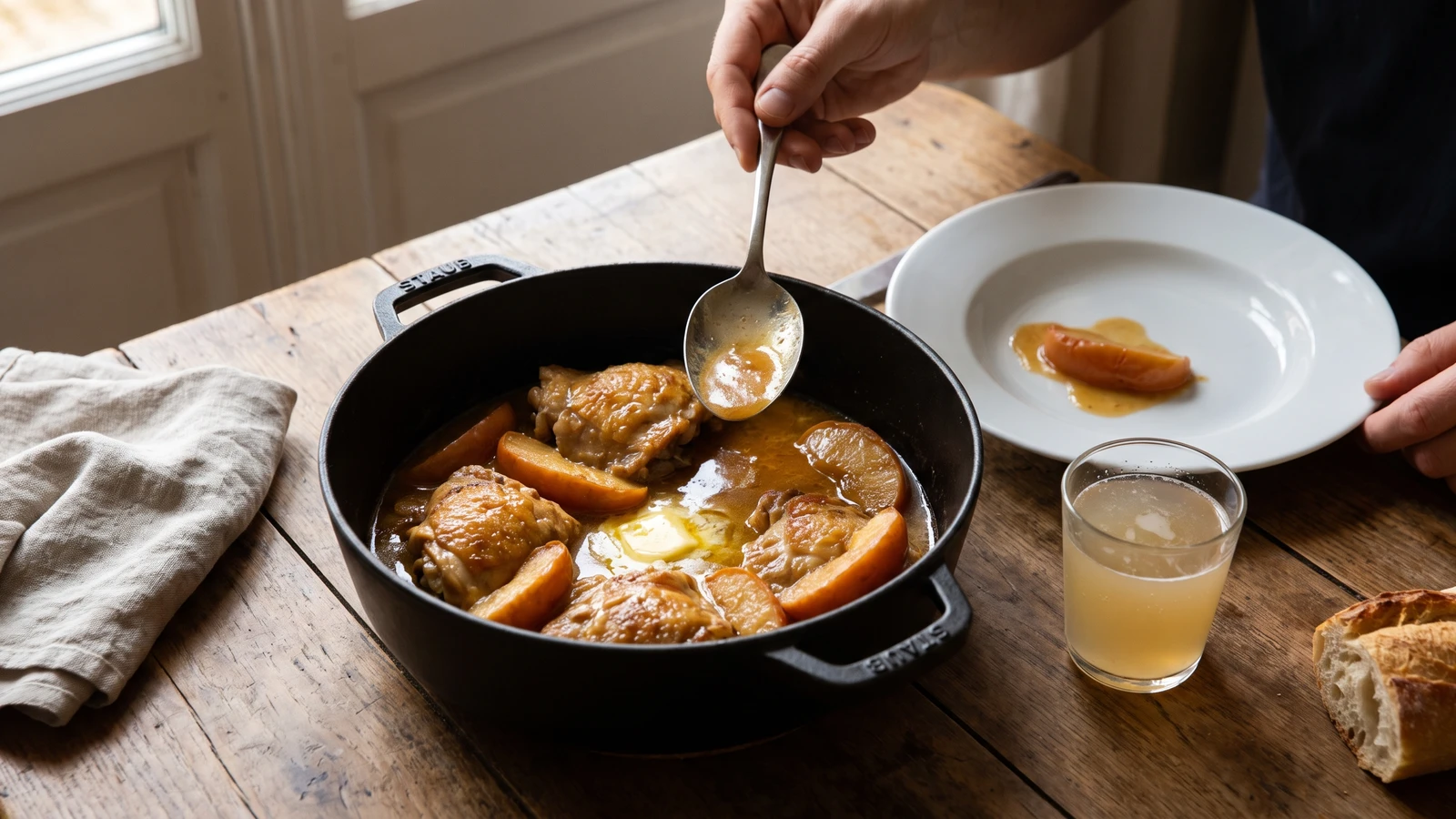
Poulet Sauté Normande is chicken taught in two heats: butter first for bronze and fond, then russet apples and liqueur cider under a lid, until the bird is tender and the cooking juices gleam.
Poulet Sauté Normande (Normandy-style sautéed chicken) teaches one true thing: the bird must meet the butter before the apples meet the bird. Sauté means brisk cooking in a shallow film of fat, and here the chicken is only half-sautéed, bronzed and partly cooked, before the apples release their water. Reverse that order and the chicken steams pale. Keep it, and butter, fond, apple, and cider become one amber cooking liquor.
The original recipe assumed a sauté pan at the fire and a cocotte waiting for the oven, with hands available to pass the chicken between them. It asks for no saucier, no stock never off the fire, and no salamander. At home, one wide ovenproof cocotte does both jobs: deglaze it into a cup, layer the apples and chicken, return the liquor, then cover. I have standardized its small glassful of liqueur cider to 1/4 cup and kept its pound of russet apples against one modest chicken. The apparatus changed because one cook needs fewer pans; the proportions and sequence did not. One cook, one stove, one evening.
The finished Poulet Sauté Normande is generous rather than elaborate, with burnished chicken over tender apple slices and buttery cider juices pooled underneath. Don't rush the first browning or let the butter burn. The half-sauté is the dish's foundation, and it is the one step that matters most before you touch the pan.
Poulet sauté Normande belongs to Normandy's apple and dairy country, where russeted reinette apples, butter, cider, and cider brandy share the same larder. The farmhouse pairing entered the classical sauté repertoire through a precise sequence: poultry browned at the stove, apples cooked beneath it in a cocotte, and cider spirit used to lift the fond. Normande is often mistaken for a guarantee of cream, but this preparation uses none; its sauce comes from butter, chicken juices, deglazed fond, liqueur cider, and apples.
Quantity
1 chicken, 3 1/2 to 4 pounds (1.6 to 1.8 kg)
cut into 8 serving pieces
Quantity
1 pound (454 g; about 3 medium)
peeled, cored, and sliced 1/4 inch (6 mm) thick
Quantity
1/4 cup (60 ml / 57 g)
Quantity
3 tablespoons (45 ml / 42 g)
divided
Quantity
2 teaspoons (10 ml / 12 g)
Quantity
1/2 teaspoon (2.5 ml / 1 g)
| Ingredient | Quantity |
|---|---|
| whole chickencut into 8 serving pieces | 1 chicken, 3 1/2 to 4 pounds (1.6 to 1.8 kg) |
| firm russet apples, such as Reinette, Golden Russet, or Ashmead's Kernelpeeled, cored, and sliced 1/4 inch (6 mm) thick | 1 pound (454 g; about 3 medium) |
| liqueur cider, meaning Calvados or another fine cider brandy | 1/4 cup (60 ml / 57 g) |
| unsalted butterdivided | 3 tablespoons (45 ml / 42 g) |
| fine sea salt | 2 teaspoons (10 ml / 12 g) |
| finely ground white pepper | 1/2 teaspoon (2.5 ml / 1 g) |
Set a rack in the middle of the oven and heat it to 375°F (190°C). Dry the chicken pieces thoroughly, especially around the joints and beneath the wings, then season them on all sides with the salt and white pepper. Keep the apples ready beside the stove. A wet bird cannot sauté properly because its surface water must boil away before the butter can begin browning it.
Melt half the butter in a wide, heavy ovenproof cocotte over medium-high heat. When it foams and then quiets, lay in the legs and thighs skin-side down without crowding them. Brown for 6 to 8 minutes, turn, and cook the bone side for 2 to 3 minutes. Transfer them to a plate, add enough remaining butter to restore a generous film, and repeat with the breasts and wings, giving the second side only about 2 minutes. The pieces should be deeply butter-gold outside but plainly unfinished within. This is the half-sauté, not merely a cosmetic sear.
Move the cocotte completely off the heat. Pour the measured liqueur cider from a cup, never directly from its bottle into the hot pot, then return the cocotte to medium heat. Déglacer means dissolving the browned film with liquid: scrape the floor and corners for 30 to 45 seconds, until every bronze morsel of fond has entered the amber liquor. Do not flambé it and do not reduce it away. Pour the deglazing liquor into a heatproof cup.
Spread the sliced russet apples across the bottom of the cocotte in an even bed. Do not sauté them first; they must release their moisture beneath the lid, exactly after the chicken has taken its colour. Set the legs and thighs around the hotter outer edge and the breast pieces nearer the centre, all skin-side up. Pour the liqueur-cider deglazing liquor and every collected chicken juice around the pieces rather than over their browned surfaces.
Cover the cocotte tightly and place it in the oven. Cook for 25 minutes, then check the pieces separately: breast meat should reach 165°F (74°C), while thighs and legs are tenderest around 175°F (79°C), measured away from bone. The apples should yield to a knife while retaining visible slices. If the breasts finish before the legs, lift them to a covered plate and let the dark meat continue for 5 to 10 minutes, then return the breasts. Do not chase crisp skin with a broiler; the original preparation finishes gently beneath its lid.
Examine the cooking liquor before serving. It should be amber, glossy, and light enough to run from a spoon, not thick like a cream sauce. If the apples have released so much water that the liquor tastes weak, lift the chicken and apples carefully to a warm plate and boil the juices in the uncovered cocotte for 2 to 4 minutes, scraping once, until their flavour gathers. Return everything to the cocotte and spoon the liquor over it. Add no stock, flour, or cream. Carry the preparation to the table exactly where it finished cooking. À table!
1 serving (about 315g)
Culinary guides, cultural storytelling, and the editorial depth that makes cooking meaningful.
Discover Culinary ExplorerChef Juliette
John Dory has the delicacy of sole and the firmness of turbot. A light flouring, a quick butter sauté, and nut-brown beurre noisette show exactly why looks never mattered.

Chef Juliette
Fresh haddock proves its delicacy in the meunière pan: a fine flour crust, moist pearly flakes, and beurre noisette sharpened with lemon and parsley, ready from one skillet in half an hour.

Chef Juliette
Éperlans à l’Anglaise turns small fish into a lesson in disciplined coating: boned smelts under a close, crisp crumb, pan-fried in clarified butter and finished with bright, half-melted maître d’hôtel butter.

Chef Juliette
Tiny smelts, shallot, mushrooms, white wine, gratin sauce, and fine bread raspings meet a fierce oven, where the fish must turn tender in the same breath the buttered crust bronzes.