
Chef Juliette
John Dory (St. Pierre)
John Dory has the delicacy of sole and the firmness of turbot. A light flouring, a quick butter sauté, and nut-brown beurre noisette show exactly why looks never mattered.
A cooking platform built around craft, culture, and the stories behind what we eat.
Created by Chef Juliette
Based on No. 1567, Poulet Sauté Mexicaine, from Le Guide Culinaire (1907) by Auguste Escoffier
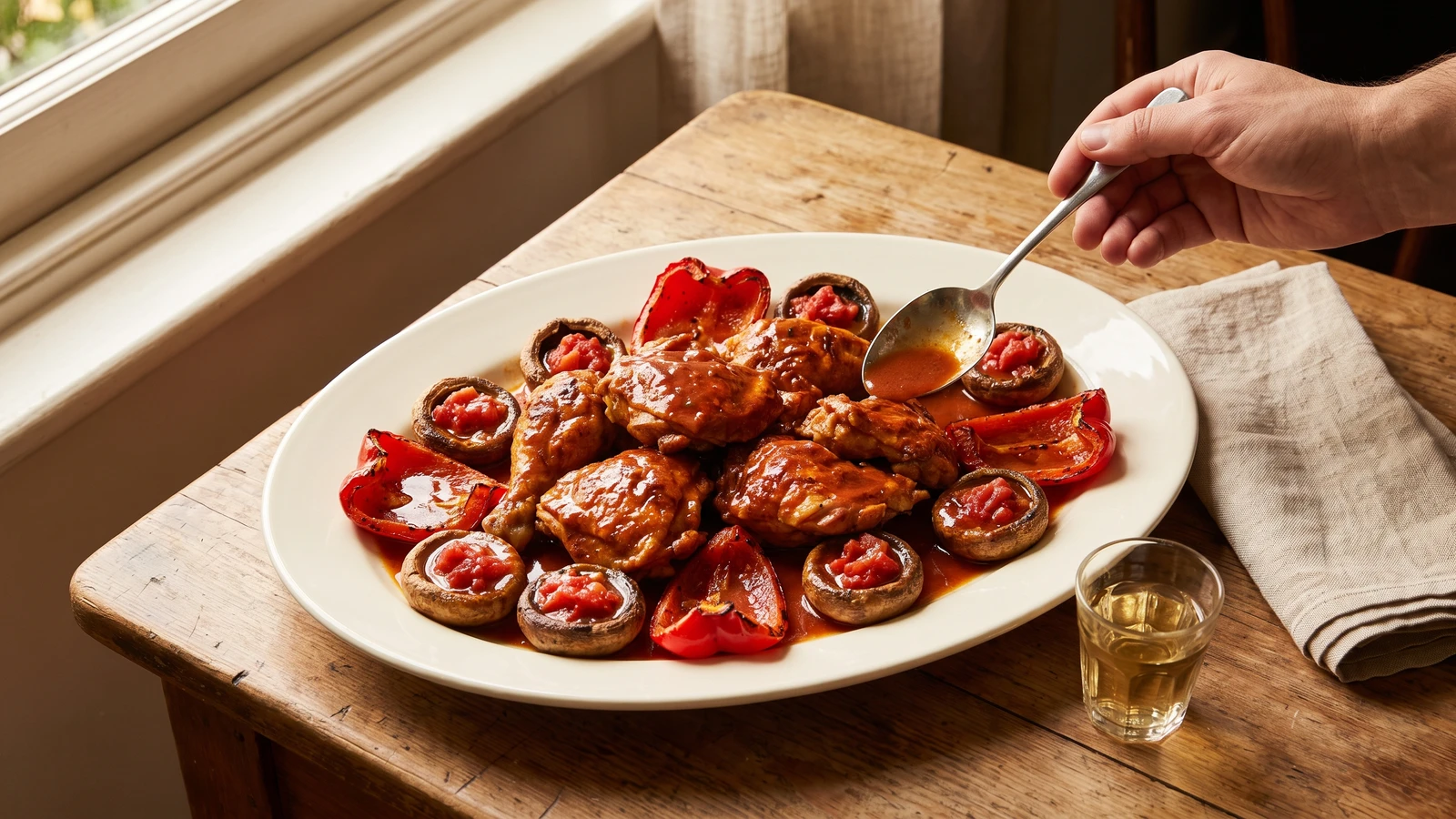
Poulet Sauté Mexicaine teaches the whole sauté grammar: brown chicken in oil, reduce white wine over the fond, finish with tomatéd veal gravy, then frame it with smoky peppers, mushrooms, and buttery tomato concassée.
Poulet Sauté Mexicaine (pan-browned chicken with grilled capsicums, mushrooms, and tomato-tinted veal gravy) teaches the governing rule of every sauté: the fond must become sauce, not scorch. Dry chicken, properly hot oil, and the patience to let it color before turning are the one true thing to know before you touch the pan. Once the bronze film is there, white wine lifts it, reduction concentrates it, and the small measure of tomatéd gravy gives it body.
The original assumed a saucier on staff, veal gravy from stock never off the fire, and a salamander ready to blister peppers while the chicken station worked. At home, good commercial veal demi-glace diluted to a light gravy, a hot broiler, and one wide sauté pan do the same work for four. We cut the separate holding pans and last-minute station choreography because that is brigade scaffolding; we keep the oil sauté, wine reduction, tomatéd veal foundation, grilled garnish, and butter-cooked tomato concassée because those steps are the dish. One cook, one stove, one evening.
Poulet Sauté Mexicaine lands generous rather than fussy: glossy chicken at the center, blistered capsicums and browned mushroom caps around it, each holding a spoonful of bright tomato. Watch the fond while the chicken cooks. Deep bronze gives character; black tastes bitter, and no sauce can sweet-talk it back.
Poulet Sauté Mexicaine belongs to the Parisian grand-kitchen repertoire, where à la mexicaine named a French garniture vocabulary of tomato and capsicum rather than a Mexican regional recipe. In this form, sautéed chicken is finished with wine and tomatéd veal gravy, then ringed with grilled peppers and mushrooms carrying buttery tomato concassée. Its path into home cookery preserved that architecture while shedding the brigade behind it, and the title is best read as a record of French menu language, not as a claim about Mexican cooking.
Quantity
1, about 3½ to 4 lb (1.6 to 1.8 kg)
cut into 8 serving pieces
Quantity
2 teaspoons (10 ml / 12 g)
divided
Quantity
½ teaspoon (2.5 ml / 1 g)
Quantity
3 tablespoons (45 ml / 41 g)
divided
Quantity
2 medium (about 12 oz / 340 g)
quartered and seeded
Quantity
8 (about 8 oz / 225 g)
stems removed
Quantity
4 medium (about 1 lb / 450 g)
peeled, seeded, and roughly chopped
Quantity
one 14.5 oz can (411 g)
drained and roughly chopped
Quantity
2 tablespoons (30 ml / 28 g)
Quantity
3 tablespoons (45 ml / 45 g)
Quantity
5 tablespoons plus 2 teaspoons (85 ml / about 90 g)
Quantity
2 teaspoons (10 ml / 11 g)
| Ingredient | Quantity |
|---|---|
| whole chickencut into 8 serving pieces | 1, about 3½ to 4 lb (1.6 to 1.8 kg) |
| fine sea saltdivided | 2 teaspoons (10 ml / 12 g) |
| freshly ground black pepper | ½ teaspoon (2.5 ml / 1 g) |
| neutral oildivided | 3 tablespoons (45 ml / 41 g) |
| red bell peppers or capsicumsquartered and seeded | 2 medium (about 12 oz / 340 g) |
| large brown mushroom capsstems removed | 8 (about 8 oz / 225 g) |
| plum tomatoespeeled, seeded, and roughly chopped | 4 medium (about 1 lb / 450 g) |
| whole peeled tomatoes (optional)drained and roughly chopped | one 14.5 oz can (411 g) |
| unsalted butter | 2 tablespoons (30 ml / 28 g) |
| dry white wine | 3 tablespoons (45 ml / 45 g) |
| prepared veal gravy made from commercial veal demi-glace | 5 tablespoons plus 2 teaspoons (85 ml / about 90 g) |
| tomato purée or double-concentrated tomato paste | 2 teaspoons (10 ml / 11 g) |
Make the tomato concassée, peeled and seeded tomato chopped roughly. This is the source's Concass. For fresh tomatoes, score the bases, lower them into boiling water for 20 seconds, cool them in cold water, then peel, halve, seed, and chop them into pieces about ½ inch wide. Canned tomatoes need only draining and chopping. Melt the butter in a small saucepan, add the tomatoes with a pinch of the salt, and cook over medium heat for 6 to 8 minutes, stirring occasionally, until their loose water has cooked away but the pieces still hold their shape. If the concassée remains watery, keep it uncovered and spread it across the pan so the moisture escapes; if it begins to catch, lower the heat and move it immediately to a clean bowl. Keep it covered and warm.
Set a broiler rack about 4 inches from the heat and heat the broiler fully. Brush the pepper quarters and mushroom caps with 1 tablespoon of the oil and season them lightly. Arrange the peppers skin-side up and the mushrooms rounded-side up on a rimmed sheet pan. Broil the mushrooms for 4 to 6 minutes, turning once, until browned and just tender; remove them as soon as they are ready. Continue grilling the peppers until their skins blister and blacken in patches, 8 to 12 minutes. Cover the peppers in a bowl for 10 minutes, then lift off the loosened skins without rinsing away their flavor. If a skin resists, return that piece to the broiler for 2 minutes and cover it again. Ça se rattrape. Keep the peppers and mushrooms covered nearby.
Dry the chicken thoroughly and season it with the remaining salt and the pepper. Sauté, in the source's vocabulary, means cooking quickly in a shallow layer of hot fat while building an even brown surface. Heat the remaining 2 tablespoons oil in a 12-inch heavy sauté pan over medium-high heat until it shimmers. Brown the thighs and drumsticks skin-side down for 5 to 6 minutes, then turn and brown for 3 minutes. Remove them and brown the breasts and wings skin-side down for 4 to 5 minutes, then turn for 2 minutes. Return all the pieces to the pan, reduce the heat to medium-low, cover, and cook for 8 to 15 minutes, removing each piece as it finishes. The breasts should reach 165°F (74°C) and the thighs and drumsticks at least 170°F (77°C). Keep the cooked chicken loosely covered. The pan film should be deep bronze, never black. If it turns black and smells acrid, transfer the chicken to a clean pan and finish it there; discard the burnt oil and fond rather than dissolving bitterness into the sauce.
Pour off the excess oil from the sauté pan, leaving the bronze fond. Set the pan over medium-high heat, add the white wine, and swill it across the bottom while scraping up every browned speck. Reduce until only about 1 tablespoon remains and the sharp smell of raw wine has softened. Stir together the prepared veal gravy and tomato purée, then add them to the pan. Tomatéd. is the source's word for a preparation in which tomato is distinctly perceptible in both shade and flavor; the sauce should turn brick-red while retaining the savor of veal. Simmer for 2 to 3 minutes, until the sauce is nappé, meaning it coats the back of a spoon in a thin glossy layer. If it becomes too thick or salty, loosen it with hot water a teaspoon at a time. If it runs thin, simmer it uncovered for another minute. Ça se rattrape.
Set the chicken in the center of a warm oval platter and spoon the tomatéd sauce directly over it. Arrange the grilled pepper quarters and mushroom caps alternately around the chicken, with the mushroom cavities facing up and the peppers curved into shallow cups. Spoon the warm tomato concassée into both. Serve at once, while the chicken skin still holds its color and the sauce remains glossy. À table!
1 serving (about 410g)
Culinary guides, cultural storytelling, and the editorial depth that makes cooking meaningful.
Discover Culinary ExplorerChef Juliette
John Dory has the delicacy of sole and the firmness of turbot. A light flouring, a quick butter sauté, and nut-brown beurre noisette show exactly why looks never mattered.

Chef Juliette
Fresh haddock proves its delicacy in the meunière pan: a fine flour crust, moist pearly flakes, and beurre noisette sharpened with lemon and parsley, ready from one skillet in half an hour.

Chef Juliette
Éperlans à l’Anglaise turns small fish into a lesson in disciplined coating: boned smelts under a close, crisp crumb, pan-fried in clarified butter and finished with bright, half-melted maître d’hôtel butter.

Chef Juliette
Tiny smelts, shallot, mushrooms, white wine, gratin sauce, and fine bread raspings meet a fierce oven, where the fish must turn tender in the same breath the buttered crust bronzes.