
Chef Juliette
John Dory (St. Pierre)
John Dory has the delicacy of sole and the firmness of turbot. A light flouring, a quick butter sauté, and nut-brown beurre noisette show exactly why looks never mattered.
A cooking platform built around craft, culture, and the stories behind what we eat.
Created by Chef Juliette
Based on No. 1564, Poulet Sauté Marengo, from Le Guide Culinaire (1907) by Auguste Escoffier
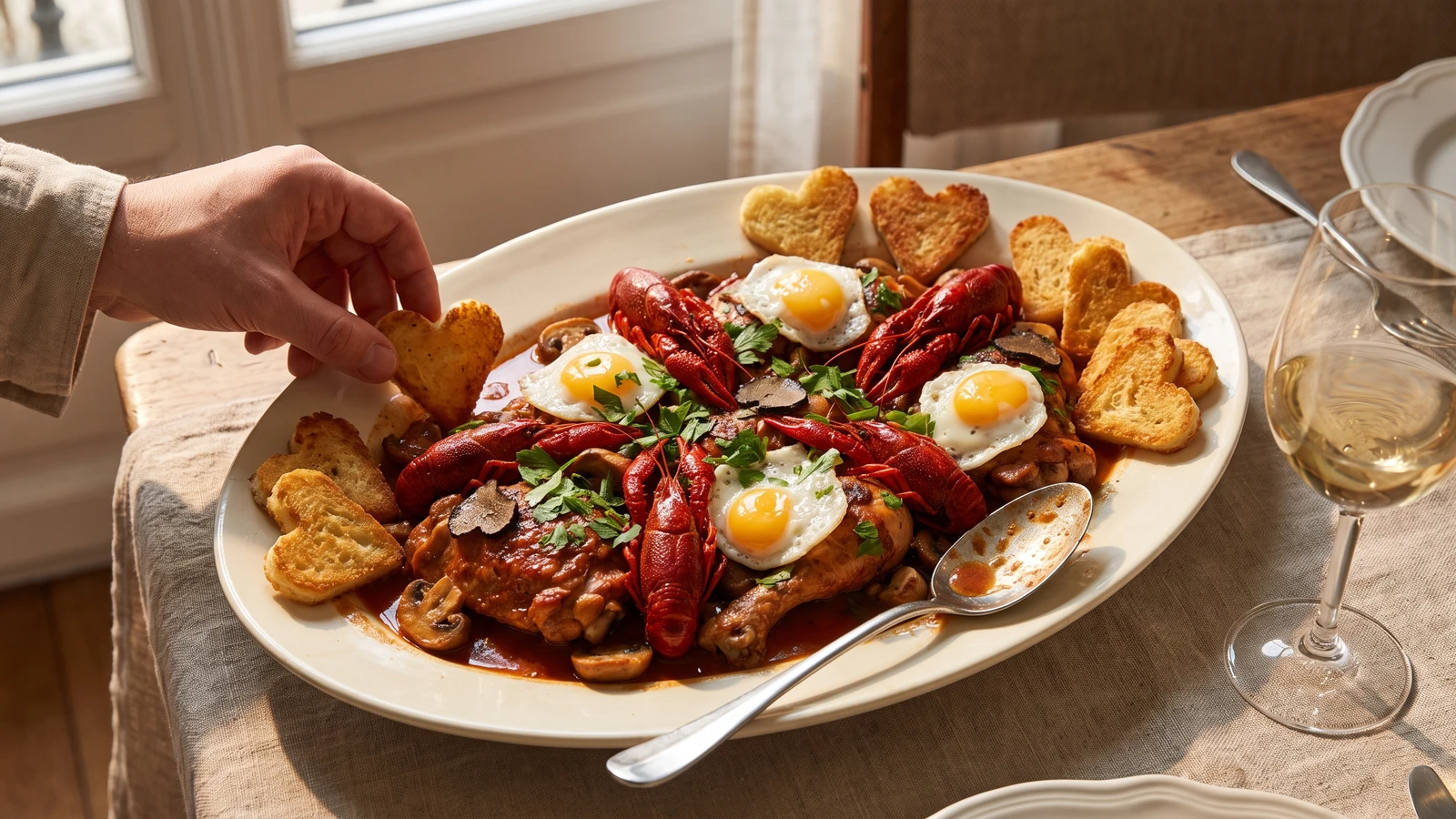
Oil-sautéed chicken in a glossy white-wine and tomato reduction, ringed with butter-fried heart croûtons, soft-yolked eggs, crayfish, mushrooms, and truffle: the full Marengo garnish, scaled for one home stove.
Poulet Sauté Marengo (oil-sautéed chicken with the full Marengo garnish) teaches one true thing before the pan is hot: the garnish is not decoration. The fried eggs, heart-shaped croûtons, crayfish, mushrooms, and truffle carry the dish's identity, surrounding deeply browned chicken under a glossy sauce of white wine, tomato, and garlic. Remove them and the result may still be good chicken, but it is no longer this Marengo.
The classical entry assumes several hands, court-bouillon ready, and plates leaving at once. It needs neither a saucier tending a mother sauce, a stockpot never off the fire, nor a salamander; its sauce is built from the sauté pan's own fond, white wine, tomato, and reduction. At home, a low oven becomes the holding place, the garnishes are made while the chicken cooks, and the serving is four. One cook, one stove, one evening.
Trussing the crayfish was brigade scaffolding, useful for regimented presentation but irrelevant to flavour, so it goes. The crayfish themselves, the truffle, the fried eggs, and the butter-fried croûtons stay because they are the dish. The step that decides both chicken and sauce is the first browning: dry the pieces, leave room in the pan, and take the skin to a confident bronze before adding wine.
The name points to Marengo in Piedmont, while the dish's culinary home is French grand cuisine, where chicken sautéed in oil with tomato, wine, garlic, mushrooms, and truffle became Poulet Sauté Marengo. Its battlefield origin is a durable tale of a French commander's cook improvising from scattered provisions, but food historians treat the neatness of that story cautiously. Parisian grand kitchens fixed the memorable garnish of crayfish, fried eggs, and croûtons, carrying the dish from legend into the classical repertoire and eventually onto ambitious home tables.
Quantity
1 (3½ lb / 1.6 kg)
cut into 8 pieces
Quantity
2 teaspoons (10 ml / 12 g)
Quantity
½ teaspoon (2.5 ml / 1 g)
Quantity
¼ cup (60 ml / 55 g)
divided
Quantity
¾ cup (180 ml / 180 g)
Quantity
2 medium tomatoes (about 1 lb / 450 g), or 1½ tablespoons purée (22 ml / 24 g)
tomatoes peeled, seeded, and concassé
Quantity
1 small clove (about 3 g)
crushed
Quantity
10 (about 5 oz / 140 g)
wiped and trimmed
Quantity
10 thin slices (about ¾ oz / 20 g)
drained if preserved
Quantity
4¼ cups (1 L / 1 kg)
Quantity
8 (about 12 oz / 340 g)
thawed if frozen
Quantity
8 thin slices (about 6 oz / 170 g)
crusts removed and cut into hearts
Quantity
4 tablespoons (60 ml / 57 g)
Quantity
4
Quantity
2 tablespoons (30 ml / 8 g)
concassé
| Ingredient | Quantity |
|---|---|
| whole chickencut into 8 pieces | 1 (3½ lb / 1.6 kg) |
| fine sea salt | 2 teaspoons (10 ml / 12 g) |
| freshly ground black pepper | ½ teaspoon (2.5 ml / 1 g) |
| mild olive oildivided | ¼ cup (60 ml / 55 g) |
| dry white wine | ¾ cup (180 ml / 180 g) |
| ripe tomatoes or tomato puréetomatoes peeled, seeded, and concassé | 2 medium tomatoes (about 1 lb / 450 g), or 1½ tablespoons purée (22 ml / 24 g) |
| garliccrushed | 1 small clove (about 3 g) |
| small button mushroomswiped and trimmed | 10 (about 5 oz / 140 g) |
| black truffledrained if preserved | 10 thin slices (about ¾ oz / 20 g) |
| prepared court-bouillon | 4¼ cups (1 L / 1 kg) |
| whole raw food-grade crayfishthawed if frozen | 8 (about 12 oz / 340 g) |
| day-old pain de miecrusts removed and cut into hearts | 8 thin slices (about 6 oz / 170 g) |
| unsalted butter | 4 tablespoons (60 ml / 57 g) |
| small or medium eggs | 4 |
| flat-leaf parsleyconcassé | 2 tablespoons (30 ml / 8 g) |
Heat the oven to 200°F (95°C) and set a wire rack over a small sheet pan. If using fresh tomatoes, score their bases, lower them into boiling water for 20 seconds, cool them under cold water, then peel, seed, and concassé them, meaning roughly chop them. Cut the bread into eight hearts and place every garnish within reach. Once the chicken meets the pan, this mise en place is what allows one cook to keep the whole Marengo garnish.
Pat the chicken completely dry and season it with the salt and pepper. Sauté, cooking in a shallow pan with a little hot fat, begins with a dry surface and properly heated oil. Heat 3 tablespoons of the olive oil in a heavy 12-inch sauté pan over medium-high heat until it moves freely across the pan, then brown the chicken in two batches, skin-side first, for 8 to 10 minutes per batch. Do not force a piece that sticks; browned chicken releases when its crust is ready. If the fond turns black rather than deep brown, remove the pan from the heat, transfer the chicken out, carefully wipe away the burnt patches, and resume with a little reserved oil. Ça se rattrape. Burnt fond cannot be improved with wine.
Return all the chicken to the pan, keeping the skin mostly above the liquid. Pour in the white wine and scrape every brown deposit from the pan floor. Add the tomato concassé, or dissolve the tomato purée in the wine, then add the garlic, mushrooms, and all ten truffle slices. Bring the liquid to a bare simmer, cover the pan slightly ajar, and cook for 20 to 30 minutes. Remove the breast pieces when they register 160°F (71°C), allowing them to reach 165°F (74°C) while resting; continue until the thighs reach at least 175°F (79°C). If the liquid threatens to disappear before the legs are tender, add hot water one tablespoon at a time. The sauce must reduce, not scorch.
While the chicken simmers, bring the court-bouillon to a lively simmer in a saucepan. Lower in the crayfish, cover, and cook for 4 to 6 minutes, until their shells are brilliant red and the flesh is opaque and reaches 145°F (63°C). Drain well and hold them loosely covered near the stove for no longer than 15 minutes. Leave them whole; their naturally curved tails give the platter the form once achieved by trussing.
Melt half the butter in a skillet over medium heat until it foams, then fry the heart-shaped croûtons, pieces of bread fried in butter, in two batches. Add the remaining butter as the pan dries and turn the croûtons when their undersides are deep butter-gold. Drain them on the prepared rack and keep them crisp in the low oven. Do not stack them. If they colour before their centres crisp, lower the heat and let the oven finish them.
Transfer the cooked chicken to a warmed oval platter and hold it loosely covered. Bring the sauce, mushrooms, and truffle to a brisk simmer for 3 to 6 minutes, until the liquid turns glossy and nappes, or coats, the back of a spoon while remaining pourable. If it is thin, keep reducing. If it tightens too far, loosen it with a spoonful of hot water. Skim away any heavy pool of oil, taste for salt, then spoon the sauce over the chicken with the mushrooms and truffle plainly visible.
Heat the reserved tablespoon of olive oil in the cleaned skillet over medium heat. Fry the eggs in batches until the whites are set and the yolks remain soft; if a glassy patch of white persists, cover the pan for 20 seconds rather than flipping the egg. Set the four eggs at intervals around the chicken, place the crayfish between them, and tuck the butter-fried heart croûtons around the rim. Sprinkle with the parsley concassé and serve at once. The crowded garnish is the dish's memory, so bring it to the table whole. À table!
1 serving (about 450g)
Culinary guides, cultural storytelling, and the editorial depth that makes cooking meaningful.
Discover Culinary ExplorerChef Juliette
John Dory has the delicacy of sole and the firmness of turbot. A light flouring, a quick butter sauté, and nut-brown beurre noisette show exactly why looks never mattered.

Chef Juliette
Fresh haddock proves its delicacy in the meunière pan: a fine flour crust, moist pearly flakes, and beurre noisette sharpened with lemon and parsley, ready from one skillet in half an hour.

Chef Juliette
Éperlans à l’Anglaise turns small fish into a lesson in disciplined coating: boned smelts under a close, crisp crumb, pan-fried in clarified butter and finished with bright, half-melted maître d’hôtel butter.

Chef Juliette
Tiny smelts, shallot, mushrooms, white wine, gratin sauce, and fine bread raspings meet a fierce oven, where the fish must turn tender in the same breath the buttered crust bronzes.