
Chef Juliette
Poulets Sautés
The master sauté for poultry: jointed chicken coloured hard in clarified butter, cooked piece by piece to tenderness, then reunited with a pan sauce made from every bronze trace of fond.
A cooking platform built around craft, culture, and the stories behind what we eat.
Created by Chef Juliette
Based on No. 1563, Poulet Sauté Lyonnaise, from Le Guide Culinaire (1907) by Auguste Escoffier
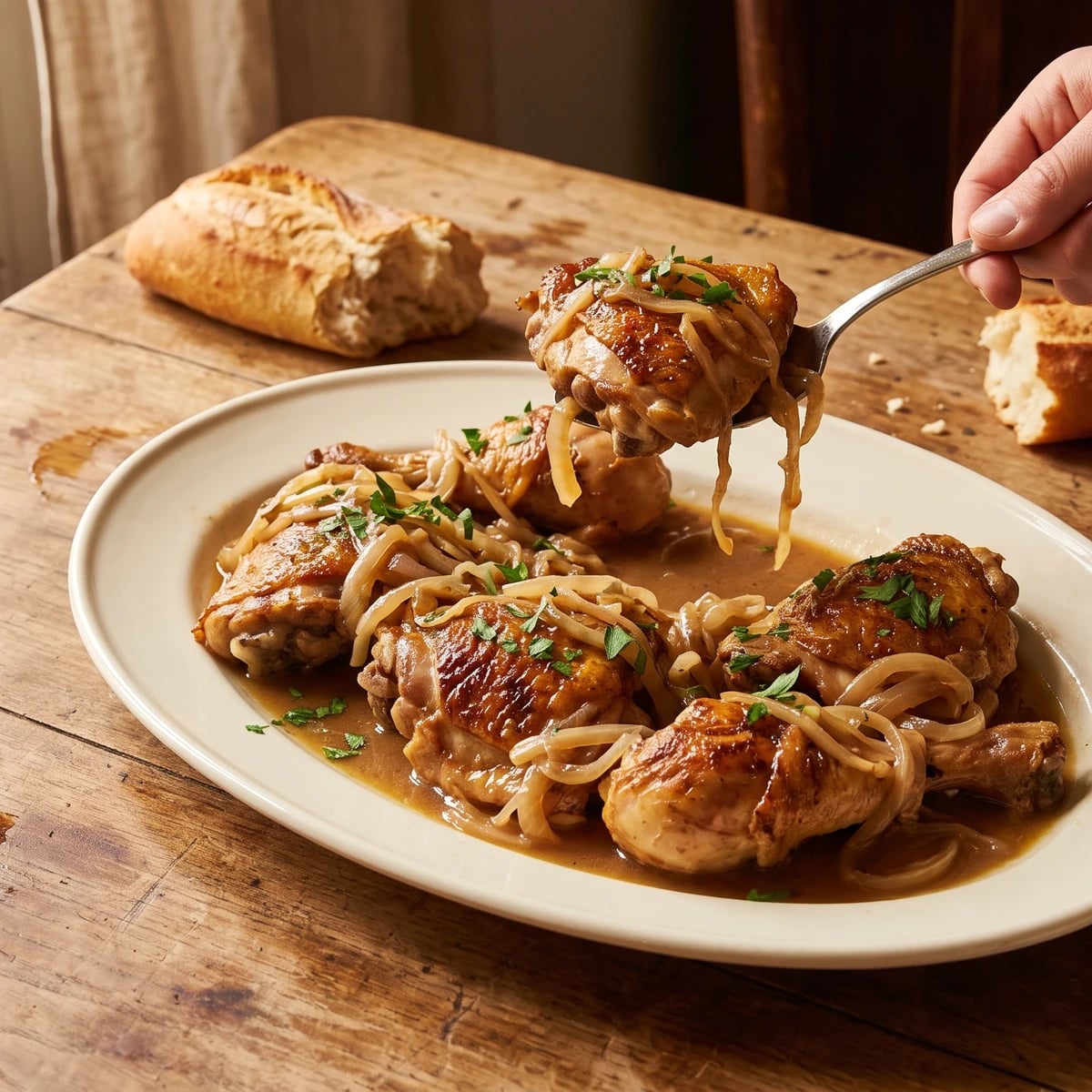
Butter-browned chicken and finely sliced onions finish together before a short veal-gravy reduction gathers every bit of fond: Lyon's plainspoken weeknight lesson in timing, one pan, and no wasted flavor.
Poulet Sauté Lyonnaise (Lyon-style sautéed chicken) teaches timing before anything else. Slice the onions fine, colour them lightly in butter, then wait until the chicken is halfway cooked before they go back into the pan. Too early and they scorch before the joints are done; too late and they never melt into the fond. When it is right, the bird is bronze, the onions are supple and butter-gold, and the veal gravy catches both in a short, glossy liquor.
The original entry assumed a saucier nearby, a pot of veal gravy never off the fire, a broad sauté pan, and enough hands to colour onions while the chicken cooked. At home, use one heavy 12 to 13-inch pan, colour the onions first and hold them, then prepare the small measure of veal gravy from your own stock or a good concentrate. The entry's one-chicken ratio already suits four, so there is no honest reason to shrink it further. One cook, one stove, one evening.
The brigade scaffolding is the second pan and the extra hand to mind it, so that can go. What must stay is the butter, the light colour on the onions, their halfway entrance, and the quick veal reduction. The one step that decides Poulet Sauté Lyonnaise is adding the onions only when the chicken is half cooked, then lowering the heat before their sweetness turns bitter.
Poulet Sauté Lyonnaise belongs to Lyon and to the classical à la lyonnaise family, where sliced onions are the defining garnish rather than decoration. Grand kitchens carried that regional cue into a precise sauté: colour the onions separately, join them to the half-cooked bird, then loosen the fond with veal gravy. The name does not signal wine, cream, or a generalized rustic sauce; in this entry, Lyon's whole argument is onion.
Quantity
1, 3½ to 4 lb (1.6 to 1.8 kg)
cut into 8 bone-in, skin-on pieces
Quantity
1¼ teaspoons (6 ml / 7 g)
Quantity
½ teaspoon (2.5 ml / 1 g)
Quantity
5 tablespoons (75 ml / 70 g)
divided
Quantity
3, about 5 cups (1.2 liters / 600 g)
finely sliced into even half-moons
Quantity
scant ½ cup (95 ml / about 100 g)
homemade or prepared from veal demi-glace concentrate
Quantity
1 generous pinch, about 1 teaspoon (5 ml / 1 g)
chopped
| Ingredient | Quantity |
|---|---|
| whole chickencut into 8 bone-in, skin-on pieces | 1, 3½ to 4 lb (1.6 to 1.8 kg) |
| fine sea salt | 1¼ teaspoons (6 ml / 7 g) |
| freshly ground black pepper | ½ teaspoon (2.5 ml / 1 g) |
| unsalted butterdivided | 5 tablespoons (75 ml / 70 g) |
| fair-sized yellow onionsfinely sliced into even half-moons | 3, about 5 cups (1.2 liters / 600 g) |
| rich unsalted veal gravyhomemade or prepared from veal demi-glace concentrate | scant ½ cup (95 ml / about 100 g) |
| flat-leaf parsleychopped | 1 generous pinch, about 1 teaspoon (5 ml / 1 g) |
Pat every chicken piece thoroughly dry, then season all over with the salt and pepper. Leave the pieces uncovered while you slice the onions and heat the pan. A dry surface browns in butter; a wet one gives off water and turns pale. Keep the breasts, legs, thighs, and wings separated so each piece can leave the pan when it is properly cooked.
Melt 2 tablespoons (30 ml / 28 g) of the butter in a heavy 12 to 13-inch sauté pan over medium heat. Add the onions and toss them frequently for 8 to 10 minutes, until they have collapsed, turned translucent, and taken only a pale golden colour at the edges. They are not being caramelized. Lift them into a bowl with all their butter, leaving any light glaze in the pan.
Add the remaining 3 tablespoons (45 ml / 42 g) butter to the pan. When it foams, lay in the legs and thighs skin-side down; brown them for 5 to 6 minutes per side, then move them to the edge and add the breasts and wings. If the pan cannot hold everything without crowding, work in two batches. Brown the breasts and wings for 4 to 5 minutes per side. Keep the heat at medium so the chicken turns a deep butter-gold without burning the milk solids. The fond, the browned glaze on the pan floor, is the foundation of the finishing liquor.
Return every chicken piece to the pan and arrange the onions over and between them. At this point the chicken is roughly half cooked, exactly when the original entry calls for the onions. Lower the heat to medium-low, cover with the lid slightly ajar, and cook for 12 to 18 minutes, turning the pieces once. If the onions begin darkening before the chicken is ready, add a tablespoon of water around the pan's edge, lower the heat, and loosen the catching spots gently. Ça se rattrape. The onions should soften into the butter, not burn into bitterness.
Check each piece rather than trusting one clock. The breasts are ready when their thickest part reaches 165°F (74°C); the legs and thighs are best nearer 175°F (80°C), when their joints move easily and the juices run clear. Transfer finished pieces to a warm serving platter as they are ready, leaving the onions and fond in the pan. Cover the chicken loosely while the liquor is finished.
If the pan holds a deep puddle of rendered chicken fat, spoon away the excess while leaving a thin buttery film. Déglacer, meaning deglaze, with the veal gravy, scraping and swilling the pan so every browned trace dissolves into it. Boil briskly for 2 to 4 minutes, stirring the onions through the gravy, until the liquor is glossy and lightly coats a spoon. It must still pour. If it becomes sticky or too salty, pull the pan from the heat and loosen it with a spoonful of water; if it remains watery, reduce it for another minute.
Taste the onion liquor and correct the seasoning only if it needs it. Spoon the onions generously over the chicken, pour every drop of the reduced gravy around and across the pieces, then finish with the modest pinch of chopped parsley called for in the entry. Bring the platter straight to the table while the butter still gleams. À table!
1 serving (about 350g)
Culinary guides, cultural storytelling, and the editorial depth that makes cooking meaningful.
Discover Culinary Explorer
Chef Juliette
The master sauté for poultry: jointed chicken coloured hard in clarified butter, cooked piece by piece to tenderness, then reunited with a pan sauce made from every bronze trace of fond.

Chef Juliette
A lesson in restraint: chicken gently stiffened in butter without browning, then cloaked in an ivory onion, brandy, cream, and velouté sauce sharpened with lemon, Madeira, and black truffle.

Chef Juliette
Golden chicken, a garlic-scented white-wine and tomatéd demi-glace sauce, and three Provençal garnishes kept distinct: Poulet Sauté Arlésienne teaches why aubergine and onion must fry separately to brown.

Chef Juliette
Poulet Sauté Armagnac teaches the pale sauté: tender chicken kept blond, then truffle, brandy, cream, and crayfish butter joined into a coral-gold sauce whose final rule is absolute, never boil it.