
Chef Juliette
John Dory (St. Pierre)
John Dory has the delicacy of sole and the firmness of turbot. A light flouring, a quick butter sauté, and nut-brown beurre noisette show exactly why looks never mattered.
A cooking platform built around craft, culture, and the stories behind what we eat.
Created by Chef Juliette
Based on No. 1560, Poulet Sauté Japonaise, from Le Guide Culinaire (1907) by Auguste Escoffier
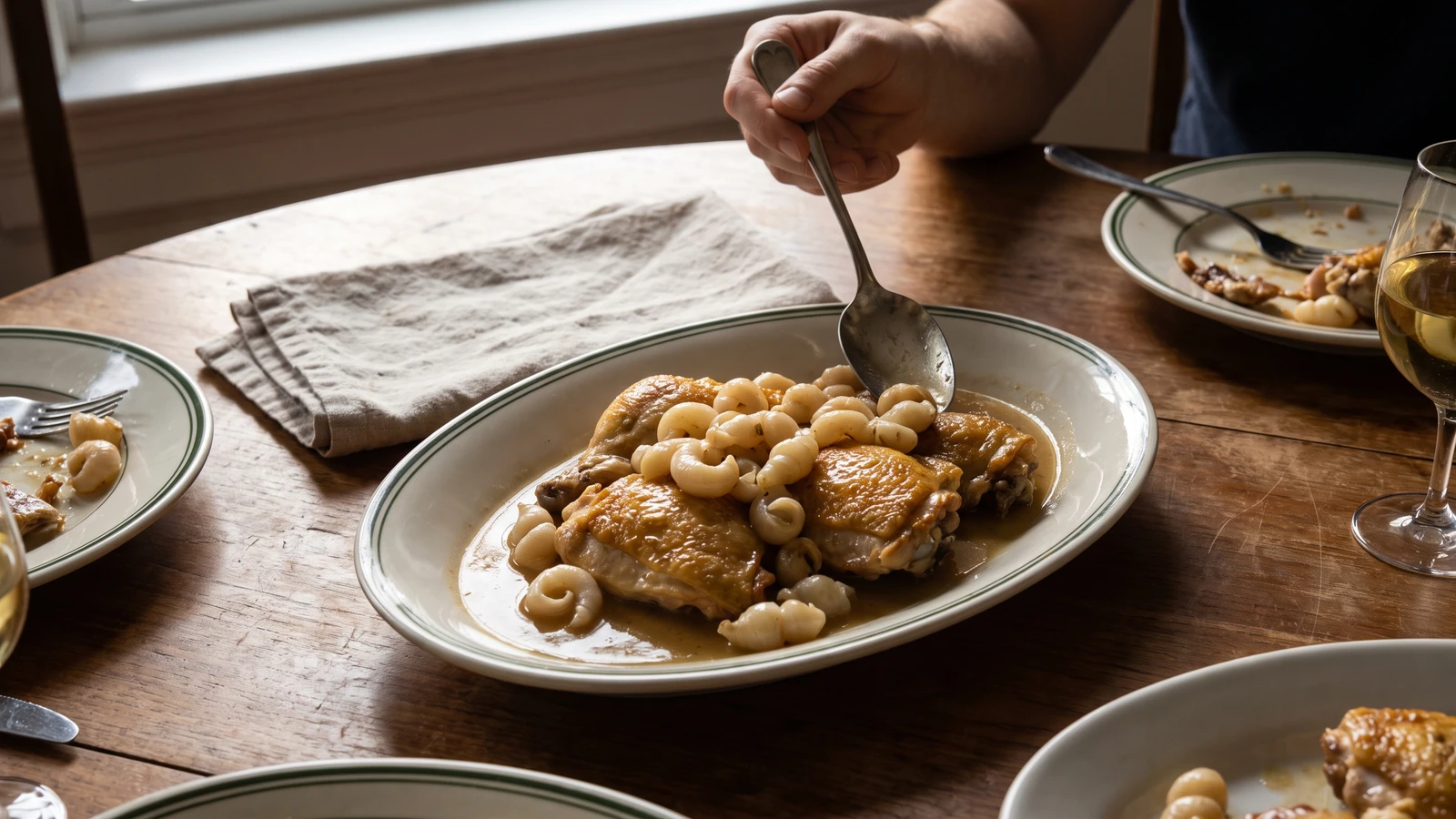
Butter-bronzed chicken and pearly crosnes finish together in one pan, then the veal-stock fond becomes a shining sauce mounted with cold butter: a quiet classical sauté built for four and served without fuss.
Poulet Sauté Japonaise (butter-sautéed chicken with crosnes) teaches a clean classical sequence: color the bird, finish its garnish beside it, then turn the pan fond into the sauce. The one true thing to know before touching the pan is that both chicken and crosnes must be dry. Moisture gives you pale skin and diluted butter when the dish needs a clear bronze crust and a concentrated jus.
The original entry assumed a stockpot never off the fire and a saucier ready to swill the pan with slightly thickened veal stock, then monter au beurre (mount the sauce with cold butter) while another hand arranged the chicken. At home, reduce a small measure of gelatin-rich veal stock in advance, use one wide ovenproof pan, and keep a warm platter beside the stove. The professional handoff is scaffolding and goes; parboiling the crosnes, frying the chicken in butter, finishing them together in the oven, and mounting the sauce away from the heat are the dish and stay. One cook, one stove, one evening.
The old proportion of one chicken to one pound of crosnes already feeds four generously, so it remains intact. Crosnes are not a token garnish here; their pearly curls should tumble over the bird and catch the buttery veal jus. Protect the final monter au beurre from direct heat. That one moment decides whether the sauce gleams or separates.
Poulet Sauté Japonaise belongs to the classical Parisian repertoire, where garnish names often identified a principal vegetable rather than a foreign seasoning. Here Japonaise means crosnes du Japon, the small ridged tubers cultivated around Crosne, southeast of Paris, after reaching French markets by way of Japan, although the plant itself comes from China. Their delicate, artichoke-like flavor carried them from market gardens into the grand-kitchen canon; soy sauce, ginger, and other Japanese seasonings have no place in this particular preparation.
Quantity
1 chicken (3½ to 4 lb / 1.6 to 1.8 kg)
cut into 8 sauté pieces
Quantity
About 3 cups (710 ml / 455 g)
Quantity
½ cup (120 ml / 140 g)
for scrubbing the crosnes
Quantity
2 quarts (1.9 L / 1.9 kg)
for parboiling
Quantity
1 tablespoon plus 1½ teaspoons (22.5 ml / 26 g)
divided
Quantity
½ teaspoon (2.5 ml / 1 g)
Quantity
3 tablespoons (45 ml / 42 g)
divided, for frying
Quantity
⅔ cup (160 ml / 165 g), reduced to ⅓ cup plus 1 tablespoon (95 ml / 100 g)
kept warm
Quantity
3 tablespoons (45 ml / 42 g)
cut into small cubes, for finishing
Quantity
1 tablespoon (15 ml / 15 g)
only if needed to rescue the sauce
| Ingredient | Quantity |
|---|---|
| whole chickencut into 8 sauté pieces | 1 chicken (3½ to 4 lb / 1.6 to 1.8 kg) |
| fresh crosnes (Stachys affinis) | About 3 cups (710 ml / 455 g) |
| coarse sea saltfor scrubbing the crosnes | ½ cup (120 ml / 140 g) |
| waterfor parboiling | 2 quarts (1.9 L / 1.9 kg) |
| fine sea saltdivided | 1 tablespoon plus 1½ teaspoons (22.5 ml / 26 g) |
| freshly ground white or black pepper | ½ teaspoon (2.5 ml / 1 g) |
| unsalted butterdivided, for frying | 3 tablespoons (45 ml / 42 g) |
| unsalted gelatin-rich veal stockkept warm | ⅔ cup (160 ml / 165 g), reduced to ⅓ cup plus 1 tablespoon (95 ml / 100 g) |
| cold unsalted buttercut into small cubes, for finishing | 3 tablespoons (45 ml / 42 g) |
| cold water (optional)only if needed to rescue the sauce | 1 tablespoon (15 ml / 15 g) |
Heat the oven to 400°F (200°C) with a rack in the center. Simmer the veal stock in a small saucepan until reduced to ⅓ cup plus 1 tablespoon (95 ml) and able to leave a thin, translucent film on a spoon. Keep it warm. It should have gentle body from gelatin and reduction, not the thickness of gravy.
Dampen the crosnes, place them with the coarse salt inside a folded clean kitchen towel, and rub them firmly for 2 to 3 minutes. The salt works into their crevices, removing soil and much of the papery skin without wasting the little tubers. Rinse them through several changes of cold water. Bring the measured water and 1 tablespoon of the fine salt to a boil, add the crosnes, and parboil for 5 minutes. They should yield slightly at the ridges but remain firm at the center. Drain and dry them thoroughly.
Dry the chicken thoroughly and season it with the remaining 1½ teaspoons fine salt and the pepper. Melt one-third of the frying butter in a wide ovenproof sauté pan over medium heat. When the foam subsides, brown the chicken in batches, skin-side down first, adding the remaining frying butter in portions as needed. Give the skin 4 to 5 minutes without fussing with it, then brown the second side for 2 to 3 minutes. Deep gold is right. If the butter develops black flecks or smells bitter, lift out the chicken, pour off the burnt butter, wipe away the loose black specks while leaving the bronze fond attached, and continue with fresh butter from the measured amount. Ça se rattrape.
Add the dried crosnes to the sauté pan and roll them through the butter for 1 to 2 minutes. Return the chicken in a single layer, skin-side up, tucking the crosnes around and beneath the pieces. Transfer the uncovered pan to the oven. Begin checking after 15 minutes and continue until the chicken reaches 165°F (74°C) at the thickest part without touching bone, about 18 to 25 minutes. The legs may go closer to 175°F (79°C), while the crosnes should be tender but still hold their curled shape. If the breasts finish first, move them to the platter and let the legs continue. Timing serves the chicken, not the other way around.
Arrange the chicken on a warm platter and spoon the crosnes over it, keeping the pieces loosely covered nearby. Set the sauté pan over medium heat, pour in the warm reduced veal stock, and swill it around the pan while scraping up every soluble bronze speck. Simmer for 30 to 60 seconds, just until the jus lightly coats a spoon. If it becomes too concentrated, loosen it with a teaspoon of the measured cold water.
Take the pan completely away from the heat and wait until the bubbling stops. Add the cold finishing butter a few cubes at a time, swirling or whisking until each addition disappears before adding the next. The monter au beurre is ready when the sauce looks glossy, lightly bronze, and unified. If an oily rim appears, stop adding butter and whisk in 1 teaspoon of cold water away from the heat; let the pan cool for 20 seconds, then continue a cube at a time. Ça se rattrape. Taste for salt, pour the sauce over the chicken and crosnes, and serve at once. À table!
1 serving (about 380g)
Culinary guides, cultural storytelling, and the editorial depth that makes cooking meaningful.
Discover Culinary ExplorerChef Juliette
John Dory has the delicacy of sole and the firmness of turbot. A light flouring, a quick butter sauté, and nut-brown beurre noisette show exactly why looks never mattered.

Chef Juliette
Fresh haddock proves its delicacy in the meunière pan: a fine flour crust, moist pearly flakes, and beurre noisette sharpened with lemon and parsley, ready from one skillet in half an hour.

Chef Juliette
Éperlans à l’Anglaise turns small fish into a lesson in disciplined coating: boned smelts under a close, crisp crumb, pan-fried in clarified butter and finished with bright, half-melted maître d’hôtel butter.

Chef Juliette
Tiny smelts, shallot, mushrooms, white wine, gratin sauce, and fine bread raspings meet a fierce oven, where the fish must turn tender in the same breath the buttered crust bronzes.