
Chef Juliette
John Dory (St. Pierre)
John Dory has the delicacy of sole and the firmness of turbot. A light flouring, a quick butter sauté, and nut-brown beurre noisette show exactly why looks never mattered.
A cooking platform built around craft, culture, and the stories behind what we eat.
Created by Chef Juliette
Based on No. 1559, Poulet Sauté à l’Indienne ou Currie de Poulet, from Le Guide Culinaire (1907) by Auguste Escoffier
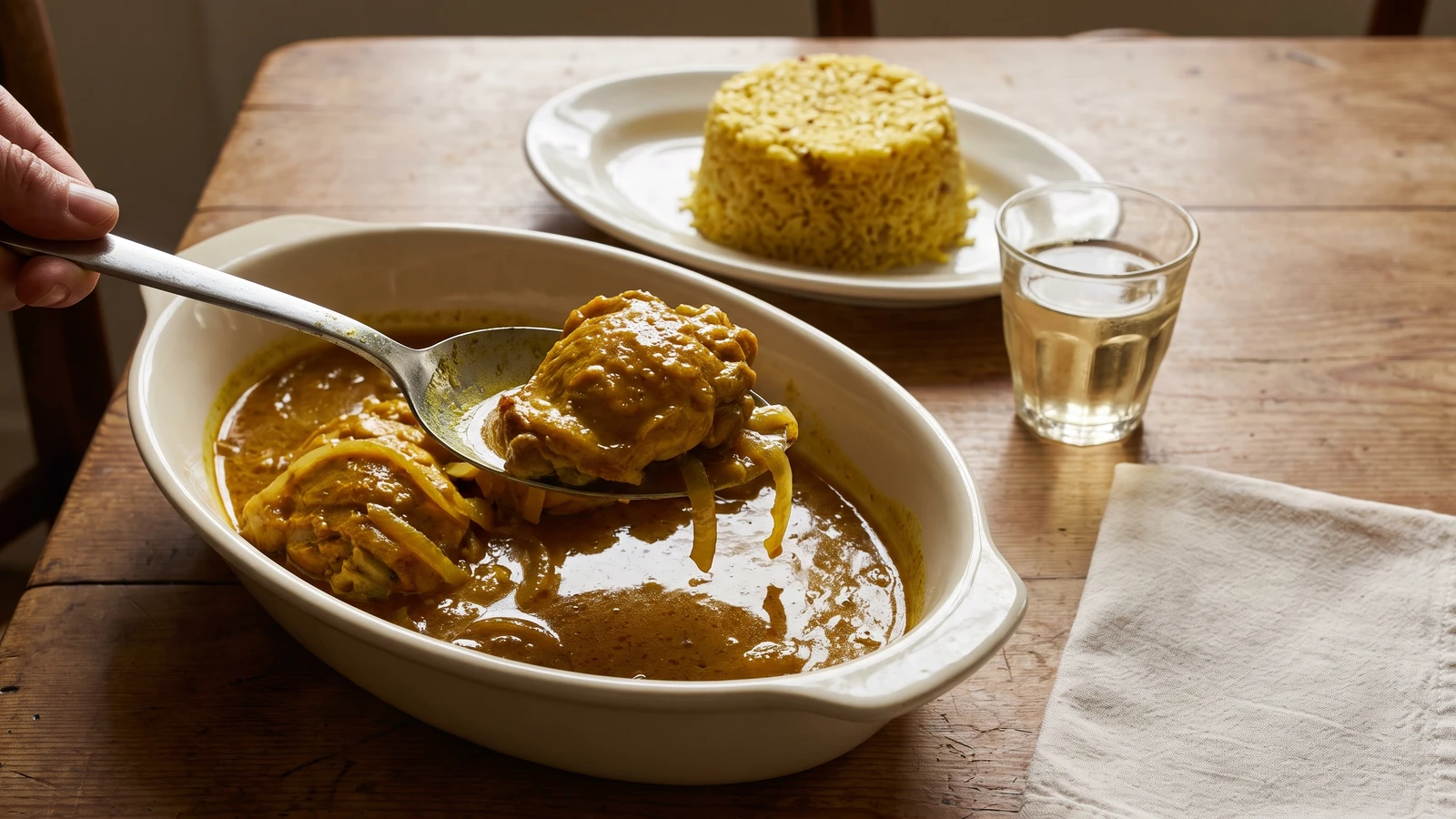
Poulet Sauté à l’Indienne wakes curry powder in hot oil, then lets coconut milk and velouté reduce around browned chicken into a close, golden sauce, with rice à l’Indienne alongside.
Poulet Sauté à l’Indienne ou Currie de Poulet (French chicken curry) teaches one precise thing: curry powder must meet hot fat before liquid, long enough to wake its fragrance and no longer. Once the coconut milk and velouté arrive, the spice can soften into the sauce, but it cannot develop what the oil never drew out. Fry it briefly. Watch it closely.
The original kitchen assumed a saucier, a stockpot never off the fire, finished chicken velouté at arm’s reach, and rice à l’Indienne ready to mold. For a home table, one small chicken, a broad sauté pan, measured portions of those prepared components, and sensible management of breast and leg pieces deliver four generous servings. The brigade’s holding pots are scaffolding and can go. The 1:2 measure of coconut milk to velouté, the spice fried with onion, and the uncovered reduction to half are the dish, so they stay. One cook, one stove, one evening.
The finished sauce should be curry-gold and glossy, close enough to cling to each piece without becoming heavy, with the softened onion nearly dissolved beneath it. The only moment that asks for nerve comes before the chicken meets any liquid: the curry should smell round and fragrant after half a minute, never dark or acrid.
Poulet sauté à l’Indienne belongs to the Parisian classical repertoire, where à l’Indienne named a family of curry-seasoned preparations accompanied by rice. These dishes translated imported curry powders and coconut into the French sauce system, binding them with velouté rather than reproducing any one regional Indian curry. The separate rice timbale is not decoration: it receives the reduced sauce without loosening it in the pan.
Quantity
1 chicken (about 3 lb 5 oz / 1.5 kg)
cut into 12 small bone-in, skin-on pieces
Quantity
3 tablespoons (45 ml / 41 g)
Quantity
2 cups (475 ml / 250 g)
thinly sliced
Quantity
2 teaspoons (10 ml / 5 g)
Quantity
½ cup (120 ml / 120 g)
stirred smooth
Quantity
1 cup (240 ml / 240 g)
Quantity
1 teaspoon (5 ml / 6 g)
divided
Quantity
3 cups (710 ml / 555 g)
kept hot
Quantity
Up to ¼ cup (60 ml / 60 g)
| Ingredient | Quantity |
|---|---|
| small whole chickencut into 12 small bone-in, skin-on pieces | 1 chicken (about 3 lb 5 oz / 1.5 kg) |
| neutral oil | 3 tablespoons (45 ml / 41 g) |
| yellow onionthinly sliced | 2 cups (475 ml / 250 g) |
| mild yellow curry powder | 2 teaspoons (10 ml / 5 g) |
| full-fat unsweetened coconut milk, or full-bodied unsweetened almond milkstirred smooth | ½ cup (120 ml / 120 g) |
| prepared chicken velouté | 1 cup (240 ml / 240 g) |
| fine saltdivided | 1 teaspoon (5 ml / 6 g) |
| prepared rice à l’Indiennekept hot | 3 cups (710 ml / 555 g) |
| hot water (optional) | Up to ¼ cup (60 ml / 60 g) |
Have the prepared chicken velouté and rice à l’Indienne finished before the sauté begins, keeping the rice covered and hot for service. Pat every chicken piece dry, because wet chicken chills the oil and sheds its skin instead of coloring. Season the pieces with three-quarters of the salt, reserving the rest for the sauce.
Heat the oil in a broad, heavy sauté pan over medium heat until it moves freely and gleams. Add the sliced onion with a pinch of the reserved salt and cook for 4 to 5 minutes, stirring, until supple and pale gold at the edges. Push the onion outward, scatter the curry powder directly into the exposed oil, and stir for 20 to 30 seconds, just until its fragrance becomes fuller. If it begins to catch, lift the pan off the heat and add the chicken at once to cool the fat. If the spice has blackened and smells bitter, discard the onion and oil and begin this step again; burnt curry only grows harsher as the sauce reduces.
Add the chicken skin-side down and turn each piece through the onion and curry. Cook over medium heat for 7 to 9 minutes, turning once or twice, until the surfaces have lost their raw look and taken patches of gold. Deep browning is not the aim here, since the curry would burn before the chicken reached a mahogany crust. If the pieces cannot sit without stacking, work in two batches over moderate heat, then return everything to the pan before adding liquid.
Pour in the coconut milk, swilling the pan and scraping up every seasoned brown trace from its floor. Add the prepared chicken velouté and stir around the pieces without flooding their crisped upper surfaces. Bring the sauce to a bare simmer, then cook uncovered for 18 to 25 minutes, turning the chicken once. Begin checking the breast pieces early and remove them as they reach 165°F / 74°C; let the legs continue until tender and at least 175°F / 79°C.
As each piece finishes, lift it to a warm plate. Continue reducing the sauce until the liquid has lost roughly half its original volume and become nappant, thick enough to coat the back of a spoon while still flowing freely. If it reaches that point before the leg pieces are tender, add hot water a tablespoon at a time and continue the gentle simmer. Ça se rattrape. If the chicken finishes while the sauce remains thin, reduce the sauce briskly on its own, then lower the heat and return every piece for 2 minutes. Taste and add the remaining salt only if the velouté has left it necessary.
Arrange the chicken in a warmed deep serving dish and spoon the onion-rich sauce over it, leaving no browned curry behind in the pan. Rinse a 3-cup bowl with hot water, pack in the hot rice à l’Indienne without crushing it, and invert it onto a separate platter to make the timbale. Bring chicken and rice to the table together, but keep them separate until each plate is served. À table!
1 serving (about 435g)
Culinary guides, cultural storytelling, and the editorial depth that makes cooking meaningful.
Discover Culinary ExplorerChef Juliette
John Dory has the delicacy of sole and the firmness of turbot. A light flouring, a quick butter sauté, and nut-brown beurre noisette show exactly why looks never mattered.

Chef Juliette
Fresh haddock proves its delicacy in the meunière pan: a fine flour crust, moist pearly flakes, and beurre noisette sharpened with lemon and parsley, ready from one skillet in half an hour.

Chef Juliette
Éperlans à l’Anglaise turns small fish into a lesson in disciplined coating: boned smelts under a close, crisp crumb, pan-fried in clarified butter and finished with bright, half-melted maître d’hôtel butter.

Chef Juliette
Tiny smelts, shallot, mushrooms, white wine, gratin sauce, and fine bread raspings meet a fierce oven, where the fish must turn tender in the same breath the buttered crust bronzes.