
Chef Juliette
John Dory (St. Pierre)
John Dory has the delicacy of sole and the firmness of turbot. A light flouring, a quick butter sauté, and nut-brown beurre noisette show exactly why looks never mattered.
A cooking platform built around craft, culture, and the stories behind what we eat.
Created by Chef Juliette
Based on No. 1557, Poulet Sauté Georgina, from Le Guide Culinaire (1907) by Auguste Escoffier
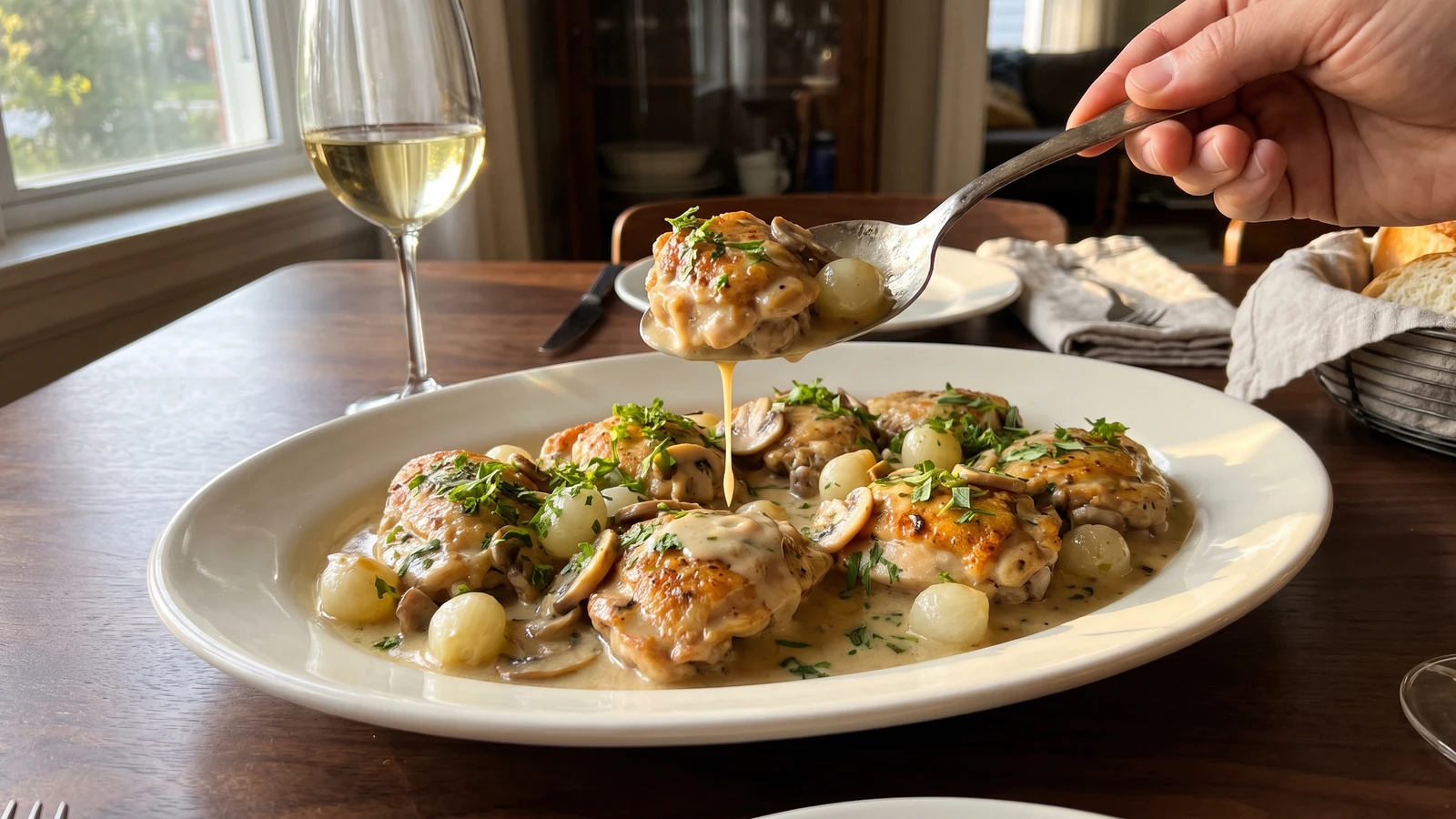
Poulet Sauté Georgina turns butter-browned chicken, twelve new onions, mushrooms, Rhine wine, and cream into a generous supper, with chervil and tarragon added only after the reduction.
Poulet Sauté Georgina (butter-sautéed chicken with Rhine wine, cream, mushrooms, and fine herbs) teaches one decisive habit: finish the sauce after the bird leaves the pan. Sauté, here, means browning the chicken in butter and letting it finish gently with its onions and fennel. If the meat stays while the cream reduces by half, the breast pays for the sauce. It should not.
The original formula assumed a saucier attending the reduction, a hot serving dish waiting at the pass, and mushroom cooking liquor already in the larder. Your home equivalent is one wide sauté pan, a small saucepan, and a low oven, with a quick liquor drawn from the mushroom stems. The one-fifth pint of cream becomes a level half cup, and a small market chicken replaces the age-specified pullet because that is what the butcher actually sells. The brigade's ready-made mushroom pot and extra pair of hands are scaffolding, so they go. The twelve onions, twelve sliced caps, equal spoonfuls of Rhine wine and mushroom liquor, and reduction by half are the dish, so they stay. This formula asks for neither the stockpot that never leaves the fire nor a salamander. One cook, one stove, one evening.
You are after bronze skin, onions tender enough to yield under a fork, and an ivory sauce sharpened by dry wine, carrying mushroom depth without heaviness. Chervil and tarragon go in after the heat is off, because boiling steals their scent. The one step that decides Georgina is the final reduction: keep the chicken warm elsewhere, and stop when the sauce coats a spoon but still pours.
Poulet Sauté Georgina belongs to the named-garnish repertoire of the formal French dining-room table, not to a farmhouse tradition claimed by one region. Rhine wine may point the mind toward Alsace, but Georgina is not an Alsatian household specialty; its title is one of the repertoire's proper names, and the combination of wine, cream, mushrooms, and fines herbes defines it. The compact sauté passed naturally into bourgeois home cooking because the whole composition rests on one bird, one pan, and a brief reduction.
Quantity
1 (3 to 3½ lb / 1.4 to 1.6 kg)
cut into 8 pieces
Quantity
2 teaspoons (10 ml / 12 g)
Quantity
½ teaspoon (2.5 ml / 1 g)
Quantity
4 tablespoons (60 ml / 56 g)
divided
Quantity
12 (about 1½ cups / 250 g)
peeled with the root ends intact
Quantity
1 small bundle
made with 4 parsley stems, 1 small thyme sprig, ½ bay leaf, and 1 sprig fresh fennel frond
Quantity
12 (about 8 oz / 225 g)
stems reserved and caps thinly sliced
Quantity
½ cup (120 ml / 120 g), reduced to 3 tablespoons (45 ml / 45 g) liquor
simmered with the mushroom stems
Quantity
3 tablespoons (45 ml / 44 g)
Quantity
½ cup (120 ml / 120 g)
Quantity
2 teaspoons (10 ml / 2 g)
finely chopped
Quantity
1 teaspoon (5 ml / 1 g)
finely chopped
| Ingredient | Quantity |
|---|---|
| small whole chicken or pulletcut into 8 pieces | 1 (3 to 3½ lb / 1.4 to 1.6 kg) |
| fine sea salt | 2 teaspoons (10 ml / 12 g) |
| finely ground white pepper | ½ teaspoon (2.5 ml / 1 g) |
| unsalted butterdivided | 4 tablespoons (60 ml / 56 g) |
| small new onionspeeled with the root ends intact | 12 (about 1½ cups / 250 g) |
| bouquet garni (tied herb bundle)made with 4 parsley stems, 1 small thyme sprig, ½ bay leaf, and 1 sprig fresh fennel frond | 1 small bundle |
| medium white button mushroomsstems reserved and caps thinly sliced | 12 (about 8 oz / 225 g) |
| water for the mushroom cooking liquorsimmered with the mushroom stems | ½ cup (120 ml / 120 g), reduced to 3 tablespoons (45 ml / 45 g) liquor |
| dry Rhine wine, preferably dry Riesling | 3 tablespoons (45 ml / 44 g) |
| heavy cream, at least 35% fat | ½ cup (120 ml / 120 g) |
| fresh chervilfinely chopped | 2 teaspoons (10 ml / 2 g) |
| fresh tarragonfinely chopped | 1 teaspoon (5 ml / 1 g) |
Put the reserved mushroom stems and water in a small saucepan. Cover and simmer gently for 10 minutes, then strain through a fine sieve, pressing the stems lightly. Return the liquid to the saucepan and reduce it to exactly 3 tablespoons (45 ml). If you pass the mark, top it back up with a little water. Slice the mushroom caps, tie the bouquet garni securely, and set a lipped serving platter in a 200°F (95°C) oven.
Pat the chicken completely dry, then season it with the salt and white pepper. Melt half the butter in a wide, heavy sauté pan over medium heat. When the foam subsides, add half the chicken skin-side down and brown it for 5 to 7 minutes without fussing with it, then brown the second side for 2 to 3 minutes. Repeat with the remaining butter and chicken. Regulate the heat so the butter stays hazelnut-gold, never black; if the milk solids begin darkening too quickly, lift the pan from the heat for a few seconds and lower the flame. The chicken should be richly bronzed but not cooked through.
Add the new onions to the same pan and roll them through the butter for 3 to 4 minutes, until patched with gold. Return the legs and thighs, add the bouquet garni, cover, and cook over low heat for 8 minutes. Add the breast pieces skin-side up, cover again, and cook for another 10 to 14 minutes, turning the onions once. Remove each piece as it becomes ready: the breasts should reach 165°F (74°C), while the joints are best near 175°F (79°C). The onions should yield to a knife without collapsing. Transfer the chicken and onions to the warm platter, cover loosely, and discard the bouquet garni.
Pour off any excess fat while preserving the browned film on the pan. Déglace, loosen that fond, with the 3 tablespoons of mushroom cooking liquor and the 3 tablespoons of Rhine wine, scraping until every brown speck dissolves. Add the cream and sliced mushroom caps, then simmer briskly for 6 to 9 minutes, until the mushrooms are tender and the liquid has reduced by roughly half to a glossy sauce that coats the back of a spoon but still flows. If the mushrooms finish first, lift them out and continue reducing the liquid. If the sauce tightens or looks greasy, remove it from the heat and whisk in a teaspoon of cold water. Ça se rattrape.
Take the pan completely off the heat. Stir in the chervil and tarragon, taste, and correct the seasoning. Do not boil the herbs; their fresh scent is the final note, not something to cook away. Spoon the mushrooms around the chicken and onions, then pour the sauce generously over everything, including any juices collected on the platter. Serve at once. À table!
1 serving (about 335g)
Culinary guides, cultural storytelling, and the editorial depth that makes cooking meaningful.
Discover Culinary ExplorerChef Juliette
John Dory has the delicacy of sole and the firmness of turbot. A light flouring, a quick butter sauté, and nut-brown beurre noisette show exactly why looks never mattered.

Chef Juliette
Fresh haddock proves its delicacy in the meunière pan: a fine flour crust, moist pearly flakes, and beurre noisette sharpened with lemon and parsley, ready from one skillet in half an hour.

Chef Juliette
Éperlans à l’Anglaise turns small fish into a lesson in disciplined coating: boned smelts under a close, crisp crumb, pan-fried in clarified butter and finished with bright, half-melted maître d’hôtel butter.

Chef Juliette
Tiny smelts, shallot, mushrooms, white wine, gratin sauce, and fine bread raspings meet a fierce oven, where the fish must turn tender in the same breath the buttered crust bronzes.