
Chef Juliette
John Dory (St. Pierre)
John Dory has the delicacy of sole and the firmness of turbot. A light flouring, a quick butter sauté, and nut-brown beurre noisette show exactly why looks never mattered.
A cooking platform built around craft, culture, and the stories behind what we eat.
Created by Chef Juliette
Based on No. 1555, Poulet Sauté Forestière, from Le Guide Culinaire (1907) by Auguste Escoffier
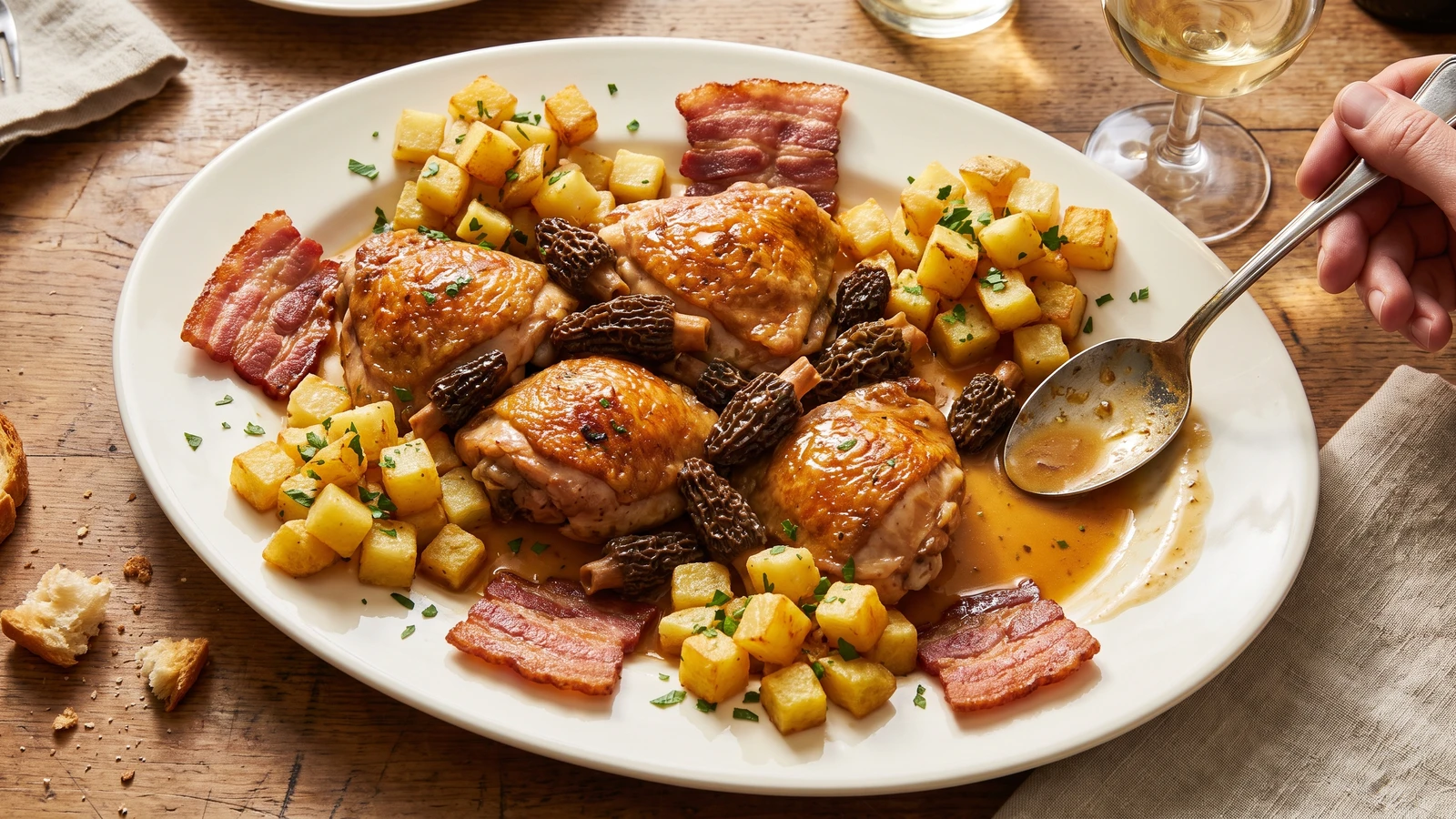
Butter-browned chicken, earthy morels, crisp bacon, and golden potato dice meet in one reduced white-wine sauce, a lesson in sautéing where every drop of mushroom liquor and every trace of fond belongs.
Poulet Sauté Forestière (forest-style sautéed chicken) teaches the central rule of a sauté: the pan is not merely where the meat browns, it is where the sauce begins. Sauté means cooking the chicken in shallow butter over lively heat so its surface bronzes and a fond forms below; white wine and veal stock later lift that fond into the sauce. The morels drink butter, then give it back with their own dark juices. None of that liquid leaves the pan.
The source assumes a saucier at the range, veal stock never off the fire, a garnish cook keeping potatoes and frizzled bacon ready, and enough pans to pass the work from hand to hand. Your honest equivalents are a 12-inch ovenproof sauté pan, a measured scant half-cup of gelatinous veal stock, and a second skillet; one small chicken gives four generous portions. There is no salamander work to imitate. The brigade handoffs and holding trays are scaffolding, so they go, but the butter sauté, ten-minute covered oven stew, white-wine swill, and reduction remain because they are the dish. One cook, one stove, one evening.
When it lands, chicken bronzed in butter sits under an amber gloss crowded with honeycombed morels, four heaps of potato dice ring the platter, and crisp bacon waits between them. Before touching the pan, know the one true thing: protect the fond and every spoonful of morel liquor. If either goes down the sink, no later flourish can put it back.
In the Parisian classical repertoire, forestière identifies a garnish family rather than a single provincial recipe: woodland mushrooms, potatoes, and bacon gathered around sautéed meat or poultry. Morels make this version the grander member of that family, while the white-wine and veal-stock reduction ties it to the bourgeois dining room and the professional sauce station. The name is often mistaken for a regional claim, but it is practical kitchen language, a promise that the forest enters through the garnish and pan juices, not through decorative rusticity.
Quantity
1 (about 3½ lb / 1.6 kg)
cut into 8 pieces, skin on
Quantity
2 teaspoons (10 ml / 12 g)
divided
Quantity
½ teaspoon (2.5 ml / 1 g)
Quantity
8 tablespoons (120 ml / 113 g)
divided
Quantity
1 tablespoon (15 ml / 10 g)
finely chopped
Quantity
3 loosely packed cups (710 ml / 140 g) fresh, or 1½ loosely packed cups (355 ml / 40 g) dried
fresh morels quartered; dried morels rehydrated and quartered
Quantity
1½ cups (355 ml / 355 g)
for rehydrating dried morels only
Quantity
½ cup (120 ml / 120 g)
Quantity
Scant ½ cup (95 ml / 95 g)
Quantity
2 tablespoons (30 ml / 30 g)
for loosening the sauce only
Quantity
4 cups (950 ml / 680 g)
peeled and cut into large ¾-inch (2 cm) dice
Quantity
4 thick rectangles (about 4 oz / 115 g total)
Quantity
1 tablespoon (15 ml / 4 g)
finely chopped
| Ingredient | Quantity |
|---|---|
| small chickencut into 8 pieces, skin on | 1 (about 3½ lb / 1.6 kg) |
| fine sea saltdivided | 2 teaspoons (10 ml / 12 g) |
| freshly ground black pepper | ½ teaspoon (2.5 ml / 1 g) |
| unsalted butterdivided | 8 tablespoons (120 ml / 113 g) |
| shallotfinely chopped | 1 tablespoon (15 ml / 10 g) |
| fresh morels, or dried morelsfresh morels quartered; dried morels rehydrated and quartered | 3 loosely packed cups (710 ml / 140 g) fresh, or 1½ loosely packed cups (355 ml / 40 g) dried |
| warm water (optional)for rehydrating dried morels only | 1½ cups (355 ml / 355 g) |
| dry white wine | ½ cup (120 ml / 120 g) |
| unsalted gelatinous veal stock | Scant ½ cup (95 ml / 95 g) |
| additional veal stock (optional)for loosening the sauce only | 2 tablespoons (30 ml / 30 g) |
| waxy potatoespeeled and cut into large ¾-inch (2 cm) dice | 4 cups (950 ml / 680 g) |
| unsmoked slab bacon | 4 thick rectangles (about 4 oz / 115 g total) |
| flat-leaf parsleyfinely chopped | 1 tablespoon (15 ml / 4 g) |
Heat the oven to 400°F (200°C). Check fresh morels carefully for grit, split larger ones lengthwise, rinse them briefly in cold water, and dry them well before quartering. If using dried morels, cover them with the warm water for 30 minutes, lift them out so the grit stays behind, and strain the soaking liquor through a damp coffee filter or two layers of fine cloth. Reserve ¼ cup (60 ml) of that dark liquor for the sauce. Dry the chicken thoroughly, but wait to season it until the pan is ready.
Lay the bacon rectangles in a dry skillet over medium heat. Cook for 6 to 8 minutes, turning once, until their edges are crisp and rippled while the centres remain pleasantly meaty. Lift them onto a rack or absorbent paper. Pour the rendered bacon fat into a heatproof jar for another meal and wipe the skillet clean; the potatoes are tossed in butter because that is the garnish the source specifies.
Melt 3 tablespoons of the butter in the wiped skillet over medium heat. Add the potato dice in one layer with ½ teaspoon of the salt, cover, and cook for 6 minutes. Uncover and toss them frequently for another 8 to 10 minutes, until nearly tender and golden on several faces, then take the pan off the heat. If they colour before their centres soften, lower the heat and cover them again for 3 minutes. They will finish while the sauce reduces.
Season the chicken with the remaining salt and the pepper. Melt 4 tablespoons of butter in the ovenproof sauté pan over medium-high heat. When the foam subsides, lay in the thighs and drumsticks skin-side down; add the breasts and wings about 3 minutes later. Brown the pieces in batches if necessary, giving the skin 5 to 7 minutes and the second side 2 to 3 minutes. You want a deep butter-gold crust and a brown fond on the pan floor, but the meat need not yet be cooked through.
Return every chicken piece to the pan and lower the heat to medium. Sprinkle in the chopped shallot and cook for 30 seconds without letting it darken. Add the morels and turn them through the butter for 1 to 2 minutes, keeping every drop of their juice in the pan. Cover tightly and place the pan in the oven for 10 minutes. Check the chicken at the thickest part; it must reach at least 165°F (74°C). Remove finished breast pieces if necessary and give the legs another 3 to 5 minutes. The morels must receive at least the full 10 minutes of cooking.
Transfer the chicken and morels to a warm oval platter, tipping every collected juice back into the sauté pan. Spoon off only an obvious excess of clear fat, leaving the browned fond and mushroom liquor untouched. Set the pan over medium-high heat, add the white wine, and swill the pan by scraping and rinsing every brown trace into the liquid. Reduce the wine to about 2 tablespoons, then add the veal stock and, if you used dried morels, the reserved ¼ cup of filtered soaking liquor. Boil steadily until the sauce forms a thin, glossy veil on a spoon, then return the morels and any resting juices. If it is thin, keep reducing. If it tightens too far, loosen it with the additional stock. If butter pools on top, take the pan off the heat, spoon away the excess, and whisk in a teaspoon of cold stock. Ça se rattrape. Taste and correct the seasoning.
Return the potato skillet to medium-high heat, add the final tablespoon of butter, and toss for 2 to 3 minutes until the dice are tender, deeply golden, and gleaming. Arrange the chicken in the centre of the platter and spoon the morels and reduced sauce over it. Make four small heaps of potato dice around the chicken, place one frizzled bacon rectangle between each heap, and sprinkle the parsley over the chicken rather than the whole platter. Serve at once. À table!
1 serving (about 475g)
Culinary guides, cultural storytelling, and the editorial depth that makes cooking meaningful.
Discover Culinary ExplorerChef Juliette
John Dory has the delicacy of sole and the firmness of turbot. A light flouring, a quick butter sauté, and nut-brown beurre noisette show exactly why looks never mattered.

Chef Juliette
Fresh haddock proves its delicacy in the meunière pan: a fine flour crust, moist pearly flakes, and beurre noisette sharpened with lemon and parsley, ready from one skillet in half an hour.

Chef Juliette
Éperlans à l’Anglaise turns small fish into a lesson in disciplined coating: boned smelts under a close, crisp crumb, pan-fried in clarified butter and finished with bright, half-melted maître d’hôtel butter.

Chef Juliette
Tiny smelts, shallot, mushrooms, white wine, gratin sauce, and fine bread raspings meet a fierce oven, where the fish must turn tender in the same breath the buttered crust bronzes.