
Chef Juliette
John Dory (St. Pierre)
John Dory has the delicacy of sole and the firmness of turbot. A light flouring, a quick butter sauté, and nut-brown beurre noisette show exactly why looks never mattered.
A cooking platform built around craft, culture, and the stories behind what we eat.
Created by Chef Juliette
Based on No. 1554, Poulet Sauté aux Fines Herbes, from Le Guide Culinaire (1907) by Auguste Escoffier
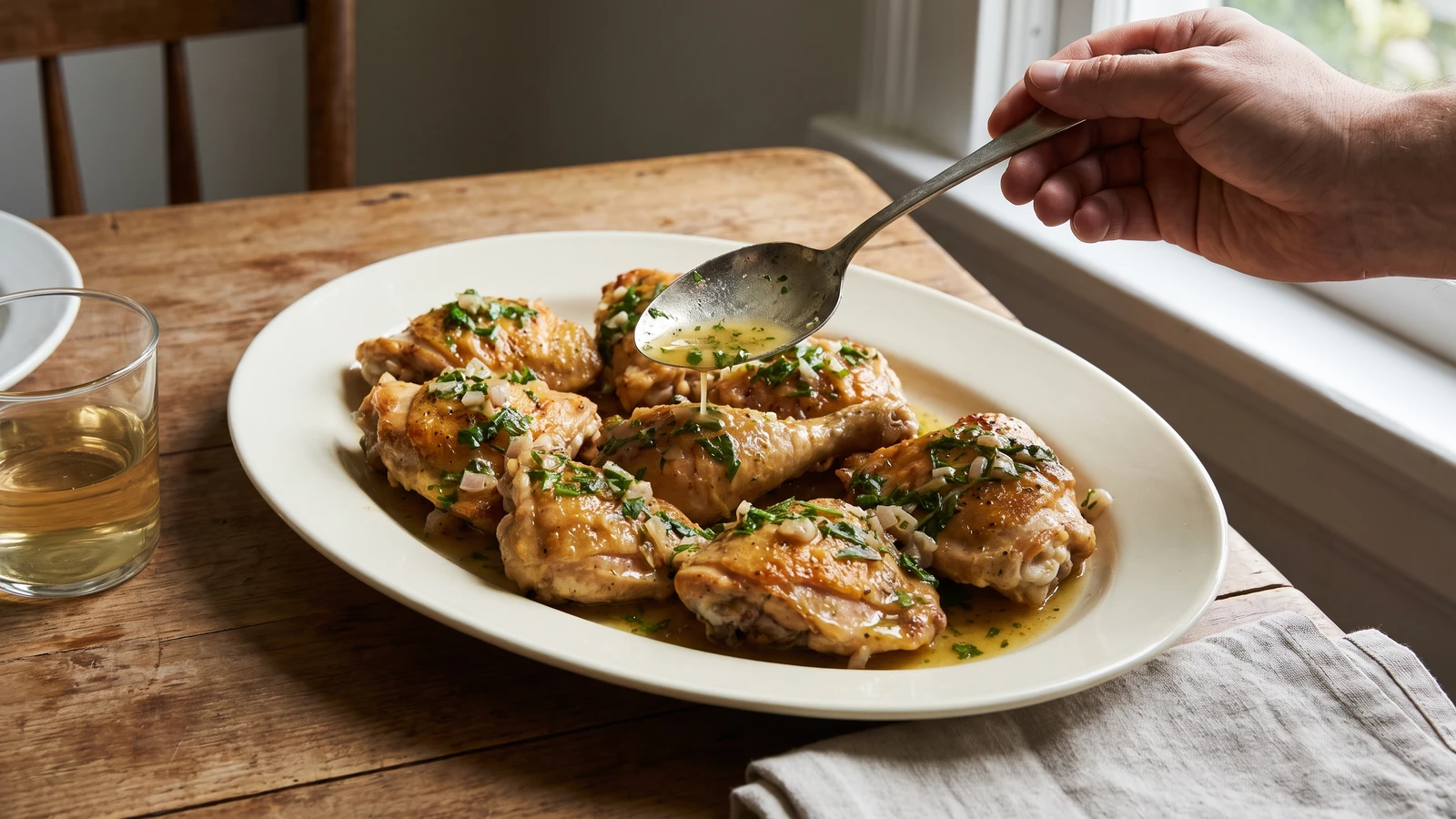
Golden chicken and a taut white-wine pan sauce teach the grammar of sauté: build the fond in butter, give it body with veal gravy and half-glaze, then finish the fines herbes off the fire.
Poulet Sauté aux Fines Herbes (butter-sautéed chicken with parsley, chervil, and tarragon) teaches the clean finish of a pan sauce. The one true thing to know before touching the pan is this: the fines herbes do not cook. Heat kills their fragrance, so they enter off the fire with cold butter, where they stay green, fresh, and unmistakably themselves.
The original entry assumed a saucier on staff, strong veal gravy and half-glaze already waiting, and a stockpot that never left the fire. At home, deeply reduced unsalted veal stock supplies the strong gravy, while a good prepared demi-glace supplies the half-glaze. The quantity becomes one small market chicken for four, but the source's proportions and sequence remain intact. Having foundation sauces ready by the gallon was brigade scaffolding, and it can go. Sautéing in butter, adding the shallot two minutes before dishing, reducing the wine first, and finishing away from the fire are the dish itself, and they stay. No salamander is hidden in the method; one wide sauté pan is the proper tool. One cook, one stove, one evening.
When the Poulet Sauté aux Fines Herbes is right, the chicken is Maillard bronze and the sauce lies over it in a thin, glossy coat, deepened by veal but lifted by the sudden green perfume of the herbs. Take the pan off the fire before the finishing butter and herbs enter. That is the step that decides the dish.
Poulet sauté aux fines herbes belongs to the French classical dining room, especially the Parisian repertoire, rather than to the farmhouse table of one particular province. It grew from the base sauté method, a jointed bird browned and cooked in butter, then distinguished at service by a sauce assembled from the pan fond and the saucier's ready veal preparations. The name is often flattened into generic herb chicken, but its identity lies in the sequence: shallot touches the bird at the end, wine reduces first, and parsley, chervil, and tarragon enter only after the heat.
Quantity
1 chicken (3½ to 4 pounds / 1.6 to 1.8 kg)
cut into 8 pieces
Quantity
1 teaspoon (5 ml / 6 g)
Quantity
¼ teaspoon (1.25 ml / 0.6 g)
Quantity
3 tablespoons (45 ml / 43 g)
Quantity
1 tablespoon (15 ml / 14 g)
finely chopped
Quantity
⅓ cup plus 1 tablespoon (95 ml / 94 g)
Quantity
3 tablespoons (45 ml / 45 g)
Quantity
3 tablespoons (45 ml / 45 g)
Quantity
3 tablespoons (45 ml / 43 g)
cut into small cubes
Quantity
1 teaspoon (5 ml / 1 g) total
finely chopped in equal parts
Quantity
2 tablespoons (30 ml / 30 g)
| Ingredient | Quantity |
|---|---|
| whole chickencut into 8 pieces | 1 chicken (3½ to 4 pounds / 1.6 to 1.8 kg) |
| fine sea salt | 1 teaspoon (5 ml / 6 g) |
| freshly ground white pepper | ¼ teaspoon (1.25 ml / 0.6 g) |
| unsalted butter for sautéing | 3 tablespoons (45 ml / 43 g) |
| shallotfinely chopped | 1 tablespoon (15 ml / 14 g) |
| dry white wine | ⅓ cup plus 1 tablespoon (95 ml / 94 g) |
| strong veal gravy or deeply reduced unsalted veal stock | 3 tablespoons (45 ml / 45 g) |
| prepared half-glaze sauce (demi-glace) | 3 tablespoons (45 ml / 45 g) |
| cold unsalted buttercut into small cubes | 3 tablespoons (45 ml / 43 g) |
| fresh parsley, chervil, and tarragonfinely chopped in equal parts | 1 teaspoon (5 ml / 1 g) total |
| cold water (optional) | 2 tablespoons (30 ml / 30 g) |
Pat the chicken completely dry, then season it on every side with the salt and white pepper. Combine the parsley, chervil, and tarragon, but keep them cool and away from the stove. Set the cubed finishing butter in the cold until the moment it is needed; cold butter enters a warm sauce gradually and forms a gloss instead of an oily slick.
Melt 2 tablespoons of the sautéing butter in a 12-inch heavy sauté pan over medium heat. When the foam subsides, lay in the leg pieces skin-side down and brown them for about 5 minutes, then turn and cook for 3 minutes. Transfer them to a plate. Add the remaining sautéing butter if the pan looks dry, then brown the breast and wing pieces for about 4 minutes on the skin side and 2 minutes on the other side. Work without crowding, because the brown film on the pan floor is fond, and that fond is the foundation of the sauce. If the butter solids turn black rather than hazelnut brown, lift out the chicken, wipe away the burnt fat without scraping off the firm brown fond, and resume with the reserved butter.
Return all the chicken to the pan, arranging the leg pieces nearer the hotter outer edge. Lower the heat to medium-low, cover with the lid slightly ajar, and cook for 8 to 12 minutes. Begin checking early. When the breast pieces reach about 160°F / 71°C and the thighs about 170°F / 77°C, sprinkle the chopped shallot over and around the chicken. Cook for exactly 2 minutes more, turning the pieces once through the shallot without letting it color. The finished breast should reach 165°F / 74°C and the thighs at least 175°F / 79°C. Transfer the chicken to a warm oval platter and cover it loosely.
Pour away any pool of free fat, leaving the shallot and brown fond in the pan. Déglacer, deglaze the pan, with the white wine over medium-high heat, scraping until every brown trace dissolves. Boil until the wine has reduced to about 2 tablespoons and smells rounded rather than raw. Add the strong veal gravy and the half-glaze sauce (demi-glace), then reduce for 2 to 3 minutes, until the sauce coats the back of a spoon and a finger drawn through it leaves a clean track. If it becomes gluey, loosen it with cold water a teaspoon at a time; if it runs like broth, reduce it a little longer.
Take the pan completely off the heat and wait 20 seconds. Monter au beurre, whisk in the cold butter, one cube at a time, until the sauce turns glossy and lightly thickened. Fold in the parsley, chervil, and tarragon only after the last butter disappears. If the sauce separates into yellow droplets, stop adding butter. Ça se rattrape: place 1 teaspoon of cold water in a clean bowl and whisk in the broken sauce a spoonful at a time until it comes together, then continue with any remaining butter. Taste for seasoning, spoon the sauce immediately over the chicken, and bring the platter to the table. À table!
1 serving (about 255g)
Culinary guides, cultural storytelling, and the editorial depth that makes cooking meaningful.
Discover Culinary ExplorerChef Juliette
John Dory has the delicacy of sole and the firmness of turbot. A light flouring, a quick butter sauté, and nut-brown beurre noisette show exactly why looks never mattered.

Chef Juliette
Fresh haddock proves its delicacy in the meunière pan: a fine flour crust, moist pearly flakes, and beurre noisette sharpened with lemon and parsley, ready from one skillet in half an hour.

Chef Juliette
Éperlans à l’Anglaise turns small fish into a lesson in disciplined coating: boned smelts under a close, crisp crumb, pan-fried in clarified butter and finished with bright, half-melted maître d’hôtel butter.

Chef Juliette
Tiny smelts, shallot, mushrooms, white wine, gratin sauce, and fine bread raspings meet a fierce oven, where the fish must turn tender in the same breath the buttered crust bronzes.