
Chef Juliette
John Dory (St. Pierre)
John Dory has the delicacy of sole and the firmness of turbot. A light flouring, a quick butter sauté, and nut-brown beurre noisette show exactly why looks never mattered.
A cooking platform built around craft, culture, and the stories behind what we eat.
Created by Chef Juliette
Based on No. 1552, Poulet Sauté au Fenouil, from Le Guide Culinaire (1907) by Auguste Escoffier
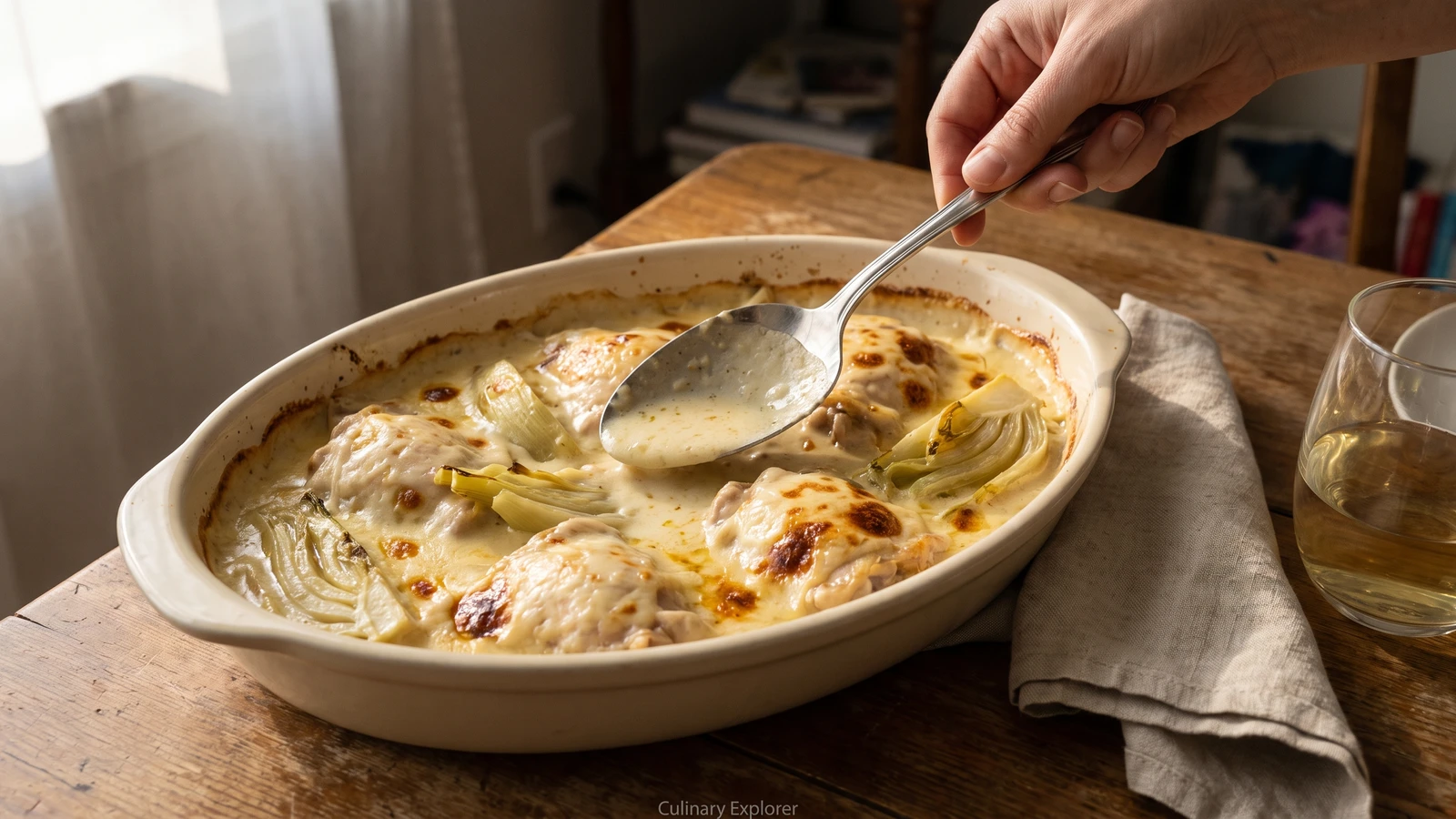
A pale, butter-soft sauté of chicken and parboiled fennel, gathered under chicken-rich Mornay and glazed to a bubbling gold, proves that managing tenderness before browning is sometimes the finer discipline.
Poulet Sauté au Fenouil (chicken sautéed with fennel) teaches an unusual discipline: tenderness comes before colour. The chicken is set gently in butter, moistened with cream and cooked beside fennel that has already been parboiled. Do not let the word sauté bully you into making a dark crust. This dish wants pale, succulent meat under an ivory sauce, with fennel soft enough to cut using the side of a fork.
The original kitchen assumed a saucier ready with Mornay, béchamel enriched with cheese, chicken essence drawn from stock never off the fire, a salamander for glazing and extra hands to turn three fennel bulbs into matching cloves. At home, a saucepan and whisk make one small Mornay, reduced unsalted stock supplies the essence, and the broiler supplies the fierce top heat. The professional quantity becomes one chicken for four. The separate holding pans and last-minute brigade choreography can go; they were scaffolding. Turning and parboiling the fennel stay because they determine both the crown and the tenderness. One cook, one stove, one evening.
What reaches the table is generous and unabashed: fennel arranged around the dish, chicken nestled in its centre, and Mornay gleaming under a mottled golden glaze. Parboil the fennel until a knife nearly reaches its core before it ever meets the chicken. That is the step that decides the dish, because no broiler can rescue a raw, stringy bulb hidden beneath sauce.
Poulet sauté au fenouil belongs to the formal French grand-kitchen repertoire centered in Paris, where a sauté could remain pale, be moistened with cream and receive a second sauce before glazing. Fennel may suggest Provence, but the Mornay and concentrated chicken essence place this preparation in the national grand style rather than the olive-oil cooking of the Mediterranean coast. Its crown of carefully turned bulbs shows how a market vegetable became part garnish, part architecture and a full partner to the poultry.
Quantity
1 (3½ to 4 lb / 1.6 to 1.8 kg)
cut into 8 bone-in pieces
Quantity
3 (about 1½ lb / 680 g total)
stalks removed, quartered through the cores and turned into garlic-clove shapes
Quantity
1 tablespoon (15 ml / 18 g)
divided
Quantity
¾ teaspoon (3.75 ml / 1.5 g)
divided
Quantity
3 tablespoons (45 ml / 42 g)
Quantity
1¼ cups (300 ml / 300 g)
divided
Quantity
1 cup (240 ml / 240 g)
Quantity
3 tablespoons (45 ml / 42 g)
Quantity
3 tablespoons (45 ml / 24 g)
Quantity
1¼ cups (300 ml / 305 g)
divided
Quantity
¾ cup (180 ml / 75 g)
finely grated
Quantity
¼ cup (60 ml / 25 g)
finely grated
| Ingredient | Quantity |
|---|---|
| whole chickencut into 8 bone-in pieces | 1 (3½ to 4 lb / 1.6 to 1.8 kg) |
| small Florence fennel bulbsstalks removed, quartered through the cores and turned into garlic-clove shapes | 3 (about 1½ lb / 680 g total) |
| fine sea saltdivided | 1 tablespoon (15 ml / 18 g) |
| finely ground white pepperdivided | ¾ teaspoon (3.75 ml / 1.5 g) |
| unsalted butter for the sauté | 3 tablespoons (45 ml / 42 g) |
| heavy creamdivided | 1¼ cups (300 ml / 300 g) |
| unsalted chicken stock | 1 cup (240 ml / 240 g) |
| unsalted butter for the Mornay sauce | 3 tablespoons (45 ml / 42 g) |
| all-purpose flour | 3 tablespoons (45 ml / 24 g) |
| whole milkdivided | 1¼ cups (300 ml / 305 g) |
| Gruyèrefinely grated | ¾ cup (180 ml / 75 g) |
| Parmesanfinely grated | ¼ cup (60 ml / 25 g) |
Bring a wide pot of water to a boil and season it with 1 teaspoon of the salt. Peel away any bruised outer fennel layer, then trim each quarter into a plump, tapered garlic-clove shape while preserving enough core to hold the layers together. Lower in the 12 pieces and parboil for 7 to 10 minutes. A knife should enter the outer flesh easily and meet only slight resistance near the core. If the centre still feels woody or squeaks against the knife, give it another 2 minutes. Drain carefully and let the pieces dry. This parboil is the dish, not decorative fuss: skip it and the fennel remains raw and stringy beneath the glaze.
Pour the unsalted chicken stock into a small wide saucepan and boil steadily until reduced to ¼ cup (60 ml), about 10 to 15 minutes. It should taste deeply of chicken and lightly coat a spoon without becoming salty or sticky. This reduction is the home equivalent of the chicken essence once drawn from a stockpot that never left the fire. If it reduces too far, loosen it with a spoonful of water. Set it aside.
Pat the chicken completely dry and season it with the remaining 2 teaspoons salt and ½ teaspoon white pepper. Melt the sauté butter in a wide, lidded pan over medium-low heat. When it foams but remains pale, add the thighs and drumsticks; after 3 minutes, add the breasts and wings. Turn the pieces gently for another 6 to 8 minutes, just until their surfaces lose their raw look. Sauté means cooking in a small amount of fat, but this preparation explicitly asks for no colouration. Keep the butter gold, not brown, because dark milk solids will muddy the ivory sauce.
Reserve 2 tablespoons of the cold cream, then pour the rest around the chicken and swirl the pan to gather its pale cooking juices. Tuck the parboiled fennel between the pieces, cover partially and hold everything at the barest simmer. Begin checking after 18 minutes, removing each chicken piece as it finishes: breasts and wings must reach 165°F (74°C), while thighs and drumsticks are best at 170 to 175°F (77 to 79°C). The fennel should yield completely to a knife while remaining intact. If the chicken finishes first, lift it to a warm platter and let the fennel continue alone. If the cream turns grainy after boiling too hard, remove the pan from the heat and whisk in the reserved cold cream. Ça se rattrape.
Transfer the tender fennel beside the chicken. Strain the cream cooking liquor and measure it; you need ¾ cup (180 ml). If there is more, return it to the pan and simmer gently until reduced. If there is less, add enough of the measured milk to reach ¾ cup. Keep this liquor warm. It carries the butter, cream and chicken juices into the final sauce instead of abandoning them in a brigade holding pan.
Heat the broiler to high with a rack 6 to 8 inches (15 to 20 cm) below it. Melt the Mornay butter in a saucepan, stir in the flour and cook this roux, a paste of butter and flour, for 2 minutes without letting it colour. Whisk in 1 cup (240 ml) of the milk a little at a time, then add the warm cream cooking liquor and reduced chicken essence. Simmer gently for 4 to 5 minutes, whisking, until the sauce coats the back of a spoon. Remove it from the heat and stir in the Gruyère, Parmesan and remaining white pepper. If the Mornay is too thick to flow, loosen it with the remaining milk; if it is lumpy, whisk firmly and pass it through a sieve. Never boil it after the cheese goes in, or it can become oily.
Arrange the fennel in a crown around a shallow broiler-safe gratin dish. Place the chicken pieces side by side in the centre, skin side up, preserving the source preparation's generous family-style arrangement. Coat the chicken and fennel completely with the Mornay, letting the sauce settle between the pieces. Broil for 3 to 6 minutes, rotating the dish if necessary, until the sauce bubbles around the rim and takes scattered patches of deep gold. If one area colours too quickly, move the dish down a rack rather than letting the cheese scorch. Rest for 5 minutes, then carry the gratin dish straight to the table. À table!
1 serving (about 580g)
Culinary guides, cultural storytelling, and the editorial depth that makes cooking meaningful.
Discover Culinary ExplorerChef Juliette
John Dory has the delicacy of sole and the firmness of turbot. A light flouring, a quick butter sauté, and nut-brown beurre noisette show exactly why looks never mattered.

Chef Juliette
Fresh haddock proves its delicacy in the meunière pan: a fine flour crust, moist pearly flakes, and beurre noisette sharpened with lemon and parsley, ready from one skillet in half an hour.

Chef Juliette
Éperlans à l’Anglaise turns small fish into a lesson in disciplined coating: boned smelts under a close, crisp crumb, pan-fried in clarified butter and finished with bright, half-melted maître d’hôtel butter.

Chef Juliette
Tiny smelts, shallot, mushrooms, white wine, gratin sauce, and fine bread raspings meet a fierce oven, where the fish must turn tender in the same breath the buttered crust bronzes.