
Chef Juliette
John Dory (St. Pierre)
John Dory has the delicacy of sole and the firmness of turbot. A light flouring, a quick butter sauté, and nut-brown beurre noisette show exactly why looks never mattered.
A cooking platform built around craft, culture, and the stories behind what we eat.
Created by Chef Juliette
Based on No. 1549, Poulet Sauté à l’Espagnole, from Le Guide Culinaire (1907) by Auguste Escoffier
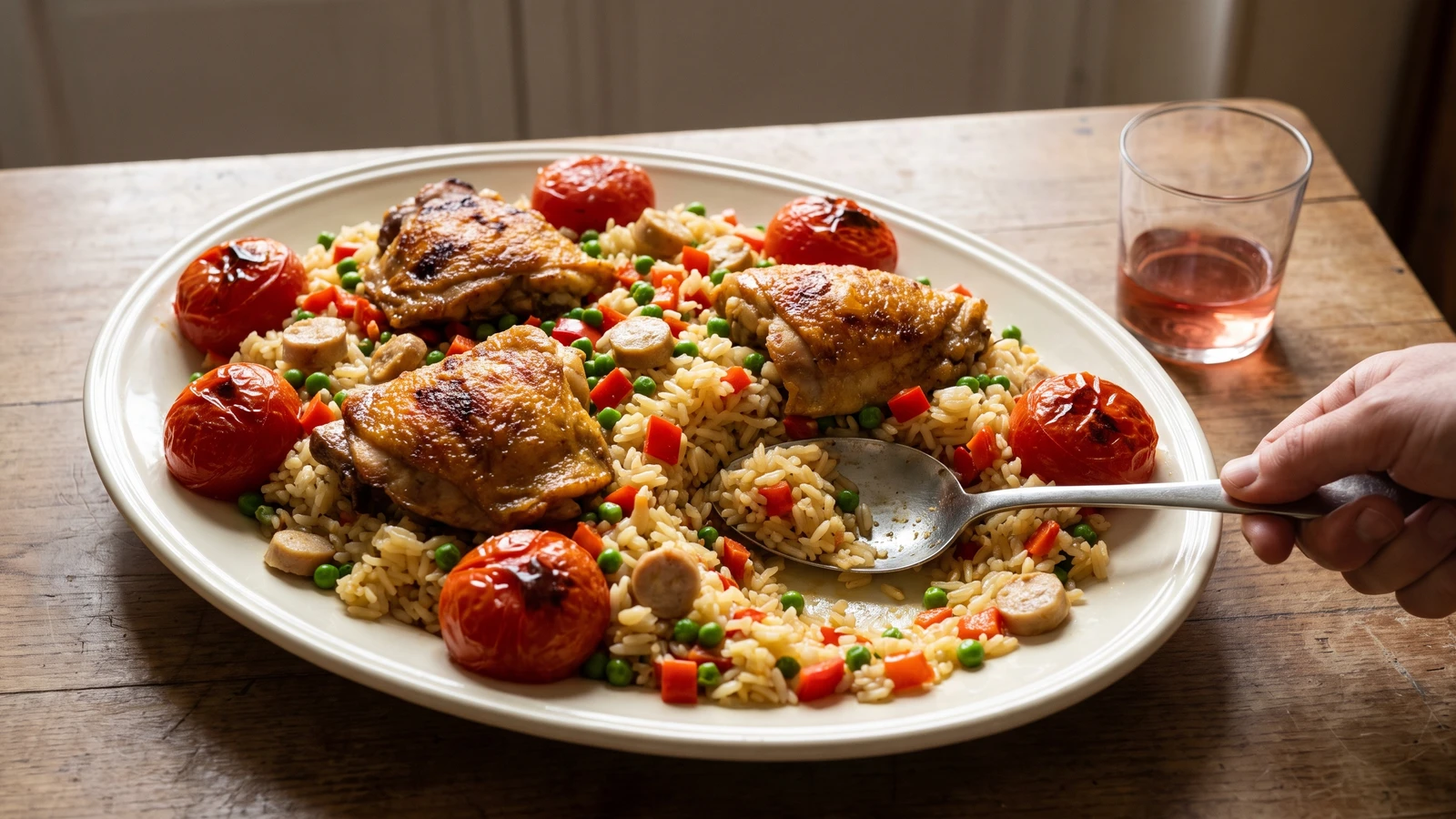
Poulet Sauté à l’Espagnole turns one strict gesture into a generous supper: drain the sautéing oil, then let pilaff, capsicum, peas, and sausage finish beneath the bronzed bird, with grilled tomatoes ringing the platter.
Poulet Sauté à l’Espagnole (oil-sautéed chicken with pilaff rice, capsicum, peas, sausage, and grilled tomatoes) teaches one severe little law: the fat that browns the bird has finished its work before rice enters the pan. Pour it away while the pan is still hot, leaving the mahogany fond behind; otherwise the pilaff drinks the oil and becomes heavy. That is the one true thing to know before you touch a pan.
The original entry assumed a stockpot never off the fire, finished pilaff and peas à l’Anglaise waiting at their stations, sausages already poached, and a salamander free for six tomatoes. It did not assume a saucier, because the name belongs to the garnish, not to a mother sauce. At home, 160 ml of sound stock, a small saucepan, an ovenproof sauté pan, and the broiler do the same work. The separate holding pans are brigade scaffolding and go; the half-pound of pilaff, anglaise peas, poached sausage, drained oil, covered ten-minute stew, and grilled tomatoes are the dish and stay.
The home sequence is deliberate: make the pilaff first, then use the sauté pan for poaching, blanching, and browning before everything meets for its covered ten minutes. One cook, one stove, one evening. You want bronzed chicken, loose rice bright with capsicum and peas, tender sausage coins, and tomatoes blistered at the edges. Set a heatproof bowl beside the stove before you begin, because draining the oil cleanly is the step that decides the dish.
Poulet Sauté à l’Espagnole belongs to the French classical garnish vocabulary of Parisian grand kitchens, not to one of Spain’s regional chicken traditions. In that vocabulary, à l’Espagnole signaled a French idea of Spanish color and abundance through capsicum, tomato, rice, peas, and sausage; the title describes the garnish, not a brown mother sauce. It passed comfortably to the bourgeois table because the prepared elements meet for one short covered finish, while the grilled tomatoes remain bright and separate.
Quantity
1 bird (about 3¼ lb / 1.5 kg)
cut into 8 pieces
Quantity
3 tablespoons (45 ml / 41 g)
divided
Quantity
7 tablespoons (105 ml / 80 g)
Quantity
1 tablespoon (15 ml / 14 g)
Quantity
2 tablespoons (30 ml / 20 g)
finely chopped
Quantity
⅔ cup (160 ml / 160 g)
Quantity
6 cups (1.4 L / 1.4 kg)
divided, for poaching and cooking à l’Anglaise
Quantity
2 small links (about 6 oz / 170 g total)
Quantity
⅓ cup (80 ml / 43 g)
cut into small dice
Quantity
½ cup plus 1 tablespoon (135 ml / 85 g)
fresh or frozen
Quantity
6 tomatoes (about 1 lb / 450 g total)
halved crosswise
Quantity
2¼ teaspoons (11 ml / 13 g)
divided
Quantity
½ teaspoon (2.5 ml / 1 g)
| Ingredient | Quantity |
|---|---|
| small whole chickencut into 8 pieces | 1 bird (about 3¼ lb / 1.5 kg) |
| neutral oildivided | 3 tablespoons (45 ml / 41 g) |
| long-grain white rice | 7 tablespoons (105 ml / 80 g) |
| unsalted butter | 1 tablespoon (15 ml / 14 g) |
| yellow onionfinely chopped | 2 tablespoons (30 ml / 20 g) |
| unsalted chicken stock | ⅔ cup (160 ml / 160 g) |
| waterdivided, for poaching and cooking à l’Anglaise | 6 cups (1.4 L / 1.4 kg) |
| mild pork chipolatas | 2 small links (about 6 oz / 170 g total) |
| red bell pepper or capsicumcut into small dice | ⅓ cup (80 ml / 43 g) |
| large green peasfresh or frozen | ½ cup plus 1 tablespoon (135 ml / 85 g) |
| small ripe tomatoeshalved crosswise | 6 tomatoes (about 1 lb / 450 g total) |
| fine saltdivided | 2¼ teaspoons (11 ml / 13 g) |
| freshly ground black pepper | ½ teaspoon (2.5 ml / 1 g) |
Melt the butter in a small saucepan over medium-low heat. Add the onion and cook for 2 minutes until translucent but not browned. Stir in the rice and turn every grain through the butter until glossy. Add the chicken stock and ¼ teaspoon of the salt, bring to a lively simmer, then cover and lower the heat. Cook for 13 minutes, remove from the heat, and rest covered for 5 minutes before fluffing with a fork. This produces about 1⅓ cups (320 ml / 225 g) of prepared pilaff rice, the half-pound called for in the original entry. If the rice remains chalky at its core, add 1 tablespoon of hot water, cover, and cook gently for another 3 minutes; if it looks wet, spread it in a wide bowl for 5 minutes.
Lay the chipolatas in the ovenproof sauté pan and add 3 cups of the water. Bring it just to a tremble, never a hard boil, and poach the sausages for 10 to 12 minutes, turning once, until they register 160°F (71°C). Lift them out, let them cool briefly, and slice them into ½-inch (1.25 cm) rounds. Discard the poaching water and rinse the pan. Add the remaining fresh water, bring it to a full boil, and season with ¾ teaspoon salt. Cook the peas à l’Anglaise, plainly in boiling water, for 1 to 2 minutes until tender and vividly green. Drain them thoroughly and dry the pan.
Heat the oven to 375°F (190°C) with a rack in the middle. Reserve 1 teaspoon of the oil for the tomatoes. Dry the chicken thoroughly, then season it with 1 teaspoon salt and all the pepper. Heat the remaining oil in the sauté pan over medium-high heat until it shimmers. Brown the chicken in two uncrowded batches, skin-side down for 6 to 7 minutes and on the second side for about 4 minutes, until the skin is a deep Maillard bronze. Let each piece release from the pan on its own; if it clings, the crust is not ready. Transfer the browned pieces to a plate.
Take the pan off the heat and pour every visible pool of sautéing oil into a heatproof bowl, leaving the mahogany fond attached to the pan. Mix the pilaff rice with the diced capsicum, peas, and sliced sausages, then spread the garnish across the pan and nestle the chicken over it, skin-side up. This separation is the dish: the oil has done its browning work, and the rice must not drink it. If a puddled sheen appears because some oil escaped you, lift out the chicken and touch a folded paper towel briefly to the rice with tongs. Ça se rattrape. Do not stir the grease further into the grains.
Cover the pan tightly and set it in the oven for 10 minutes. The rice will absorb the chicken juices, the capsicum will soften while retaining a little bite, and the sausages and peas will heat through beneath the bird. Check the thickest pieces: the breast must register at least 165°F (74°C), and the thigh should give easily at its joint. If the breast is ready before the legs, remove the breast pieces and return the covered pan to the oven for another 5 minutes. If the rice looks dry, sprinkle 1 to 2 tablespoons of hot water around the edge and let it stand covered for 2 minutes.
Arrange the tomato halves cut-side up on a broiler-safe sheet pan. Brush them with the reserved teaspoon of oil and season with the remaining ¼ teaspoon salt. When the chicken is ready, lift it to a warm oval platter and spoon the pilaff garnish beneath, over, and around the pieces, leaving some bronzed skin visible. Switch the oven to high broil and grill the tomatoes about 6 inches (15 cm) from the element for 3 to 5 minutes, until their cut surfaces glisten and their edges blister without collapsing. Ring the platter with all six tomatoes and serve at once. À table!
1 serving (about 400g)
Culinary guides, cultural storytelling, and the editorial depth that makes cooking meaningful.
Discover Culinary ExplorerChef Juliette
John Dory has the delicacy of sole and the firmness of turbot. A light flouring, a quick butter sauté, and nut-brown beurre noisette show exactly why looks never mattered.

Chef Juliette
Fresh haddock proves its delicacy in the meunière pan: a fine flour crust, moist pearly flakes, and beurre noisette sharpened with lemon and parsley, ready from one skillet in half an hour.

Chef Juliette
Éperlans à l’Anglaise turns small fish into a lesson in disciplined coating: boned smelts under a close, crisp crumb, pan-fried in clarified butter and finished with bright, half-melted maître d’hôtel butter.

Chef Juliette
Tiny smelts, shallot, mushrooms, white wine, gratin sauce, and fine bread raspings meet a fierce oven, where the fish must turn tender in the same breath the buttered crust bronzes.