
Chef Juliette
John Dory (St. Pierre)
John Dory has the delicacy of sole and the firmness of turbot. A light flouring, a quick butter sauté, and nut-brown beurre noisette show exactly why looks never mattered.
A cooking platform built around craft, culture, and the stories behind what we eat.
Created by Chef Juliette
Based on No. 1548, Poulet Sauté à l’Égyptienne, from Le Guide Culinaire (1907) by Auguste Escoffier
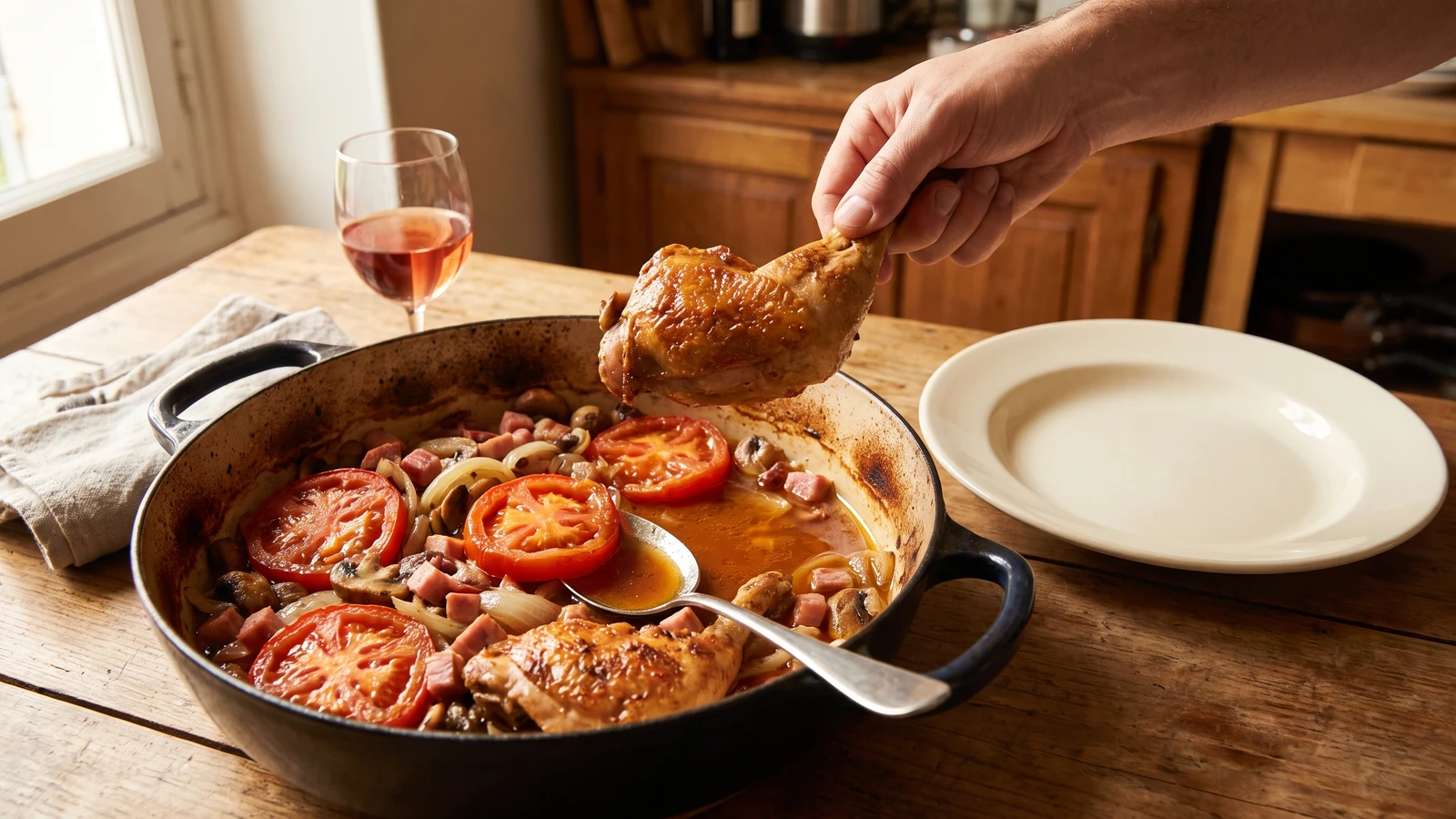
Poulet Sauté à l’Égyptienne layers bronze chicken with onion, mushrooms, raw ham, and tomato in a covered cocotte. Drain the garnish properly, and the pieces roast in their own savor instead of swimming.
Poulet Sauté à l’Égyptienne (Egyptian-style sautéed chicken) teaches moisture control in a covered cocotte. The one true thing to know is this: the onion, mushroom, and ham garnish must be well drained before it meets the chicken. Skip that, and the pieces stew wet beneath the tomatoes. Drain it properly, and the chicken keeps its bronze edges while the mingled juices form a shallow, savory glaze.
The original entry assumed a cook who could reach for a spoonful of veal stock from a stockpot never off the fire, then send the cocotte straight through service. At home, a prepared strong veal stock replaces that permanent pot, and a heavy lidded Dutch oven does the work of the service cocotte. The unspecified bird is fixed here at a modest size so the covered twenty-minute finish remains honest and feeds four. A separate sauté pan and service choreography are brigade scaffolding, so they go. The exact onion, mushroom, and raw-ham proportions, the draining, the alternating arrangement, the tomato cover, and the final spoon of stock stay. They are the dish.
This is not a deep braise and should not arrive flooded with sauce. It is browned chicken held closely with a concentrated garnish, softened tomato, and just enough glossy juice to moisten each serving. One cook, one stove, one evening. Before touching the pan, set a sieve over a bowl. Draining the garnish is the step that decides everything.
Poulet Sauté à l’Égyptienne belongs to the Parisian classical table, where sautéed chickens were catalogued by their accompanying garnitures and often finished in the cocotte used for serving. Its title reflects the canon’s habit of attaching faraway place names to composed treatments; onion, mushroom, raw ham, and tomato do not make this a record of Egyptian domestic cooking. The preparation passed naturally into cuisine bourgeoise because its professional logic, colour the bird, drain the garnish, finish under cover, requires only one stout pot at home.
Quantity
1 chicken, 3¼ to 3½ lb (1.5 to 1.6 kg)
cut into 8 pieces
Quantity
Up to ½ tsp (2.5 ml / 3 g)
Quantity
3 tbsp (45 ml / 41 g)
divided
Quantity
¾ cup (3 oz / 85 g)
thinly sliced
Quantity
¾ cup (2 oz / 57 g)
thinly sliced
Quantity
1¼ cups (6 oz / 170 g)
cut into ¼-inch (6 mm) dice
Quantity
2 medium, about 2 cups (12 oz / 340 g)
cut into thick slices
Quantity
1 tbsp (15 ml / 15 g)
warmed
| Ingredient | Quantity |
|---|---|
| whole chickencut into 8 pieces | 1 chicken, 3¼ to 3½ lb (1.5 to 1.6 kg) |
| fine salt (optional) | Up to ½ tsp (2.5 ml / 3 g) |
| neutral cooking oildivided | 3 tbsp (45 ml / 41 g) |
| yellow onionthinly sliced | ¾ cup (3 oz / 85 g) |
| button mushroomsthinly sliced | ¾ cup (2 oz / 57 g) |
| thick-cut unsmoked jambon crucut into ¼-inch (6 mm) dice | 1¼ cups (6 oz / 170 g) |
| ripe tomatoescut into thick slices | 2 medium, about 2 cups (12 oz / 340 g) |
| strong veal stockwarmed | 1 tbsp (15 ml / 15 g) |
Heat the oven to 400°F (200°C). Set a fine-mesh sieve over a heatproof bowl before cooking begins. Pat every chicken piece thoroughly dry. Taste a morsel of jambon cru and a drop of the prepared veal stock; if both are assertively salty, season the chicken with little or none of the measured salt. Slice the onion and mushrooms, dice the ham, and cut the tomatoes into thick slices that will hold their shape over the chicken.
Heat 2 tbsp (30 ml) of the oil in a 5-quart (4.7-liter) cocotte over medium-high heat until it gleams. Brown the chicken in two batches, skin-side down first, leaving each piece undisturbed until it releases cleanly and wears a deep golden crust. Turn and colour the second side briefly, about 6 to 8 minutes per batch altogether. The meat will not be cooked through. Transfer it to a plate. Keep the hazelnut-brown fond on the bottom of the cocotte, because the covered cooking juices will loosen it later.
Add the remaining 1 tbsp (15 ml) oil to the cocotte, then add the onion, mushrooms, and diced jambon cru together, exactly in that order but without pausing between them. Toss over medium-high heat for 5 to 7 minutes, until the onion is supple, the mushroom edges have taken light colour, and the ham glistens. Immediately tip the entire garnish into the waiting sieve and let it drain for 2 full minutes. If liquid collected early and the garnish began simmering instead of colouring, ça se rattrape: drain it at once, return it to the hot cocotte, and toss for another minute before draining again. No loose liquid should follow it into the finished dish.
Return the browned chicken to the cocotte, arranging the larger leg pieces around the hotter outer edge and the breast pieces nearer the centre. Scatter the drained garnish between, beneath, and lightly over the pieces so chicken and garnish alternate across the pot rather than forming two solid layers. Cover everything with the thick tomato slices, overlapping them only where necessary. Add no stock yet. Fit the lid tightly.
Transfer the covered cocotte to the oven and cook for 20 minutes. Check the thickest breast piece away from the bone; it must register 165°F (74°C), while the leg pieces should feel tender at the joint and may reach 175°F (79°C). If the chicken is shy of that mark, replace the lid and cook for 5 minutes more. The tomato should be softened but still recognizable, and the juices beneath should be shallow and glossy, not a pale bath.
Just before serving, spoon the warm veal stock evenly over the tomatoes and exposed chicken. Tilt the cocotte once so that the stock meets the browned juices and fond without disturbing the arrangement. This final tablespoon is seasoning and gloss, not gravy. Let it settle for 1 minute, then bring the cocotte directly to the table. À table!
1 serving (about 320g)
Culinary guides, cultural storytelling, and the editorial depth that makes cooking meaningful.
Discover Culinary ExplorerChef Juliette
John Dory has the delicacy of sole and the firmness of turbot. A light flouring, a quick butter sauté, and nut-brown beurre noisette show exactly why looks never mattered.

Chef Juliette
Fresh haddock proves its delicacy in the meunière pan: a fine flour crust, moist pearly flakes, and beurre noisette sharpened with lemon and parsley, ready from one skillet in half an hour.

Chef Juliette
Éperlans à l’Anglaise turns small fish into a lesson in disciplined coating: boned smelts under a close, crisp crumb, pan-fried in clarified butter and finished with bright, half-melted maître d’hôtel butter.

Chef Juliette
Tiny smelts, shallot, mushrooms, white wine, gratin sauce, and fine bread raspings meet a fierce oven, where the fish must turn tender in the same breath the buttered crust bronzes.