
Chef Juliette
John Dory (St. Pierre)
John Dory has the delicacy of sole and the firmness of turbot. A light flouring, a quick butter sauté, and nut-brown beurre noisette show exactly why looks never mattered.
A cooking platform built around craft, culture, and the stories behind what we eat.
Created by Chef Juliette
Based on No. 1545, Poulet Sauté Demidoff, from Le Guide Culinaire (1907) by Auguste Escoffier
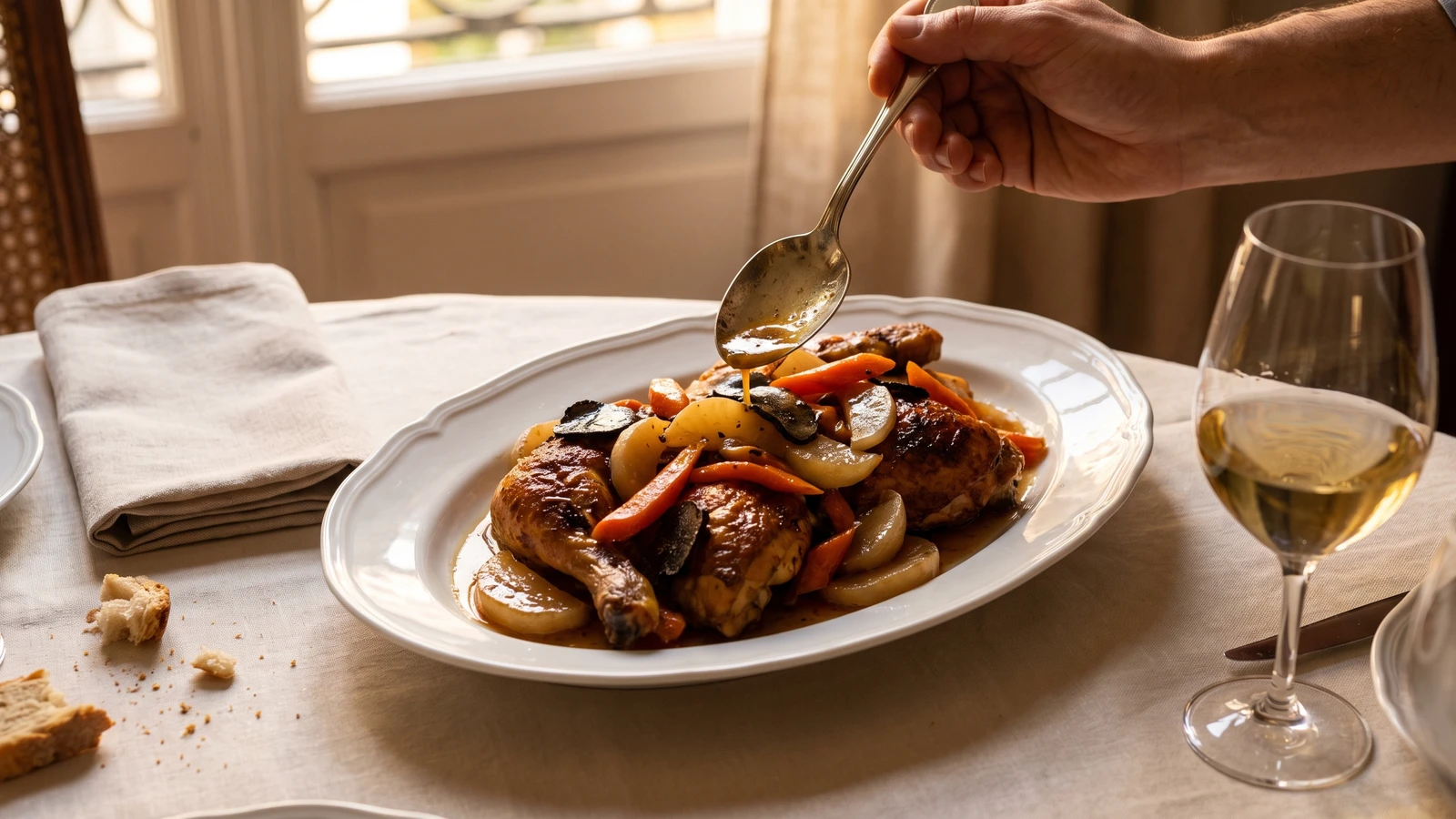
Poulet Sauté Demidoff turns exact knife work into flavor: butter-browned chicken, tender carrot and turnip crescents, and truffle joined by a spoonful of veal stock.
Poulet Sauté Demidoff (butter-browned chicken with carrot, turnip, and truffle crescents) teaches that garnish can be structure, not decoration. Carrot, turnip, and truffle are taillés en croissants, cut into matching crescents, so they cook and meet the eye as one garnish. If their sizes wander, the plate becomes vegetables beside a chicken rather than one composed dish.
The original entry assumed a young chicken already jointed, a garnish cook with crescent cutters, a saucier beside veal stock never off the fire, and separate hands watching the white and dark meat. Your home equivalent is one small bird, one lidded ovenproof pan, two inexpensive round cutters, and three tablespoons of concentrated, gelatin-rich veal stock. The extra hands were brigade scaffolding, so they go. The butter browning, identical croissants, covered oven stew, and final ten minutes with truffle are the dish, so they stay. One cook, one stove, one evening.
The finished chicken wears a deep butter-bronze skin, with orange carrot, ivory turnip, and black truffle held together by glossy pan juices. A modern chicken may release more water than the lean young bird the entry assumed, so a brief final reduction restores the intended coating without inventing a new sauce. Before the chicken touches butter, finish the knife work. Matched croissants are the one step that decides the dish.
Poulet Sauté Demidoff belongs to the Parisian classical table, where dishes carrying the Demidoff name joined French technique to the truffle-rich taste associated with a prominent Russian family in Paris. It is not a regional farmhouse chicken disguised with a grand title: its identity lies in garniture Demidoff, with carrot, turnip, and truffle repeating one crescent shape. The sauté brought the garnish used with a whole poularde into the quicker service of a jointed bird, carrying formal grand-kitchen knife work naturally toward the ambitious home table.
Quantity
1 (about 3½ lb / 1.6 kg)
cut into 8 serving pieces
Quantity
2 teaspoons (10 ml / 12 g)
Quantity
¾ teaspoon (3.75 ml / 1.5 g)
Quantity
5 tablespoons (75 ml / 70 g)
divided
Quantity
2, about 1¼ cups sliced (300 ml / 180 g)
peeled
Quantity
2, about 1½ cups sliced (360 ml / 220 g)
peeled
Quantity
2 oz, about ½ cup sliced (120 ml / 57 g)
fresh or whole preserved, drained
Quantity
3 tablespoons (45 ml / 45 g)
| Ingredient | Quantity |
|---|---|
| small chickencut into 8 serving pieces | 1 (about 3½ lb / 1.6 kg) |
| fine sea salt | 2 teaspoons (10 ml / 12 g) |
| freshly ground black pepper | ¾ teaspoon (3.75 ml / 1.5 g) |
| unsalted butterdivided | 5 tablespoons (75 ml / 70 g) |
| large carrotspeeled | 2, about 1¼ cups sliced (300 ml / 180 g) |
| medium white turnipspeeled | 2, about 1½ cups sliced (360 ml / 220 g) |
| black trufflesfresh or whole preserved, drained | 2 oz, about ½ cup sliced (120 ml / 57 g) |
| concentrated gelatin-rich veal stock | 3 tablespoons (45 ml / 45 g) |
Heat the oven to 350°F (180°C) with a rack in the center. Slice the carrots and turnips crosswise about ⅛ inch (3 mm) thick. Stamp each slice with a 1¼-inch (3 cm) round cutter, then use a ¾-inch (2 cm) cutter to remove an overlapping bite from one side, leaving a neat crescent. Make every croissant the same span and thickness; matched shapes are why the garnish cooks and reads as one. Slice the truffles thinly and cut them to the same outline, keeping them tightly covered until needed. Reserve the truffle trimmings with the crescents, and save the clean vegetable trimmings for another stock.
Pat the chicken completely dry and season it all over with the salt and pepper. Melt 3 tablespoons of the butter in a wide lidded ovenproof sauté pan over medium heat. When the foam subsides, lay in the chicken skin-side down without crowding, working in two batches and adding a fourth tablespoon of butter if the pan needs it. Color each piece patiently until the skin is a deep, even gold, about 6 to 8 minutes on the first side and 3 minutes on the second. If the milk solids turn black, lift out the chicken, wipe away only the bitter specks, and continue with fresh butter. Ça se rattrape. Burnt butter cannot become fond, but a clean pan and another knob put you back on course.
Transfer the colored chicken to a tray and lower the heat to medium-low. Add the remaining butter, then the carrot and turnip croissants. Turn them through the butter for 3 minutes, scraping gently so the chicken fond begins to release. They should glisten and soften at their edges without taking deep color. Return the chicken in one layer, skin-side up, and arrange the vegetables around the pieces rather than burying them underneath.
Cover the pan tightly and place it in the oven for about 20 minutes. Do not add the veal stock yet; the original sequence holds that concentrated spoonful for the final ten minutes, when it can join the chicken juices without washing away the truffle. Check once after 12 minutes. The vegetables should sit in a shallow gloss of butter and released juices. If the pan floor is dry and catching, add 1 tablespoon of water around the edge and scrape gently. If the chicken has released a deep pool instead, leave the lid slightly ajar for the final 5 minutes of this stage.
Check the chicken with an instant-read thermometer. When the breast pieces register about 150 to 155°F (66 to 68°C) and the legs about 160 to 165°F (71 to 74°C), scatter in the truffle croissants and their trimmings. Pour the veal stock around the edge of the pan, keeping the browned skin uncovered by liquid, then replace the lid and cook for 10 minutes. The breasts should reach 165°F (74°C) and the thighs about 175°F (79°C). If the breasts finish before the legs, lift them to a warm platter while the dark meat continues. Mixed chicken pieces rarely obey one clock, and removing a finished breast is sound cooking, not defeat.
Arrange the chicken on a warmed serving platter. Lift the carrot, turnip, and truffle croissants with a slotted spoon and spread them generously over and around the pieces. Set the pan over medium-high heat and reduce the juices only if needed, scraping up the fond, until they nappe, or coat, the back of a spoon with a light gloss. If the juices separate into a greasy slick, take the pan off the heat, add 1 teaspoon of cold water, and shake or whisk until they come together. Ça se rattrape. Taste for salt, spoon the glossy juices over the garnish, and serve at once. À table!
1 serving (about 335g)
Culinary guides, cultural storytelling, and the editorial depth that makes cooking meaningful.
Discover Culinary ExplorerChef Juliette
John Dory has the delicacy of sole and the firmness of turbot. A light flouring, a quick butter sauté, and nut-brown beurre noisette show exactly why looks never mattered.

Chef Juliette
Fresh haddock proves its delicacy in the meunière pan: a fine flour crust, moist pearly flakes, and beurre noisette sharpened with lemon and parsley, ready from one skillet in half an hour.

Chef Juliette
Éperlans à l’Anglaise turns small fish into a lesson in disciplined coating: boned smelts under a close, crisp crumb, pan-fried in clarified butter and finished with bright, half-melted maître d’hôtel butter.

Chef Juliette
Tiny smelts, shallot, mushrooms, white wine, gratin sauce, and fine bread raspings meet a fierce oven, where the fish must turn tender in the same breath the buttered crust bronzes.