
Chef Juliette
John Dory (St. Pierre)
John Dory has the delicacy of sole and the firmness of turbot. A light flouring, a quick butter sauté, and nut-brown beurre noisette show exactly why looks never mattered.
A cooking platform built around craft, culture, and the stories behind what we eat.
Created by Chef Juliette
Based on No. 1544, Poulet Sauté Cynthia, from Le Guide Culinaire (1907) by Auguste Escoffier
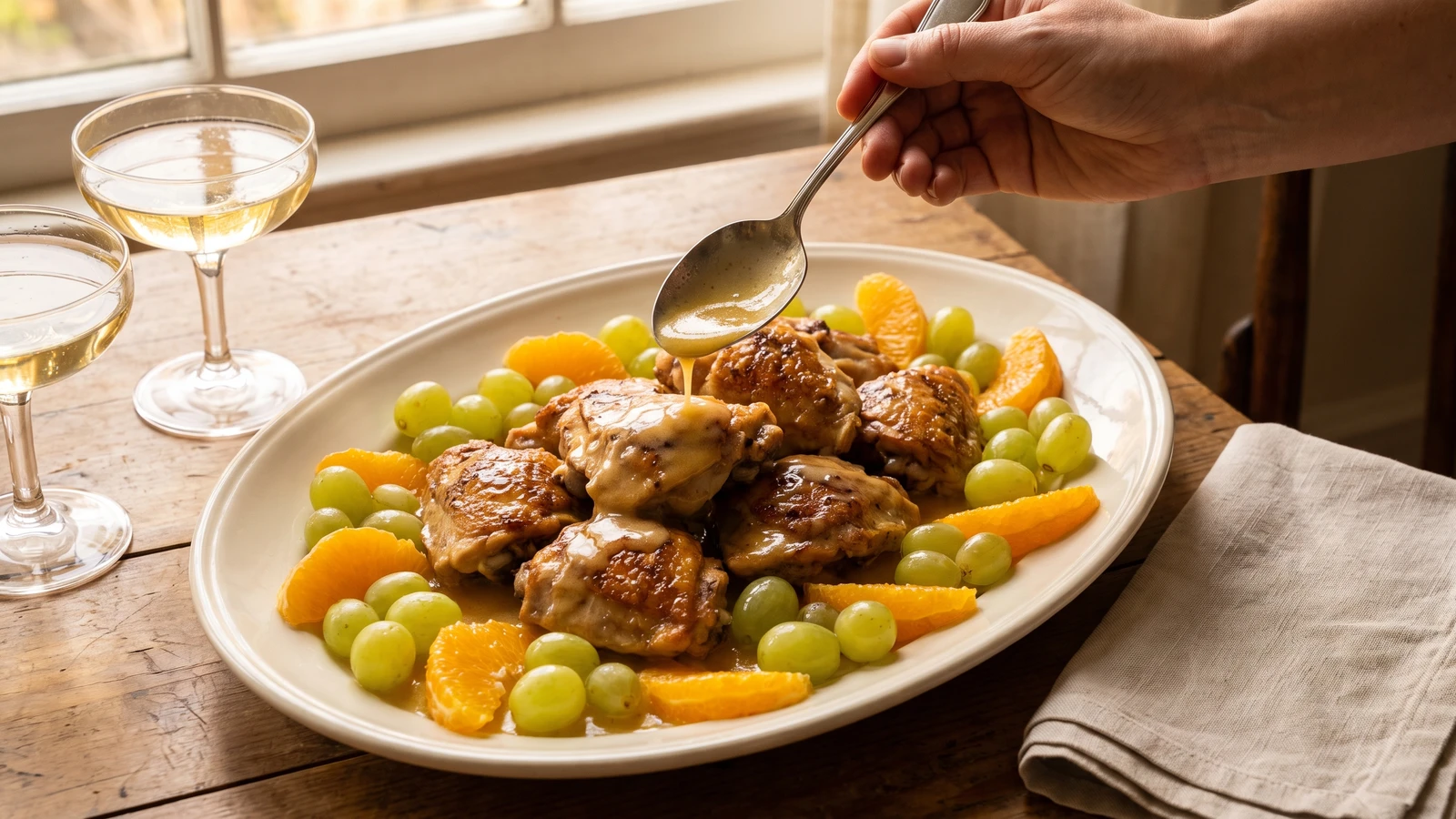
Butter-browned chicken meets a dry Champagne reduction mounted with cold butter, lemon, and curaçao, while peeled grapes and raw orange sections bring the bright freshness that keeps this classical sauce alive.
Poulet Sauté Cynthia (chicken browned in butter with Champagne, grapes, and orange) teaches the discipline of a mounted pan sauce: the chicken must leave a golden fond, and the reduction must stop boiling before the cold butter goes in. That is the one true thing. Boil after mounting and the gloss turns greasy; keep the heat quiet and the sauce clings like satin.
The original entry assumed a saucier beside the cook and light poultry glaze drawn from stock never off the fire. For four at home, one wide skillet cooks the chicken and builds the sauce, while a spoonful of prepared light poultry glaze, or a good low-salt chicken demi-glace, supplies the same concentrated foundation. No salamander belongs in this preparation. The extra pan and the waiting brigade are scaffolding; the dry Champagne reduced by half, the full two and one-half ounces of finishing butter, the lemon, dry curaçao, and raw fruit are the dish, so they stay in their original sequence and proportion. One cook, one stove, one evening.
Expect bronze chicken under a pale butter-gold sauce, with cool peeled grapes and raw orange sections giving the mouth a fresh interruption. Prepare the fruit first, but add it only after the sauce covers the chicken. The step that decides everything is monter au beurre, whisking cold butter into the reduction off the boil; if it breaks, ça se rattrape, and the method gives you the way back.
Poulet Sauté Cynthia belongs to the named repertory of Parisian grand kitchens, where a basic sauté of poultry took its identity from the sauce and garnish that followed. Despite the Champagne in the pan, it is not a regional dish of Champagne; the wine marks a celebration register, while dry curaçao, grapes, and raw orange make the finish cosmopolitan rather than rustic. The uncooked fruit is deliberate, preserving acidity and freshness against a sauce rich with butter.
Quantity
1 chicken (3½ to 4 lb / 1.6 to 1.8 kg)
cut into 8 pieces
Quantity
2 teaspoons (10 ml / 12 g)
Quantity
½ teaspoon (2.5 ml / 1 g)
Quantity
8 tablespoons (120 ml / 113 g), divided into 3 tablespoons (45 ml / 42 g) for sautéing and 5 tablespoons (75 ml / 71 g) for the sauce
chill and cube the sauce portion
Quantity
½ cup (120 ml / 120 g)
Quantity
1 tablespoon (15 ml / 18 g)
Quantity
1 tablespoon (15 ml / 15 g), from about ½ lemon
Quantity
1 tablespoon (15 ml / 14 g)
Quantity
½ cup (120 ml / 85 g)
peeled and checked for seeds
Quantity
1, yielding 10 sections
peel, pith, and membranes removed while the pulp remains raw
| Ingredient | Quantity |
|---|---|
| small whole chickencut into 8 pieces | 1 chicken (3½ to 4 lb / 1.6 to 1.8 kg) |
| fine sea salt | 2 teaspoons (10 ml / 12 g) |
| freshly ground black pepper | ½ teaspoon (2.5 ml / 1 g) |
| unsalted butterchill and cube the sauce portion | 8 tablespoons (120 ml / 113 g), divided into 3 tablespoons (45 ml / 42 g) for sautéing and 5 tablespoons (75 ml / 71 g) for the sauce |
| dry brut Champagne | ½ cup (120 ml / 120 g) |
| prepared light poultry glaze or low-salt chicken demi-glace | 1 tablespoon (15 ml / 18 g) |
| fresh lemon juice | 1 tablespoon (15 ml / 15 g), from about ½ lemon |
| dry curaçao | 1 tablespoon (15 ml / 14 g) |
| firm green seedless grapespeeled and checked for seeds | ½ cup (120 ml / 85 g) |
| large orangepeel, pith, and membranes removed while the pulp remains raw | 1, yielding 10 sections |
Cut the top and bottom from the orange, then follow its curve with a sharp knife to remove every strip of peel and white pith. Working over a bowl, cut between the membranes to release 10 suprêmes d’orange, raw orange sections freed from their membranes. Peel each grape with the tip of a paring knife and remove any seeds you find. Keep both fruits raw, covered, and close to room temperature; blot away loose juice before serving so it cannot thin the sauce.
Pat every chicken piece completely dry, then season evenly with the salt and pepper. Set a serving platter in a 200°F (95°C) oven to warm. Measure the glaze, lemon juice, and curaçao now, and keep the five tablespoons of finishing butter cold; once the reduction is ready, the sauce must move without delay.
Melt two tablespoons of the sautéing butter in a wide, heavy skillet over medium heat. When it foams, add the thighs and drumsticks skin-side down and brown them for 6 to 8 minutes, then turn and cook for 4 minutes. Remove them briefly and brown the breasts and wings skin-side down for about 5 minutes, then turn them for 2 minutes. Return the dark pieces, lower the heat to medium-low, cover slightly ajar, and cook until the breasts and wings reach at least 165°F (74°C) and the thighs and drumsticks reach about 175°F (79°C), removing each piece as it is done. Use the reserved tablespoon of sautéing butter as needed between batches. If the butter turns black or smells bitter, lift out the chicken, wipe the pan, add the reserved butter, and continue; scorched milk solids have no place in the sauce.
Arrange the cooked chicken skin-side up on the warm platter and hold it in the switched-off oven, uncovered or very loosely tented. Pour away the loose cooking fat from the skillet but leave the brown film attached to its floor. That film is the fond, the foundation of the sauce; golden brown is useful, while black is bitter.
Return the skillet to medium-high heat, pour in the Champagne, and scrape up the fond with a wooden spoon as the wine boils. Reduce it by exactly half, from ½ cup to roughly ¼ cup (60 ml), until the bubbles tighten and the sharp smell of raw wine softens. If the fond proves black when the wine loosens it, strain the Champagne into a clean saucepan and leave the burnt specks behind. Better a lighter sauce than a bitter one.
Whisk the light poultry glaze into the reduced Champagne and bring it just to a simmer, only long enough to dissolve and combine. The base should taste concentrated and lightly coat a spoon while still flowing freely. If it has tightened to a syrup, loosen it with one teaspoon of Champagne or water before adding any butter.
Take the pan completely off the heat and wait about 20 seconds. Monter au beurre means whisking cold butter into a hot reduction to form a smooth emulsion: add the chilled butter one cube at a time, whisking each nearly smooth before adding the next. Return the pan to the lowest heat only for a few seconds if the butter stops melting, and never let the sauce boil. If yellow butter pools on the surface, put one teaspoon of cold Champagne or water in a clean bowl and whisk the broken sauce into it one spoonful at a time. Ça se rattrape. Once the sauce is glossy and butter-gold, whisk in the lemon juice and dry curaçao in thin streams. Taste for salt, and do not reboil.
Pour the sauce over the chicken immediately. Arrange the peeled grapes and 10 raw orange sections around it at the last moment, exactly as the original directs; do not simmer them in the sauce or their freshness disappears. Carry the platter straight to the table. À table!
1 serving (about 295g)
Culinary guides, cultural storytelling, and the editorial depth that makes cooking meaningful.
Discover Culinary ExplorerChef Juliette
John Dory has the delicacy of sole and the firmness of turbot. A light flouring, a quick butter sauté, and nut-brown beurre noisette show exactly why looks never mattered.

Chef Juliette
Fresh haddock proves its delicacy in the meunière pan: a fine flour crust, moist pearly flakes, and beurre noisette sharpened with lemon and parsley, ready from one skillet in half an hour.

Chef Juliette
Éperlans à l’Anglaise turns small fish into a lesson in disciplined coating: boned smelts under a close, crisp crumb, pan-fried in clarified butter and finished with bright, half-melted maître d’hôtel butter.

Chef Juliette
Tiny smelts, shallot, mushrooms, white wine, gratin sauce, and fine bread raspings meet a fierce oven, where the fish must turn tender in the same breath the buttered crust bronzes.