
Chef Juliette
John Dory (St. Pierre)
John Dory has the delicacy of sole and the firmness of turbot. A light flouring, a quick butter sauté, and nut-brown beurre noisette show exactly why looks never mattered.
A cooking platform built around craft, culture, and the stories behind what we eat.
Created by Chef Juliette
Based on No. 1542, Poulet Sauté Champeaux, from Le Guide Culinaire (1907) by Auguste Escoffier
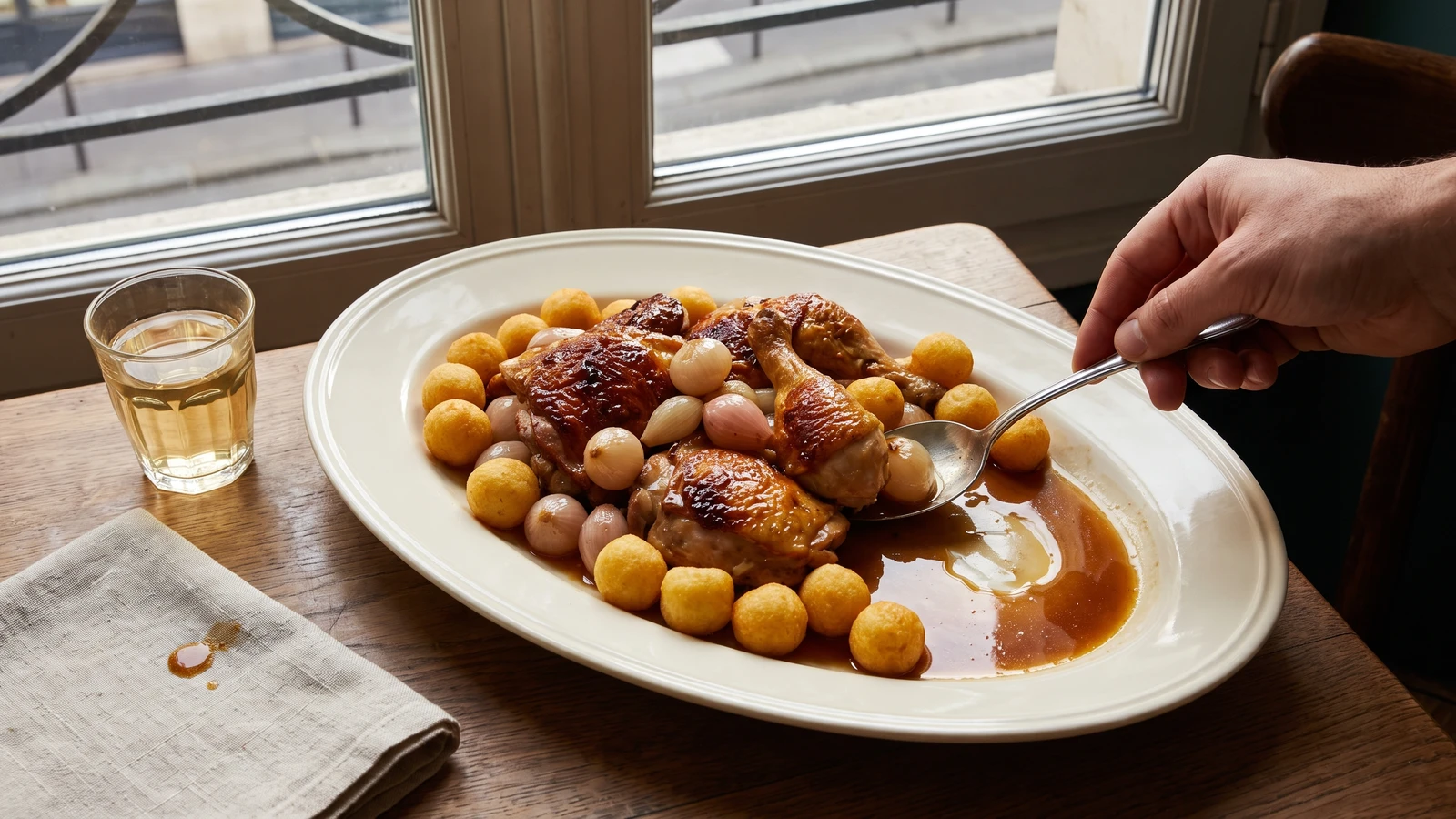
Butter-sautéed chicken, pearl onions, and pommes noisette meet a white-wine reduction enriched with veal gravy, meat glaze, and cold butter: a Paris plate whose lesson is reduction before emulsion.
Poulet Sauté Champeaux (butter-sautéed chicken with glazed small onions and hazelnut potatoes) teaches one exact thing: reduce first, mount with butter second. Ask cold butter to thicken a watery sauce and it merely floats; boil the finished emulsion and it separates. Get the reduction right, and the chicken, onions, and potatoes meet beneath one gleaming sauce.
The entry assumed a saucier at the range, veal gravy from a stockpot never off the fire, meat glaze ready by the spoonful, and separate pans moving through the brigade. It calls for no salamander, so none is invented. At home, prepared veal gravy, true meat glaze, and one wide sauté pan used in sequence do the same work. Only the brigade scaffolding changes: the portions come down to four, and the extra pans disappear. Cooking each garnish in butter, deglazing with wine, reducing the sauce, and finishing it away from the fire must stay. Those steps are the dish.
The finished platter should be generous: deeply bronzed chicken in the middle, little copper-gold onions and pommes noisette around it, butter-mounted sauce pooling underneath. One cook, one stove, one evening. Before you touch the pan, remember the decisive moment: reduce until the sauce has body before the cold butter goes anywhere near it.
Poulet Sauté Champeaux belongs to the Parisian classical table; Champeaux is a Paris name, not a province whose larder dictates a regional seasoning. In the repertory, the title is carried by a fixed service idea: chicken sautéed in butter, ringed with small onions and pommes noisette, then coated with a white-wine reduction strengthened by veal gravy and meat glaze. Its brigade origins show in those ready-made sauce components, while the quick final pan work explains how it passed naturally onto bistro and bourgeois tables.
Quantity
1 whole, 3½ to 4 pounds (1.6 to 1.8 kilograms)
cut into 8 serving pieces
Quantity
1½ teaspoons (7.5 ml / 9 g)
divided, plus more only if needed
Quantity
½ teaspoon (2.5 ml / 1 g)
Quantity
18 (about 10 ounces / 285 g)
peeled
Quantity
4 medium (about 1 pound / 450 g)
peeled and shaped into 24 to 28 pommes noisette, ¾-inch / 2-cm balls
Quantity
6 tablespoons (90 ml / 85 g)
divided
Quantity
¼ cup (60 ml / 60 g)
Quantity
⅓ cup plus 1 tablespoon (95 ml / 95 g)
unthickened and preferably unsalted
Quantity
1 tablespoon (15 ml / 18 g)
Quantity
3 tablespoons (45 ml / 43 g)
cut into 6 cubes
Quantity
Up to 2 tablespoons (30 ml / 30 g)
for adjusting or rescuing the sauce
| Ingredient | Quantity |
|---|---|
| whole chickencut into 8 serving pieces | 1 whole, 3½ to 4 pounds (1.6 to 1.8 kilograms) |
| fine sea saltdivided, plus more only if needed | 1½ teaspoons (7.5 ml / 9 g) |
| freshly ground black pepper | ½ teaspoon (2.5 ml / 1 g) |
| small pearl onionspeeled | 18 (about 10 ounces / 285 g) |
| waxy potatoespeeled and shaped into 24 to 28 pommes noisette, ¾-inch / 2-cm balls | 4 medium (about 1 pound / 450 g) |
| unsalted butter for cookingdivided | 6 tablespoons (90 ml / 85 g) |
| dry white wine | ¼ cup (60 ml / 60 g) |
| prepared veal gravyunthickened and preferably unsalted | ⅓ cup plus 1 tablespoon (95 ml / 95 g) |
| meat glaze | 1 tablespoon (15 ml / 18 g) |
| cold unsalted butter for finishingcut into 6 cubes | 3 tablespoons (45 ml / 43 g) |
| cold water (optional)for adjusting or rescuing the sauce | Up to 2 tablespoons (30 ml / 30 g) |
Take the chicken from the cold about 20 minutes before cooking. Pat every piece completely dry, then season it with most of the salt and all the pepper, keeping a little salt for the onions and potatoes. Measure the wine, veal gravy, and meat glaze before the fire is lit, and leave the finishing butter in the cold. Fill the serving platter with hot water so it will be warm when the chicken is dished.
Melt 1½ tablespoons of the cooking butter in a heavy 12-inch sauté pan over medium-low heat. Add the pearl onions and a small pinch of the measured salt, cover, and roll them around the pan every few minutes until tender at the center and evenly pale gold, about 12 to 15 minutes. Keep the heat patient; scorched butter makes bitter onions. If they color before a knife enters easily, lower the heat and cover again so their own moisture finishes the centers. Lift the onions to a plate.
Add 2 tablespoons of cooking butter to the same pan, followed by the pommes noisette and another small pinch of salt. Cover and cook over medium-low heat for 6 minutes, shaking the pan often, then uncover and continue for 8 to 10 minutes until the potato balls are tender inside and evenly butter-gold outside. If the exteriors brown too quickly, lower the heat and cover for another few minutes. Transfer them to the plate with the onions and wipe away any loose potato crumbs without scrubbing off the pan's browned glaze.
Add the remaining cooking butter to the pan in two additions and raise the heat to medium-high. When the butter foams briskly, sauté the chicken in two uncrowded batches, skin-side down first, until the skin is deep gold and releases cleanly, about 5 minutes on the first side and 3 minutes on the second. Keep the heat lively but not fierce, because butter should brown, not blacken. Return the thighs and drumsticks to the pan, lower the heat, cover, and cook for 6 minutes. Add the breast pieces, cover again, and cook until the breasts reach 160°F / 71°C and the dark meat reaches at least 170°F / 77°C, another 6 to 10 minutes. Resting will carry the breasts safely to 165°F / 74°C.
Empty and dry the warmed platter. Arrange the chicken in the center and surround it with the butter-glazed onions and pommes noisette, exactly as the entry directs. Cover loosely while the sauce is finished. Dishing now is deliberate: it leaves the pan free for an honest reduction and lets the chicken rest without surrendering its juices.
Pour off the loose cooking fat while leaving the browned fond in the pan. Return the pan to medium-high heat, add the white wine, and swill it across the floor while scraping up every browned morsel. Reduce until only a syrupy spoonful remains and the raw wine smell is gone. Add the prepared veal gravy and meat glaze, stir until smooth, and simmer until the sauce is nappant, coating the back of a spoon in a clear, glossy layer. This is the moment that decides the dish. If the sauce is still watery, reduce it now; if it has tightened or become too salty, loosen it with cold water a teaspoon at a time. Do not try to correct its thickness after the finishing butter is added.
Monter au beurre, or mount the sauce with butter: take the pan completely away from the fire and wait until the bubbling stops. Whisk in the cold butter one cube at a time, adding the next only when the previous cube has disappeared. The sauce should become supple, bright, and slightly thicker without feeling greasy. If it separates into an oily slick, stop. Ça se rattrape: put 1 teaspoon of cold water in a clean bowl, then whisk the broken sauce into it a spoonful at a time until the emulsion returns. Taste only now for salt, pour the sauce immediately over the chicken and garnishes, and never return it to a boil. À table!
1 serving (about 435g)
Culinary guides, cultural storytelling, and the editorial depth that makes cooking meaningful.
Discover Culinary ExplorerChef Juliette
John Dory has the delicacy of sole and the firmness of turbot. A light flouring, a quick butter sauté, and nut-brown beurre noisette show exactly why looks never mattered.

Chef Juliette
Fresh haddock proves its delicacy in the meunière pan: a fine flour crust, moist pearly flakes, and beurre noisette sharpened with lemon and parsley, ready from one skillet in half an hour.

Chef Juliette
Éperlans à l’Anglaise turns small fish into a lesson in disciplined coating: boned smelts under a close, crisp crumb, pan-fried in clarified butter and finished with bright, half-melted maître d’hôtel butter.

Chef Juliette
Tiny smelts, shallot, mushrooms, white wine, gratin sauce, and fine bread raspings meet a fierce oven, where the fish must turn tender in the same breath the buttered crust bronzes.