
Chef Juliette
John Dory (St. Pierre)
John Dory has the delicacy of sole and the firmness of turbot. A light flouring, a quick butter sauté, and nut-brown beurre noisette show exactly why looks never mattered.
A cooking platform built around craft, culture, and the stories behind what we eat.
Created by Chef Juliette
Based on No. 1541, Poulet Sauté aux Cèpes, from Le Guide Culinaire (1907) by Auguste Escoffier
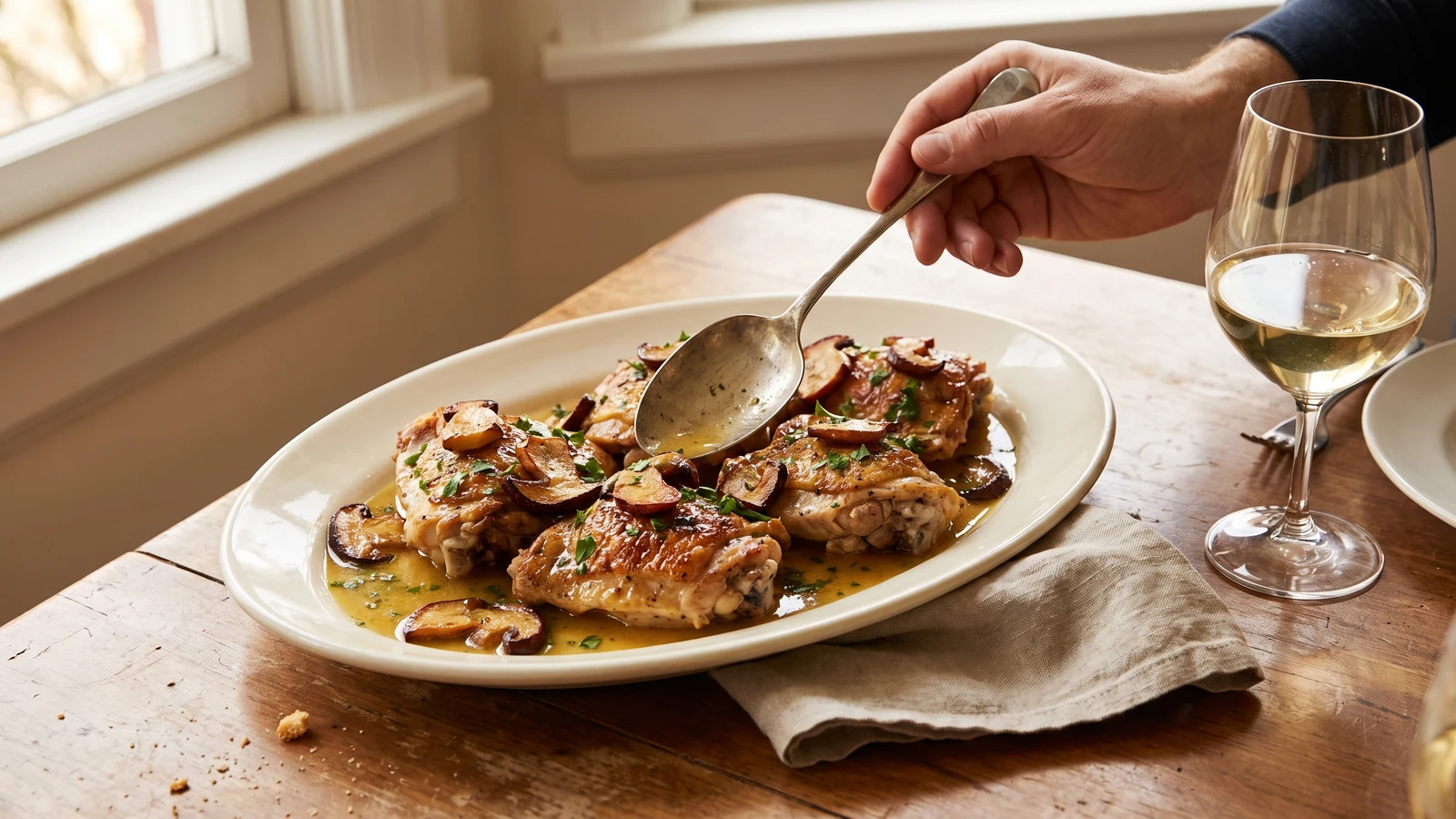
Poulet Sauté aux Cèpes teaches the rhythm of the sauté pan: bronze the bird in oil, keep the porcini dry enough to colour, then mount the shallot and wine reduction with real butter.
Poulet Sauté aux Cèpes (oil-sautéed chicken with porcini mushrooms) teaches the most useful truth in the sauté pan: water is the enemy of browning. The chicken must meet the oil with dry skin, and the cèpes must be cleaned without soaking, or neither will take on the deep bronze that gives this spare dish its character.
The source entry assumed that a cèpes garnish could arrive from another station while a saucier finished the reduction and a warm platter waited nearby. It calls for no stock and no salamander, so neither belongs here. For one cook, the brigade's simultaneous service is scaffolding that can go: prepare everything first, use two ordinary skillets, and keep the original proportions for four, eight ounces of cèpes, three shallots in the pan sauce, a quarter pint of wine, and one and a half ounces of butter. One cook, one stove, one evening.
The steps that must stay are the dish itself: chicken sautéed in oil, cèpes sautéed à la Bordelaise, the chicken fond released with white wine, and the reduction finished monté au beurre (whisked with cold butter off the heat). Dry both chicken and mushrooms before they touch their pans. That is the step that decides everything.
Poulet sauté belongs to the classical French pan repertoire, while its cèpes à la Bordelaise place this version in Bordeaux and the forests and market stalls of Aquitaine. Gatherers brought cèpes to town markets, and cooks carried the local oil, shallot, garlic, and parsley treatment from household pans into the grand kitchen as a named garnish. Bordelaise does not always mean a red wine sauce; here it names the mushroom method, while the chicken receives white wine and butter.
Quantity
1 whole (3½ to 4 lb / 1.6 to 1.8 kg)
cut into 8 pieces
Quantity
2½ teaspoons (12.5 ml / 15 g)
divided
Quantity
¾ teaspoon (3.75 ml / 1.5 g)
divided
Quantity
5 tablespoons (75 ml / 68 g)
divided
Quantity
8 ounces (225 g)
Quantity
3 medium (about ½ cup / 120 ml / 90 g)
finely chopped
Quantity
1 small (about 2 tablespoons / 30 ml / 25 g)
finely chopped
Quantity
1 small clove
finely chopped
Quantity
A generous ½ cup (140 ml / 138 g)
Quantity
3 tablespoons (45 ml / 43 g)
cut into small cubes
Quantity
2 tablespoons (30 ml / 8 g)
finely chopped and divided
| Ingredient | Quantity |
|---|---|
| whole chickencut into 8 pieces | 1 whole (3½ to 4 lb / 1.6 to 1.8 kg) |
| fine sea saltdivided | 2½ teaspoons (12.5 ml / 15 g) |
| freshly ground black pepperdivided | ¾ teaspoon (3.75 ml / 1.5 g) |
| mild olive oildivided | 5 tablespoons (75 ml / 68 g) |
| fresh cèpes, also called porcini mushrooms | 8 ounces (225 g) |
| medium shallots for the saucefinely chopped | 3 medium (about ½ cup / 120 ml / 90 g) |
| small shallot for the cèpesfinely chopped | 1 small (about 2 tablespoons / 30 ml / 25 g) |
| garlicfinely chopped | 1 small clove |
| dry white wine | A generous ½ cup (140 ml / 138 g) |
| cold unsalted buttercut into small cubes | 3 tablespoons (45 ml / 43 g) |
| flat-leaf parsleyfinely chopped and divided | 2 tablespoons (30 ml / 8 g) |
Pat every chicken piece completely dry, including the folds around the joints. Season with 2 teaspoons of the salt and ½ teaspoon of the pepper, then leave the pieces uncovered while you prepare the rest. Clean the cèpes with a soft brush or barely damp cloth, never by soaking. Separate the caps from the firm stalks, slice the caps about ½ inch thick, and finely chop the stalks. Wrap the chopped stalks in a clean towel and press gently to remove excess moisture. Keep the three sauce shallots separate from the small shallot and garlic for the cèpes. Measure the wine, chop the parsley, and leave the butter cold.
Heat 3 tablespoons of the oil in a 12-inch heavy sauté pan over medium-high heat until it moves freely and begins to shimmer. Lay in the chicken skin-side down without crowding, working in two batches if necessary. Brown the skin for 5 to 7 minutes, leaving each piece alone until it releases readily, then turn and brown the second side for about 3 minutes. A piece that clings is usually asking for another minute. Transfer each browned batch to a tray.
Lower the heat to medium-low and return the thighs, drumsticks, and wings to the pan. Cover and cook for 7 minutes, then add the browned breast pieces, cover again, and cook for another 8 to 12 minutes, turning the pieces once. Remove each piece as it finishes: breast meat must reach 165°F (74°C), while thighs and drumsticks are best near 175°F (79°C). If the skin is darkening before the centre is ready, lower the heat and keep the lid on. Transfer the cooked chicken to a warmed oval platter, skin-side up, and tent it loosely so the crust does not soften.
Heat the remaining 2 tablespoons oil in a second wide skillet over medium-high heat. Arrange the cèpe caps in one layer and cook without moving them for about 3 minutes, then turn and brown the other side. Transfer the caps to a plate. Add the chopped stalks to the same skillet and cook until their released moisture has evaporated and their edges begin to colour. Add the small shallot and garlic, cook for 30 seconds without scorching, then return the caps and toss with half the parsley, the remaining ½ teaspoon salt, and the remaining ¼ teaspoon pepper. If liquid collects in the pan, spread the cèpes out and raise the heat until it cooks away before adding the aromatics. Moist mushrooms can still brown once the water is gone.
Pour the cooking oil from the chicken pan into a heatproof bowl, leaving the brown fond attached to the pan. Set the pan over medium heat, add the three chopped shallots, and cook for 1 to 2 minutes until softened but not browned. Pour in the white wine and scrape the pan thoroughly with a wooden spoon, releasing every savoury brown deposit. Add any juices collected beneath the resting chicken. Boil steadily until the wine has reduced to about 3 tablespoons and looks lightly syrupy, 4 to 6 minutes. If the fond is black rather than brown, wipe out the burnt specks before adding the shallots; bitterness cannot be reduced into virtue.
Remove the pan from the heat and let the fierce bubbling subside. Add the cold butter one cube at a time, whisking or swirling until each piece disappears before adding the next. The sauce should become pale gold, glossy, and just thick enough to coat a spoon. Keep it below a simmer once the butter enters. If it separates into greasy streaks, stop adding butter and whisk in 1 teaspoon of cold water off the heat; when the sauce smooths, continue cube by cube. Ça se rattrape. Taste and adjust the seasoning only after the emulsion is complete.
Spoon the shallot and white wine sauce over the chicken, leaving some bronzed skin visible. Arrange the cèpes à la Bordelaise generously around the bird rather than burying them beneath the sauce, then scatter the remaining parsley over the chicken. Serve immediately while the butter emulsion still gleams. À table!
1 serving (about 315g)
Culinary guides, cultural storytelling, and the editorial depth that makes cooking meaningful.
Discover Culinary ExplorerChef Juliette
John Dory has the delicacy of sole and the firmness of turbot. A light flouring, a quick butter sauté, and nut-brown beurre noisette show exactly why looks never mattered.

Chef Juliette
Fresh haddock proves its delicacy in the meunière pan: a fine flour crust, moist pearly flakes, and beurre noisette sharpened with lemon and parsley, ready from one skillet in half an hour.

Chef Juliette
Éperlans à l’Anglaise turns small fish into a lesson in disciplined coating: boned smelts under a close, crisp crumb, pan-fried in clarified butter and finished with bright, half-melted maître d’hôtel butter.

Chef Juliette
Tiny smelts, shallot, mushrooms, white wine, gratin sauce, and fine bread raspings meet a fierce oven, where the fish must turn tender in the same breath the buttered crust bronzes.