
Chef Juliette
John Dory (St. Pierre)
John Dory has the delicacy of sole and the firmness of turbot. A light flouring, a quick butter sauté, and nut-brown beurre noisette show exactly why looks never mattered.
A cooking platform built around craft, culture, and the stories behind what we eat.
Created by Chef Juliette
Based on No. 1540, Poulet Sauté Bretonne, from Le Guide Culinaire (1907) by Auguste Escoffier
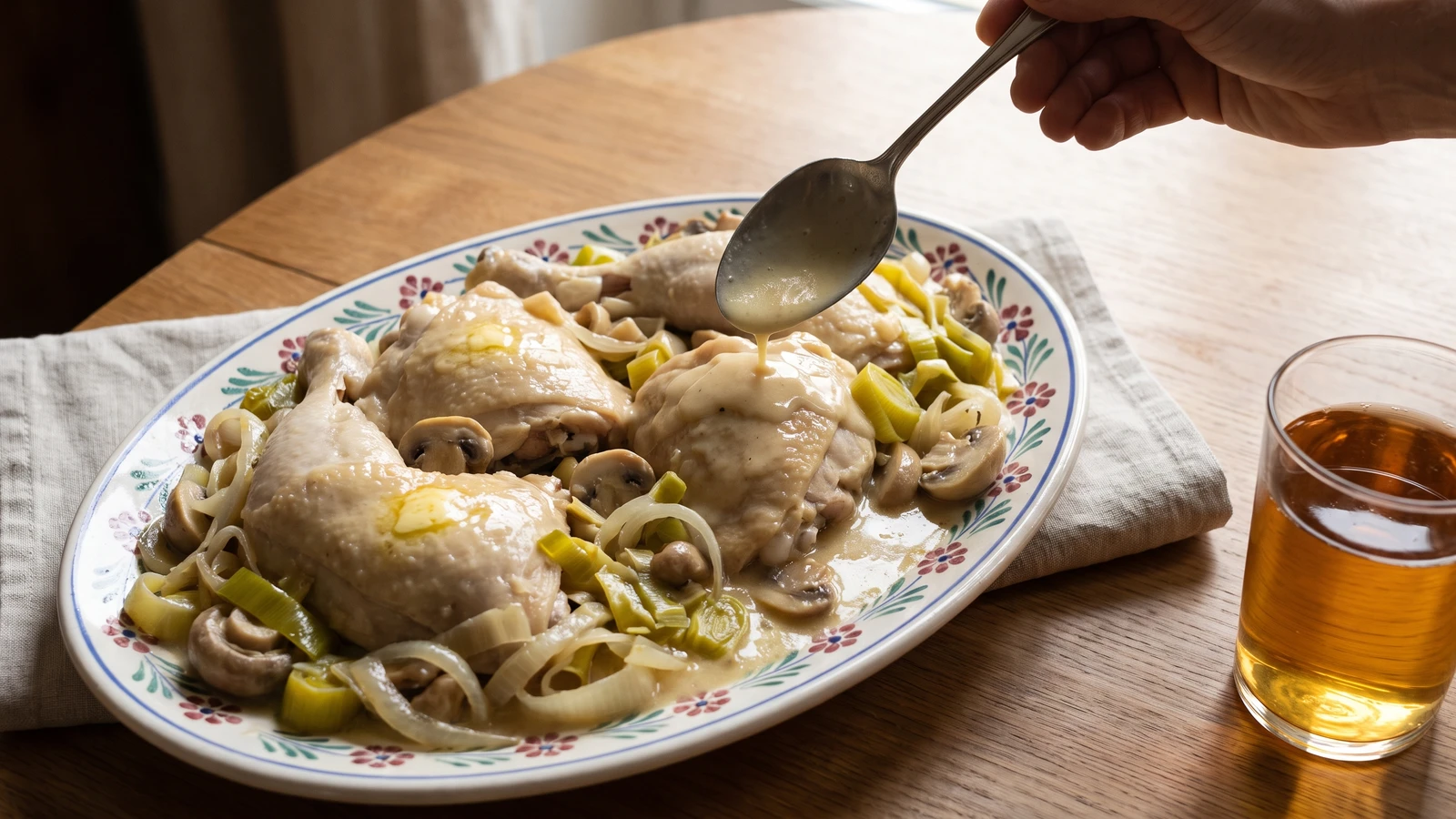
Poulet Sauté Bretonne proves that pale cooking can carry depth: chicken gently set in butter, leeks and onion softened without colour, mushrooms added late, and cream reduced with Sauce Suprême to a satin coat.
Poulet Sauté Bretonne (Breton-style sautéed chicken) teaches the discipline of cooking pale without cooking timidly. The one true thing is this: colour is not flavour's only door. Here butter coaxes sweetness from leek and onion, chicken juices deepen the covered pan, and Sauce Suprême with cream gathers everything into an ivory glaze. Brown any part and the sauce loses its clean, quiet character.
The brigade entry assumed a saucier on staff, Sauce Suprême already finished from a stock never off the fire, and enough hands to tend the vegetables while the chicken was raidi, its surface set gently in butter without colouring. A home kitchen gets one prepared batch of Sauce Suprême, an ovenproof sauté pan, and a plate for holding the vegetables. There is no salamander work to replace, because a browned finish would undo the dish. Separate holding pans are brigade scaffolding and can go; the butter-stewed alliums, the pale raidir, the late mushrooms, and equal measures of Sauce Suprême and cream reduced by half are the dish and must stay. One cook, one stove, one evening.
Keep the butter softly foaming, never hazelnut-coloured, and trust the vegetables and chicken juices to build flavour without a fond. Before you touch the pan, lower your heat: keeping every surface pale is the step that decides this dish.
In this classical entry, Bretonne points toward Brittany through leeks and onion cooked generously in butter, followed by mushrooms and a cream-enriched Sauce Suprême; it does not claim that every Breton household used this exact formula. The preparation carried a regional dairy-and-allium register into grand-kitchen menu language, then returned easily to bourgeois and home tables because its method needs only one covered pan. Its refusal of colour is deliberate, separating it from the browned chicken sautés elsewhere in the canon.
Quantity
1 (about 3¼ lb / 1.5 kg)
cut into 8 serving pieces
Quantity
6 tablespoons (90 ml / 85 g)
divided
Quantity
1 packed cup (240 ml / 85 g)
halved lengthwise, thoroughly washed, and thinly sliced
Quantity
½ medium onion (about ½ cup / 120 ml / 75 g)
thinly sliced
Quantity
1¼ cups (300 ml / 85 g)
thinly sliced
Quantity
⅓ cup plus 1 tablespoon (95 ml / about 100 g)
Quantity
⅓ cup plus 1 tablespoon (95 ml / 95 g)
Quantity
2 teaspoons (10 ml / 12 g)
divided
Quantity
½ teaspoon (2.5 ml / 1 g)
| Ingredient | Quantity |
|---|---|
| small whole chickencut into 8 serving pieces | 1 (about 3¼ lb / 1.5 kg) |
| unsalted butterdivided | 6 tablespoons (90 ml / 85 g) |
| white part of leekhalved lengthwise, thoroughly washed, and thinly sliced | 1 packed cup (240 ml / 85 g) |
| yellow onionthinly sliced | ½ medium onion (about ½ cup / 120 ml / 75 g) |
| small button mushroomsthinly sliced | 1¼ cups (300 ml / 85 g) |
| prepared Sauce Suprême | ⅓ cup plus 1 tablespoon (95 ml / about 100 g) |
| heavy cream | ⅓ cup plus 1 tablespoon (95 ml / 95 g) |
| fine sea saltdivided | 2 teaspoons (10 ml / 12 g) |
| ground white pepper | ½ teaspoon (2.5 ml / 1 g) |
Heat the oven to 325°F (165°C) with a rack in the centre. Pat the chicken pieces completely dry, then season them evenly with most of the salt and all the white pepper. Have the leek, onion, mushrooms, prepared Sauce Suprême, and measured cream ready before the butter meets the pan. This dish moves quietly but without pauses, and an unattended pan is how pale butter becomes brown butter.
Étuver means to stew gently in butter without taking colour. Melt 2 tablespoons of the butter in the ovenproof sauté pan over low heat, add the leek, onion, and a small pinch of the measured salt, then cover and cook for 8 to 10 minutes. Stir twice, keeping the vegetables translucent, supple, and pale from edge to edge. If a few pieces begin to colour, lift everything immediately to a plate and wipe the pan before continuing with fresh butter. Ça se rattrape. Deeply browned alliums belong in another supper.
Lift the softened leek and onion onto a plate. Add 2 tablespoons of butter to the same pan and keep the heat at medium-low, just high enough for a quiet foam. Lay in the chicken skin-side down and cook for 2 to 3 minutes, then turn each piece and cook for another 2 minutes. The flesh should lose its raw translucence and feel slightly firm, but remain ivory with no golden patches. This is the raidir, and it is the principle carried into the pan. If the butter browns, pull the pan from the heat, transfer the chicken to the vegetable plate, wipe out the browned butter, and resume with some of the reserved butter. Don't press on and hope the cream will hide it.
Return the leek and onion to the pan, tucking them beneath and around the chicken rather than piling them over the skin. Cover tightly and set the pan in the oven for 18 to 22 minutes. The chicken should cook in its own juices and the butter, with no added liquid. Check the thickest breast and thigh pieces near the end; when they are several degrees short of done, prepare the mushrooms.
Melt 1 tablespoon of the butter in a small skillet over medium-low heat. Add the sliced mushrooms and toss for 2 to 3 minutes, only until glossy, softened, and beginning to release their moisture, with no brown edges. Fold them into the covered chicken pan about 5 minutes before the bird is cooked through, preserving the source method and keeping the mushrooms distinct. Return the covered pan to the oven until the breasts reach 165°F (74°C) and the thighs reach at least 175°F (79°C). If the breasts finish first, lift them to the warm platter while the legs continue; tenderness is worth one extra plate.
Transfer all the chicken to a warm serving platter and cover it loosely. Set the uncovered pan with its leek, onion, mushrooms, and cooking juices over medium heat. Add the prepared Sauce Suprême and the equal measure of cream, stirring gently to combine, then simmer until reduced by roughly half, 5 to 8 minutes. The sauce is ready when it looks glossy and coats the back of a spoon in an even ivory layer. If it becomes too thick, loosen it with hot water a teaspoon at a time. If it turns oily or grainy, take it off the heat and whisk in a spoonful of cold cream. Ça se rattrape.
Taste the sauce and correct the salt without adding herbs, lemon, or any browned garnish. Spoon the vegetables over and around the chicken, then pour the Sauce Suprême and cream reduction generously across the pieces so it pools on the platter. Serve at once while the sauce still carries a soft gloss. À table!
1 serving (about 300g)
Culinary guides, cultural storytelling, and the editorial depth that makes cooking meaningful.
Discover Culinary ExplorerChef Juliette
John Dory has the delicacy of sole and the firmness of turbot. A light flouring, a quick butter sauté, and nut-brown beurre noisette show exactly why looks never mattered.

Chef Juliette
Fresh haddock proves its delicacy in the meunière pan: a fine flour crust, moist pearly flakes, and beurre noisette sharpened with lemon and parsley, ready from one skillet in half an hour.

Chef Juliette
Éperlans à l’Anglaise turns small fish into a lesson in disciplined coating: boned smelts under a close, crisp crumb, pan-fried in clarified butter and finished with bright, half-melted maître d’hôtel butter.

Chef Juliette
Tiny smelts, shallot, mushrooms, white wine, gratin sauce, and fine bread raspings meet a fierce oven, where the fish must turn tender in the same breath the buttered crust bronzes.