
Chef Juliette
John Dory (St. Pierre)
John Dory has the delicacy of sole and the firmness of turbot. A light flouring, a quick butter sauté, and nut-brown beurre noisette show exactly why looks never mattered.
A cooking platform built around craft, culture, and the stories behind what we eat.
Created by Chef Juliette
Based on No. 1539, Poulet Sauté Boivin, from Le Guide Culinaire (1907) by Auguste Escoffier
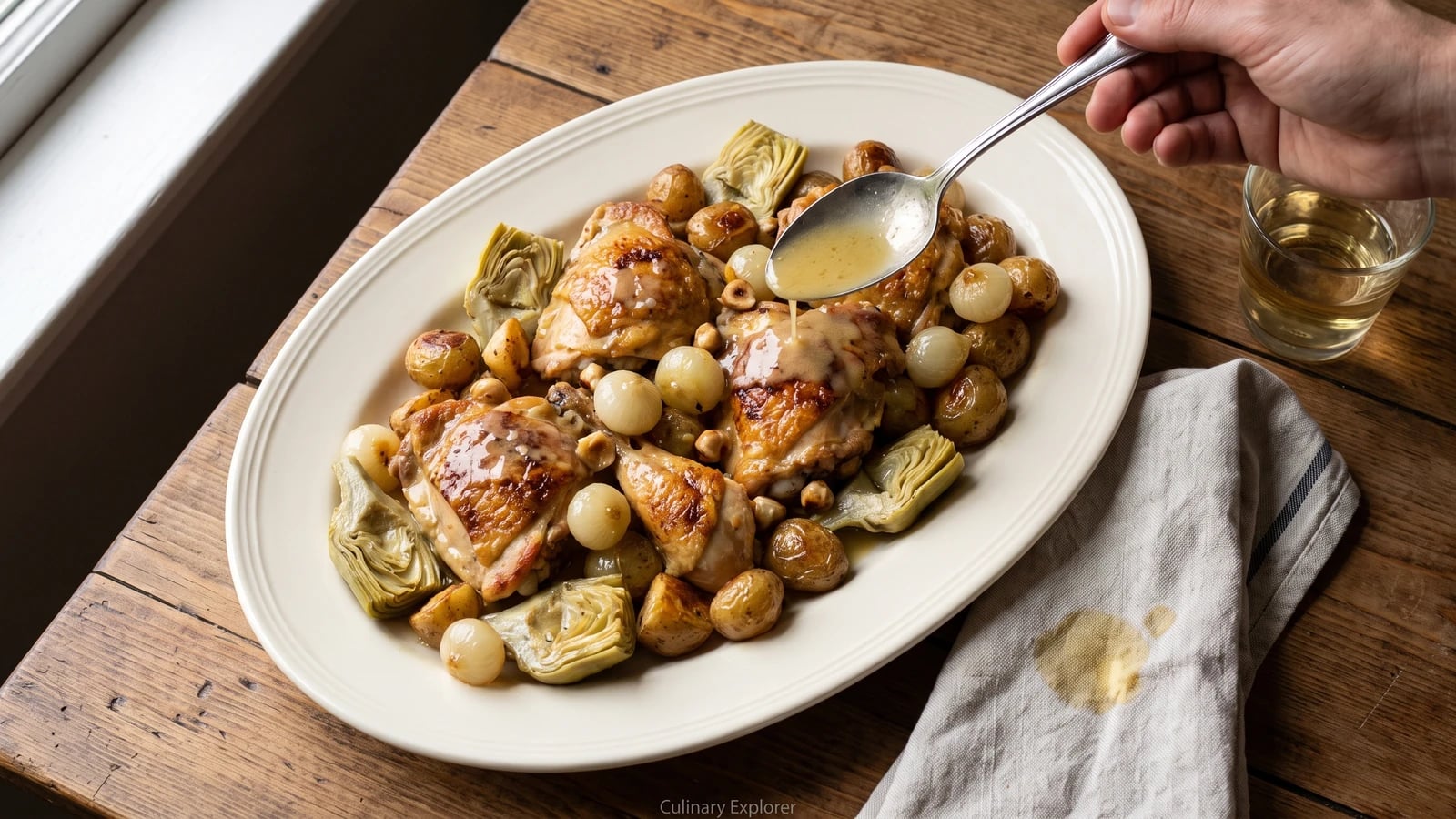
Poulet Sauté Boivin brings chicken, small onions, tender artichokes, and hazelnut potatoes from one covered pan, then turns its fond into a pale, lemon-bright butter glaze that must never boil.
Poulet Sauté Boivin (butter-sautéed chicken with small onions, tender artichokes, and hazelnut potatoes) teaches the difference between reducing a sauce and finishing one. Reduce before the butter. Once the butter enters, the pan leaves the fire. That final monter au beurre, mounting the sauce with cold butter, gives the pale glaze its body and gleam; boil it afterward and the emulsion separates.
The original entry assumed a saucier on staff, consommé ready for deglazing, and pale glaze waiting beside a stockpot that never went cold. A home kitchen needs none of that scaffolding. Strong unsalted chicken stock performs both jobs: reserve two tablespoons for the consommé role, then reduce the rest in the same sauté pan to three tablespoons of pale glaze. The covered one-pan cooking, the counted vegetable garnish, and the off-fire butter finish are the dish itself, so they stay. For four servings, twelve onions, three small artichokes, and twenty-four hazelnut-size potatoes remain exactly in balance with one small chicken. One cook, one stove, one evening.
The finished platter should be generous and pale-gold: burnished chicken beneath glossy onions and potatoes, tender artichokes around the edge, and enough lemon-bright sauce to coat everything without drowning it. Before you touch the pan, remember the step that decides the dish: reduce first, then mount with butter away from the heat.
Poulet sauté Boivin belongs to the named-garnish vocabulary of Parisian classical kitchens, where a sauté took its identity from the vegetables and finishing sauce joined to the bird. Boivin denotes no regional larder; its character lies in a precise garniture of small onions, tender artichokes, and pommes noisette, hazelnut-size potatoes, cooked under cover with the chicken. The orderly platter service traveled naturally to the bourgeois home table, though the compact formula quietly assumed the labor of a stockpot and saucier.
Quantity
1 (3 to 3½ pounds / 1.35 to 1.6 kg)
cut into 8 pieces with the backbone removed
Quantity
5 tablespoons (75 ml / 70 g)
divide 2 tablespoons for sautéing and chill the remaining 3 tablespoons in small cubes
Quantity
1½ cups (360 ml / 360 g)
divided between the consommé and pale glaze equivalents
Quantity
12 (about 8 ounces / 225 g)
peeled
Quantity
3 (about 1 pound / 450 g before trimming)
trimmed to their tender hearts and quartered
Quantity
3 medium (about 1 pound / 450 g)
cut into 24 hazelnut-size balls
Quantity
1
use 1 tablespoon juice (15 ml / 15 g) for the artichokes and ¼ teaspoon juice (1.25 ml / 1.25 g) for the sauce
Quantity
1¼ teaspoons (6 ml / 7 g)
divided
| Ingredient | Quantity |
|---|---|
| small chickencut into 8 pieces with the backbone removed | 1 (3 to 3½ pounds / 1.35 to 1.6 kg) |
| unsalted butterdivide 2 tablespoons for sautéing and chill the remaining 3 tablespoons in small cubes | 5 tablespoons (75 ml / 70 g) |
| strong unsalted chicken stockdivided between the consommé and pale glaze equivalents | 1½ cups (360 ml / 360 g) |
| small pearl or boiler onionspeeled | 12 (about 8 ounces / 225 g) |
| small tender globe artichokestrimmed to their tender hearts and quartered | 3 (about 1 pound / 450 g before trimming) |
| waxy potatoescut into 24 hazelnut-size balls | 3 medium (about 1 pound / 450 g) |
| medium lemonuse 1 tablespoon juice (15 ml / 15 g) for the artichokes and ¼ teaspoon juice (1.25 ml / 1.25 g) for the sauce | 1 |
| fine sea saltdivided | 1¼ teaspoons (6 ml / 7 g) |
Heat the oven to 375°F (190°C). Measure 2 tablespoons (30 ml / 30 g) of the stock into a cup and reserve it; this is the honest home equivalent of the consommé used to swill the finished pan. Pour the remaining stock into the ovenproof sauté pan and boil steadily until only 3 tablespoons (45 ml / 45 g) remain, about 15 minutes. Measure rather than guess. The reduction should coat a spoon lightly and remain pale amber, not dark or sticky. Scrape this home pale glaze into a second cup and set it aside.
Pull away the hard green leaves from each artichoke until the tender pale leaves appear, trim the top and tough stem, and remove any prickly choke. Quarter the tender hearts and toss them with 1 tablespoon (15 ml / 15 g) lemon juice so they don't discolor, then dry them well before cooking. Cut 24 balls from the potatoes with a Parisienne scoop and dry those too. Season the vegetables with ¼ teaspoon of the salt. The small, even size matters because the onions, artichokes, potatoes, and chicken must finish together under the lid.
Dry the chicken thoroughly and season it with the remaining 1 teaspoon salt. Melt 2 tablespoons (30 ml / 28 g) butter in the sauté pan over medium heat. When the foam subsides, lay in the chicken skin-side down, working in two batches if the pieces cannot sit without touching. Brown the skin to an even butter-gold, 6 to 8 minutes, then color the second side for 2 to 3 minutes. Keep the heat moderate so the butter and fond turn hazel-gold rather than scorched; if black specks appear, lower the heat and wipe out only the burnt butter, leaving the sound brown fond behind. Ça se rattrape.
Return all the chicken to the pan, skin-side up. Tuck the onions, artichoke quarters, and 24 potato balls closely around it, turning each vegetable once in the butter and fond. Cover tightly and transfer the pan to the oven for 25 to 35 minutes. Shake the covered pan gently after 20 minutes, then test: the potatoes should yield cleanly to a knife, the onions should be tender, the breast meat must reach 165°F (74°C), and the thighs are best near 175°F (79°C). If the breasts finish before the vegetables or legs, lift them out and keep them covered while the rest cooks. Tender chicken is the aim, not rigid simultaneity.
Transfer the chicken to a warm oval platter. Spoon the onions and hazelnut potatoes over and between the pieces, then arrange the artichoke quarters around the outside, keeping the source's generous order. Cover the platter loosely while you finish the sauce. Pour away any large pool of clear fat from the pan, but keep every browned deposit and spoonful of cooking juice.
Set the pan over medium heat and add the reserved 2 tablespoons (30 ml / 30 g) stock. Swirl and scrape until the fond dissolves, then add the reserved 3 tablespoons (45 ml / 45 g) pale glaze and ¼ teaspoon (1.25 ml / 1.25 g) lemon juice. Let this bubble only until smooth and lightly syrupy. Remove the pan completely from the heat and whisk in the 3 tablespoons (45 ml / 42 g) cold butter, one cube at a time, until the sauce turns glossy and coats the spoon. Do not boil it again. If the butter separates into an oily rim, whisk in 1 teaspoon cold water away from the heat until the emulsion returns. Ça se rattrape. Taste for salt, pour the pale glaze over the chicken and vegetables, and serve at once. À table!
1 serving (about 400g)
Culinary guides, cultural storytelling, and the editorial depth that makes cooking meaningful.
Discover Culinary ExplorerChef Juliette
John Dory has the delicacy of sole and the firmness of turbot. A light flouring, a quick butter sauté, and nut-brown beurre noisette show exactly why looks never mattered.

Chef Juliette
Fresh haddock proves its delicacy in the meunière pan: a fine flour crust, moist pearly flakes, and beurre noisette sharpened with lemon and parsley, ready from one skillet in half an hour.

Chef Juliette
Éperlans à l’Anglaise turns small fish into a lesson in disciplined coating: boned smelts under a close, crisp crumb, pan-fried in clarified butter and finished with bright, half-melted maître d’hôtel butter.

Chef Juliette
Tiny smelts, shallot, mushrooms, white wine, gratin sauce, and fine bread raspings meet a fierce oven, where the fish must turn tender in the same breath the buttered crust bronzes.