Culinary Explorer

A cooking platform built around craft, culture, and the stories behind what we eat.
Discover Culinary Explorer
Poulet Sauté d’Artois

Poulet Sauté d’Artois

Created by Chef Juliette

Based on No. 1536, Poulet Sauté d’Artois, from Le Guide Culinaire (1907) by Auguste Escoffier

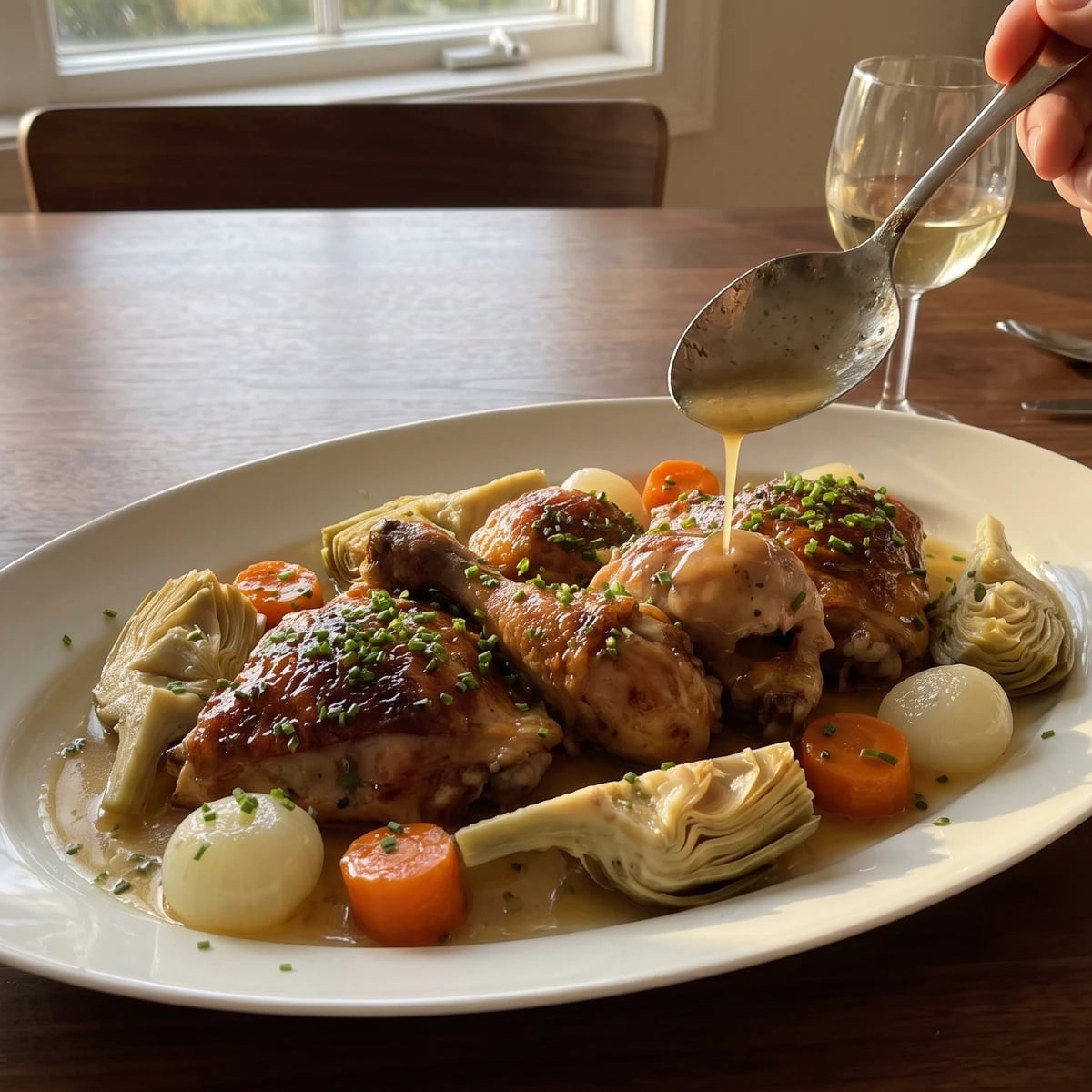
Bronzed chicken, Madeira, and a pale butter-mounted glaze meet artichoke bottoms, glazed carrot tournées, and pearl onions, each cooked separately so every element keeps its own character.

Main Dishes
French
Dinner Party
Special Occasion
35 min
Active Time
1 hr 5 min cook1 hr 40 min total
Yield4 servings

Poulet Sauté d’Artois (butter-sautéed chicken with Madeira, artichoke bottoms, glazed carrots, and small onions) teaches separation before union. The one true thing to know is that the garnish must not be tumbled into one pan from the beginning. Carrots, onions, and artichokes cook at different speeds; bring each to its proper tenderness, then let them meet only in the finished glaze. C’est la même grammaire: build each part cleanly, join it with purpose.

The original entry assumed a saucier on staff, a stockpot never off the fire, pale meat glaze already reduced, and several hands tending garnish pans at once. It calls for no salamander, so your home kitchen needs none. For four people, one whole chicken, one wide sauté pan, one small pan used in sequence, and gelatin-rich chicken stock reduced to ⅓ cup are the honest equivalents. The brigade’s simultaneous pans were scaffolding and can go; cooking the three garnishes apart, deglazing with exactly three tablespoons of Madeira, and finishing with 1½ ounces of cold butter are the dish and must stay. One cook, one stove, one evening.

When it is right, the chicken is deeply bronzed, the carrots shine, the artichokes remain distinct, and the pale amber sauce clings without heaviness. The step that decides it is the final monter au beurre (finishing by whisking in cold butter): reduce the sauce before the butter enters, then work off the heat. If it separates, don’t pour it out. Ça se rattrape, and the method catches it at the pan.

Poulet sauté d’Artois belongs to the codified grand-kitchen repertoire centered in Paris, though its name points to Artois, the region around Arras in northern France. In classical menu language, a geographical title often identified a fixed garnish more than a dish eaten daily in the named province; here artichoke bottoms, olive-shaped carrots, small onions, Madeira, and pale meat glaze define the formula. Its passage to the bourgeois table kept the separately cooked garnishes but exchanged the brigade’s many pans for careful sequencing by one cook.

The technique, the tradition, and the story behind every dish.

Discover Culinary Explorer

Ingredients

whole chicken

Quantity

1 chicken (3½ to 4 lb / 1.6 to 1.8 kg)

cut into 8 serving pieces

unsalted butter

Quantity

10 tablespoons (150 ml / 142 g)

divided, with 3 tablespoons (45 ml / 42 g) kept cold for finishing

fine sea salt

Quantity

2 teaspoons (10 g)

divided

freshly ground white or black pepper

Quantity

½ teaspoon (2.5 ml / 1 g)

light pale meat glaze

Quantity

⅓ cup (80 ml / about 85 g), made by reducing 1⅔ cups (400 ml / 400 g) unsalted gelatin-rich chicken stock

cooked artichoke bottoms

Quantity

4 small (about 1 cup / 220 g drained)

quartered

carrots

Quantity

2 medium (about 5½ oz / 150 g), yielding 10 pieces

peeled and shaped into olive-shaped tournées

chicken consommé

Quantity

⅔ cup (160 ml / 160 g)

small pearl onions

Quantity

8 onions (about 4 oz / 120 g)

peeled

dry or medium-dry Madeira

Quantity

3 tablespoons (45 ml / 45 g)

fresh chives

Quantity

1 teaspoon (5 ml / 1 g)

finely chopped

Equipment Needed

  • 12-inch (30 cm) heavy sauté pan with a lid
  • 8-inch (20 cm) saucepan or small sauté pan
  • Sharp paring knife for the carrot tournées
  • Instant-read thermometer
  • Heatproof measuring cup
  • Parchment paper for a cartouche

Instructions

  1. 1

    Concentrate the glaze

    Put the gelatin-rich chicken stock in the small pan and bring it to a lively simmer. Reduce it to ⅓ cup (80 ml), about 20 to 25 minutes, then pour it into a heatproof measure and reserve. This is the light pale meat glaze the original kitchen kept ready beside the stove. It should coat a spoon lightly while hot, not set into glue. If it goes too far, loosen it with water a tablespoon at a time. Keep it pale, with no roasting or dark browning.

    A dark beef demi-glace changes both the colour and the flavour. Use unsalted chicken stock with enough natural gelatin to become softly jellied when cold.
  2. 2

    Glaze the carrots

    Cut 10 carrot tournées, olive-shaped pieces about 1½ inches (4 cm) long. Put them in the cleaned small pan with the consommé, 1 tablespoon (15 ml / 14 g) butter, and a small pinch of salt. Cover with a parchment cartouche or a lid set slightly ajar, then simmer gently until a knife enters with little resistance, 8 to 12 minutes. Uncover and roll the carrots through the reducing liquid until they shine. If the liquid vanishes before they are tender, add consommé or water by the tablespoon. If they become tender while too much remains, lift them out, reduce the liquid, then return them for the final glaze. Set aside.

    The tournées need not resemble military drill. Their even size matters because all 10 pieces must become tender together; save the trimmings for soup or stock.
  3. 3

    Cook the garnishes

    Wipe out the small pan and melt 2 tablespoons (30 ml / 28 g) butter over low heat. Add the pearl onions with a pinch of salt, cover, and cook for 12 to 15 minutes, rolling them often, until tender and glossy but still pale. If the butter begins catching before the centers soften, add a tablespoon of water and cover again. Lift out the onions. Melt another 1 tablespoon (15 ml / 14 g) butter in the same pan, add the quartered artichoke bottoms, and toss gently for 3 to 4 minutes until heated through and butter-glossed. Keep the carrots, onions, and artichokes separate for now.

    Frozen artichoke bottoms are an honest choice when fresh ones are poor. Canned bottoms in plain brine also work if rinsed and dried well; marinated artichokes bring acid and herbs that do not belong here.
  4. 4

    Sauté the chicken

    Pat the chicken completely dry and season it with most of the remaining salt and all the pepper. Melt 3 tablespoons (45 ml / 42 g) butter in the wide sauté pan over medium heat. When the foam subsides, lay in the chicken skin-side down, working in two batches if the pieces cannot sit without touching. Sauté without shuffling until the skin is deep golden, 5 to 7 minutes, then turn and colour the second side for 2 to 3 minutes. Sauté means the chicken must make clean contact with the hot butter; wet skin or a crowded pan gives pallor instead of fond. If the butter flecks darken too quickly, pull the pan from the heat briefly and lower the flame before continuing.

    Begin with the legs and thighs, which tolerate more heat, then brown the breasts and wings. Dry chicken, patient browning, and real butter build the sauce’s foundation.
  5. 5

    Cook through gently

    Return all the chicken to the pan skin-side up. Lower the heat, cover with the lid slightly ajar, and cook gently for 12 to 18 minutes, rearranging the pieces once so they cook evenly. Remove each piece as it is ready: the breast and wings should reach 165°F (74°C), while the thighs and drumsticks are best near 175°F (79°C). If the pan dries before the chicken is done, add a tablespoon of water at the edge; it will protect the fond and cook away. Arrange the chicken on a warm platter, skin-side up, cover loosely, and pour off excess fat without disturbing the browned film in the pan.

  6. 6

    Swill with Madeira

    Set the chicken pan over medium heat and swill it with the Madeira, scraping every browned speck from the bottom with a wooden spoon. Boil until the Madeira becomes lightly syrupy, about 30 to 60 seconds. Add the light pale meat glaze and any juices collected beneath the chicken, then simmer for 2 to 4 minutes, until the sauce lightly naps the back of a spoon. Add the artichoke bottoms, glazed carrots, and butter-cooked onions, and warm them gently for 2 minutes. If the sauce remains thin, lift out the garnishes and reduce it further; if it is too tight, add stock or water by the teaspoon. Flour has no work here. Reduction is the foundation.

  7. 7

    Monter au beurre

    Take the pan completely off the heat. Add the reserved 3 tablespoons (45 ml / 42 g) cold butter one tablespoon at a time, swirling or whisking until each addition disappears before adding the next. Never let the sauce boil once the butter enters. If it turns oily around the edges, stop adding butter and whisk in 1 teaspoon cold water until it becomes smooth again. Ça se rattrape. Fold in the chives, taste for salt, arrange the three garnishes around the chicken, and pour the gleaming sauce over the pieces. À table!

Chef Tips

  • The pale meat glaze carries the sauce, so begin with unsalted, gelatin-rich chicken stock. A thin boxed broth reduced fivefold may become salty before it gains body; fortify it with plain powdered gelatin if necessary, using the package quantity for 2 cups of liquid.
  • Choose a dry or medium-dry Madeira, such as Sercial or Verdelho. Sweet Madeira makes the carrots and onions cloying, while cooking wine brings salt and little else.
  • Keep the 10 carrot tournées. Their olive shape comes directly from the entry and lets the garnish cook evenly, but imperfect curves are no tragedy. Cooking well is not cooking fancy.
  • Serve with a dry, full white wine such as white Burgundy or Chenin Blanc. The plate needs little beside it, perhaps buttered noodles or plain rice to receive the sauce.

Advance Preparation

  • Reduce the light pale meat glaze up to 3 days ahead, cool it promptly, and refrigerate it covered. It will set when cold and melt as soon as it returns to the pan.
  • The carrot tournées, pearl onions, and artichoke bottoms can be cooked up to 6 hours ahead and refrigerated in separate covered containers. Let them lose their chill before warming them in the finished sauce.
  • Cut and season the chicken earlier on the day of serving, then refrigerate it uncovered so the skin dries. Sauté the chicken and monter au beurre only near serving time; the final emulsion does not improve by waiting.

Frequently Asked Questions

Nutrition Information

1 serving (about 400g)

Calories
865 calories
Total Fat
60 g
Saturated Fat
27 g
Trans Fat
1 g
Unsaturated Fat
27 g
Cholesterol
270 mg
Sodium
1450 mg
Total Carbohydrates
15 g
Dietary Fiber
5 g
Sugars
5 g
Protein
66 g

Note: Chef personas and recipes are created with AI assistance. Cook with care: follow safe food-handling practices, check doneness with a thermometer when needed, and adapt for allergies and your kitchen.

Where cooking meets culture.

Culinary guides, cultural storytelling, and the editorial depth that makes cooking meaningful.

Discover Culinary Explorer

More from Poultry (Volaille) - Poulets Sautés

Browse the full collection