
Chef Juliette
Poulets Sautés
The master sauté for poultry: jointed chicken coloured hard in clarified butter, cooked piece by piece to tenderness, then reunited with a pan sauce made from every bronze trace of fond.
A cooking platform built around craft, culture, and the stories behind what we eat.
Created by Chef Juliette
Based on No. 1534, Poulet Sauté Arlésienne, from Le Guide Culinaire (1907) by Auguste Escoffier
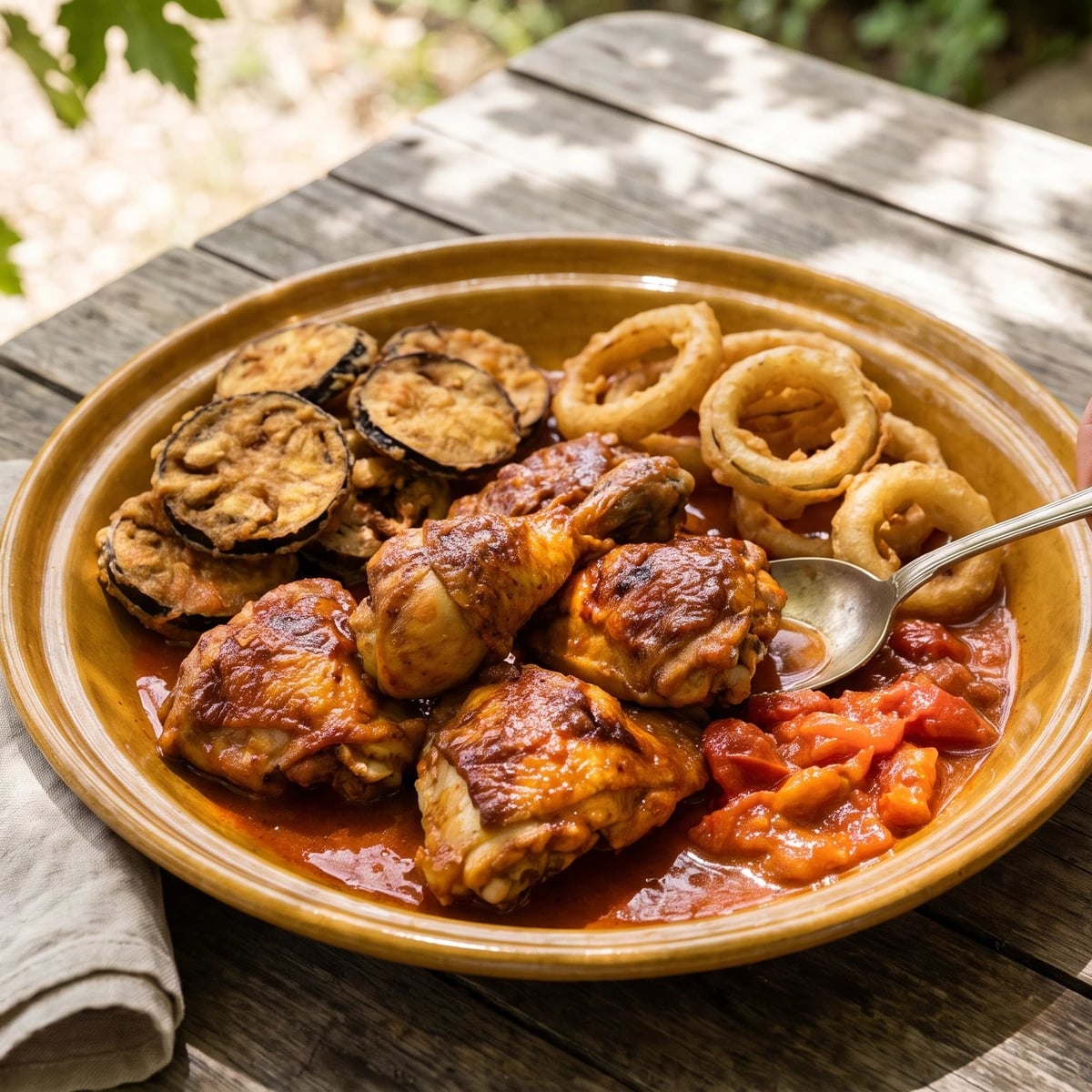
Golden chicken, a garlic-scented white-wine and tomatéd demi-glace sauce, and three Provençal garnishes kept distinct: Poulet Sauté Arlésienne teaches why aubergine and onion must fry separately to brown.
Poulet Sauté Arlésienne (Arles-style sautéed chicken) teaches a simple discipline: fry the garnish separately or lose it. Aubergine and onion crowded into one pan release water, steam each other, and turn soft. Kept apart, they bronze at the edges; the tomato concassée stays buttery and distinct; the chicken arrives beneath a glossy white-wine and tomatéd sauce.
The original entry assumed a saucier beside a stockpot never off the fire, plus enough hands to fry the garnish while the chicken sautéed. It asks for no salamander, so none is invented. At home, a small measure of good prepared demi-glace, made tomatéd with tomato paste, replaces the standing half-glaze; the vegetables fry in sequence and wait on a rack in a low oven. Concurrent pans are brigade scaffolding and can go. The wine deglaze, separate frying, butter-cooked tomato, and reduction by one-third are the dish and must stay.
One cook, one stove, one evening. Before the chicken touches the pan, finish the tomato and fry the onion and aubergine separately. That order is the one true thing to remember: brown garnish, not a covered muddle.
Poulet sauté Arlésienne belongs to Arles, at the head of the Camargue in Provence, where olive oil, tomato, garlic, aubergine, and onion form a recognizable local larder. Classical kitchens carried that market vocabulary into the national canon as a composed garnish around poultry, giving each vegetable its own treatment. The dish is sometimes mistaken for chicken with ratatouille, but its identity lies in separation: floured fried roundels, butter-cooked tomato concassée, and chicken joined only on the serving platter.
Quantity
1 whole (3½ lb / 1.6 kg)
cut into 8 pieces
Quantity
2 teaspoons (10 ml / 12 g)
divided
Quantity
1 teaspoon (5 ml / 2 g)
divided
Quantity
1¼ cups (300 ml / 275 g)
divided, for sautéing and shallow-frying
Quantity
6 medium (1½ lb / 680 g)
peeled, seeded, and roughly chopped
Quantity
2 tablespoons (30 ml / 28 g)
Quantity
1 medium (1 lb / 450 g)
cut crosswise into ⅓-inch (8 mm) roundels
Quantity
2 medium (12 oz / 340 g)
cut crosswise into ⅓-inch (8 mm) roundels
Quantity
¾ cup (180 ml / 90 g)
for dredging
Quantity
⅔ cup (150 ml / 150 g)
Quantity
1 pea-sized piece (about 1 g)
crushed
Quantity
Scant ½ cup (95 ml / 100 g)
mix ⅓ cup (80 ml / 85 g) prepared low-sodium veal demi-glace with 1 tablespoon (15 ml / 16 g) tomato paste
| Ingredient | Quantity |
|---|---|
| whole chickencut into 8 pieces | 1 whole (3½ lb / 1.6 kg) |
| fine sea saltdivided | 2 teaspoons (10 ml / 12 g) |
| freshly ground black pepperdivided | 1 teaspoon (5 ml / 2 g) |
| mild olive oildivided, for sautéing and shallow-frying | 1¼ cups (300 ml / 275 g) |
| plum tomatoespeeled, seeded, and roughly chopped | 6 medium (1½ lb / 680 g) |
| unsalted butter | 2 tablespoons (30 ml / 28 g) |
| aubergine or eggplantcut crosswise into ⅓-inch (8 mm) roundels | 1 medium (1 lb / 450 g) |
| yellow onionscut crosswise into ⅓-inch (8 mm) roundels | 2 medium (12 oz / 340 g) |
| all-purpose flourfor dredging | ¾ cup (180 ml / 90 g) |
| dry white wine | ⅔ cup (150 ml / 150 g) |
| garliccrushed | 1 pea-sized piece (about 1 g) |
| tomatéd half-glaze saucemix ⅓ cup (80 ml / 85 g) prepared low-sodium veal demi-glace with 1 tablespoon (15 ml / 16 g) tomato paste | Scant ½ cup (95 ml / 100 g) |
Heat the oven to 225°F (110°C) and set a wire rack over a rimmed sheet pan. To prepare the tomatoes, score their skins, lower them into boiling water for 20 to 30 seconds, then cool, peel, halve, seed, and chop them roughly. This is the book's concass: a rough chop, not a purée. Melt the butter in a skillet over medium heat, add the tomatoes with a pinch of the measured salt and pepper, and cook uncovered for 8 to 10 minutes. Stir gently until the loose water has evaporated and the tomato will sit in a soft heap while retaining visible pieces. If it still floods the pan when pushed aside, keep cooking; watery concassée will soak the fried garnish. Transfer it to a small covered pan or bowl.
Reserve 2 tablespoons (30 ml) of the olive oil for the chicken. Pour enough of the remaining oil into a 10-inch (25 cm) skillet to make a layer about ¼ inch (6 mm) deep, then heat it to 350°F (175°C). Put the flour in a shallow dish. Season the onion roundels, dredge them lightly, shake off every loose veil of flour, and fry them in a single layer until golden at the edges, about 2 minutes per side. Drain them on the rack in the low oven. Repeat with the aubergine, again seasoning and flouring only the pieces about to enter the oil; fry until bronzed and tender, about 2 to 3 minutes per side. Never crowd the vegetables or fry onion and aubergine together. This separation is the dish. If a batch turns pale and greasy because the oil cooled, lift it out, bring the oil back to temperature, and fry it again briefly before draining. Ça se rattrape.
Dry the chicken thoroughly and season it with the remaining salt and pepper. Heat the reserved 2 tablespoons (30 ml) olive oil in a heavy 12-inch (30 cm) sauté pan over medium-high heat. Brown the legs, thighs, and wings first, skin-side down, for 5 to 6 minutes; turn and cook for another 3 to 4 minutes, then withdraw them to a plate. Brown the breast pieces skin-side down for 4 to 5 minutes and on the second side for 2 minutes. Return the dark meat to the pan, lower the heat, cover, and cook for 6 minutes. Add the breasts, cover again, and continue for 5 to 8 minutes, until the breasts reach 165°F (74°C) and the thighs reach about 175°F (80°C). Withdraw every piece to a warm platter and cover loosely. Watch the pan floor as the chicken cooks: the fond should be deep brown, never black. If black specks appear, remove the chicken, wipe those specks away, add a little clean oil, and continue.
Pour the excess oil from the sauté pan without disturbing its brown fond. Add the white wine and swill the pan, scraping firmly with a wooden spoon until every browned deposit dissolves into the wine. Add the pea-sized piece of crushed garlic and the tomatéd half-glaze sauce. Bring the sauce to a lively simmer and reduce it by one-third, from about 1 cup (245 ml) to roughly ⅔ cup (160 ml), 5 to 8 minutes. It should be nappé (coating the back of a spoon), glossy but still fluid enough to run over the chicken. Taste only after reducing, because demi-glace concentrates its salt. If the sauce has gone syrupy, loosen it one tablespoon of hot water at a time; if it runs like wine, simmer it a little longer.
Rewarm the tomato concassée gently if needed. Arrange the chicken in the center of a warm serving platter and spoon the reduced sauce over it, leaving the fried vegetables mostly uncovered so their edges remain distinct. Surround the bird with alternating small heaps of fried onion roundels, fried aubergine roundels, and butter-cooked tomato concassée. Serve at once, while the sauce gleams and the garnish still carries its crust. À table!
1 serving (about 550g)
Culinary guides, cultural storytelling, and the editorial depth that makes cooking meaningful.
Discover Culinary Explorer
Chef Juliette
The master sauté for poultry: jointed chicken coloured hard in clarified butter, cooked piece by piece to tenderness, then reunited with a pan sauce made from every bronze trace of fond.

Chef Juliette
A lesson in restraint: chicken gently stiffened in butter without browning, then cloaked in an ivory onion, brandy, cream, and velouté sauce sharpened with lemon, Madeira, and black truffle.

Chef Juliette
Poulet Sauté Armagnac teaches the pale sauté: tender chicken kept blond, then truffle, brandy, cream, and crayfish butter joined into a coral-gold sauce whose final rule is absolute, never boil it.

Chef Juliette
Bronzed chicken, Madeira, and a pale butter-mounted glaze meet artichoke bottoms, glazed carrot tournées, and pearl onions, each cooked separately so every element keeps its own character.